Talk:Johnson solid
I have been modifying user:Cyp's image:Poly.pov povray macros to generate images of as many of the Johnson solids as I can. See User:AndrewKepert/poly.pov for …

 | This article is rated C-class on Wikipedia's content assessment scale. It is of interest to the following WikiProjects: | ||||||||||||||||||||
| |||||||||||||||||||||


Images
I have been modifying user:Cyp's image:Poly.pov povray macros to generate images of as many of the Johnson solids as I can. See User:AndrewKepert/poly.pov for what may be the latest version. Here is where I am tracking progress. Bold numbers have images.
Relocated to User:AndrewKepert/polyhedra
Images of the flat kind
Doesn't do 3d, and only knows 2 Johnson solids (so far), but here's makepolys.c.


Κσυπ Cyp 00:27, 5 Nov 2004 (UTC)
I'm making some "home-made" nets:


And the rest with Inkscape, now that I found out about it:

Now that there's enough nets for a whole section, anyone think we should incorporate them into the table?
Complete set of nets
I have Stella (software) which generates all the Johnson solids. Previously I didn't have the patience to try uploading all 92 nets, but figured easier for me than generating all from scratch. By default Stella colors faces by symmetry positions. I only had patience to upload them by indexed names. Here they all are! Feel free to "trace" or change arrangements in a complete set of SVG versions as your patience allows! I do think the symmetry coloring is worthy to use. Tom Ruen (talk) 23:46, 28 June 2008 (UTC)
- I added the nets to stub articles J47-92. Patience exhausted for now. Tom Ruen (talk) 18:11, 29 June 2008 (UTC)
Elongated square gyrobicupola
The picture is wrong - that's obviously a rhombicuboctahedron. Compare: [1]
- No it is right. Look again. Andrew Kepert 03:47, 9 Nov 2004 (UTC)
- It's definitely an image of the right polyhedron, but it's taken from an unflattering angle. Could someone POVRay up an image that is at first glance obviously not a rhombicuboctahedron? —ajo, 21 April 2005
- I'm not sure that's possible. They don't call that the "pseudorhombicuboctahedron" for nothing. RobertAustin 01:18, 8 November 2006 (UTC)
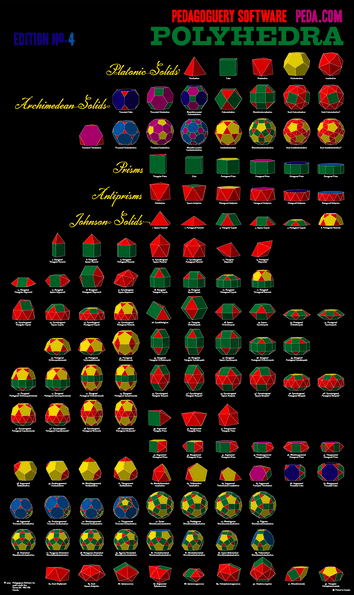
- When you look at http://peda.com/posters/img/poly4.gif 10th row sixth picture from the left you can see a view of elongated square gyrobicupola which is very distinct of rhombicuboctahedron. 19:45, 17 April 2010 —Preceding unsigned comment added by 74.125.121.33 (talk)
The list
Usually it would be called good practice to make a list such as that in this article stand-alone. Not something to insist on, perhaps, in this case; but it is something to think about, in the way of writing the article so that it doesn't 'wrap' round having the list there in the current way. Charles Matthews 09:13, 17 Nov 2004 (UTC)
Johnson numbers
Is the numbering of the Johnson solids arbitrary? If not, how are the Johnson numbers determined? I think this should be mentioned in the article. Factitious 19:25, Nov 21, 2004 (UTC)
- Good point - the numbering was in Johnson's original paper. I have amended the article. Andrew Kepert 00:29, 22 Nov 2004 (UTC)
"simple" Johnson solids?
28 of the Johnson solids are "simple". Non-simple means you can cut the solid with a plane into two other regular-faced solids. But it isn't clear which ones. Anyone? dbenbenn | talk 05:52, 26 Jan 2005 (UTC)
- Off the top of my head:
- 1-6 (pyramids, cupolae & rotunda)
- 63 (tridiminished icosahedron - can't chop any further)
- 80 and 83 (parabidiminished & tridiminished rhombicosidodecahedra - ditto)
- the "sporadics" 84-86 & 88-92, (87 is an augmented sporadic) They have no relation to platonics or archimedeans.
- which makes 6+1+2+8 = 17. There are other components from the platonic, archimedean, prisms and antiprisms that could arguably considered as needed for a building any of the J solids, but these are not "of the J solids". I think I have all or most of the list here, given your defn - well short of 28.
- Where did you get 28? ... ah I see it in the mathworld article. Google throws up no other ref to "simple johnson solid". I suspect Mathworld is wrong, probably in the defn of "simple" --Andrew Kepert 07:58, 27 Jan 2005 (UTC)
- Incidentally, the Wikipedia articles are using the term "elementary" instead of "simple," and upon incautious consideration I agree with Wikipedia's choice of terminology. —ajo, Apr 2005
- I added a table of images at the end. Very useful.
- Probably the list should be moved to "List of Johnson solids", and then this article can be shorter.
- I'd like more statistics on these solids - Vertex, Edge, Face counts (and types of faces), Symmetry group. (I don't have this information) When this is available, making a data table would be more useful.
- Tom Ruen 19:48, 15 October 2005 (UTC)
- Actually, the Mathworld article was discussing all the simple convex regular-faced solids, including the simple Archimedean solids. There are 11 of these:
- tetrahedron
- dodecahedron
- truncated tetrahedron
- truncated cube
- truncated octahedron
- truncated cuboctahedron
- truncated dodecahedron
- truncated icosahedron
- truncated icosidodecahedron
- snub cube
- snub dodecahedron
- which when added to the 17 simple Johnson solids, make 28.
- Mongo62aa (talk) 03:07, 15 August 2010 (UTC)
- The cube is excluded because ...? —Tamfang (talk) 16:50, 16 August 2010 (UTC)
- Because the prisms and antiprisms are excluded, otherwise the list would be infinite in length. Mongo62aa (talk) 14:14, 17 August 2010 (UTC)
NEW TABLE
I added a new table with columns: Name, image, Type, Vertices, Edges, Faces, (Face counts by type 3,4,5,6,8,10), and Symmetry.
I computed the VEF counts by the table from: http://mathworld.wolfram.com/JohnsonSolid.html
- Total faces by: F=F3+F4+F5+F6+F8+F10
- Computed total internal angle_sum=180*(F3+2*F4+3*F5+4*F6+6*F8+8*F10)
- Used angle defect sum to compute vertices: V=chi+angle_sum/360 (chi=2 for topological spheres)
- Computed edges by Euler: E=V+F-2
The results should be correct, but may not be correctly matched by names if the indices were inconsistent!
A Name for the #84 - #92 group? [Sporadics proposed 2009-02-21]
The series #84 - #92 are not derived from cut-and-paste of Platonics, Archimedians, and prisms. I put forth a trial name in the table: Johnson Special solids, after fiddling with a thesaurus for a while, thinking that they deserved better than "Miscellaneous". (One of them is actually an augmented Johnson special.) Other possibilities are Johnson Unique, Johnson Peculiar, Johnson Disctinctive, Johnson Elemental, etc.
- Steven Dutch calls them "Complex Elementary Forms". —Tamfang 23:42, 8 July 2006 (UTC)
- They're not really a set though, are they? As far as I can see, only the sphenocoronas form a set, and all the others are one-of-a-kind shapes. I think some sort of generic name like "Miscellaneous" or "Other" is the best way to describe them. "Special" indicates some sort of status they don't really have. Did Johnson himself give the group a name? In fact, did he group them at all? — sjorford++ 09:04, 10 July 2006 (UTC)
Very well, I will revert it back to Miscellaneous as I found it.
Any views on the name "Sporadics" for this part of the series? User:AndrewKepert used the term in passing, and I believe it fits the bill of not asserting commonality, whilst being less dismissive than "Miscellaneous". This collection is the most interesting to me because the faces generate new angles, and as I was modeling with Geomag, this gave new model possibilities.
Karl Horton (talk) 14:56, 22 February 2009 (UTC)
- I like it well enough, but making up our own words is against the rules; we need to find a term already in use in the field. For whatever it's worth, this page calls them "Complex Elementary Forms". —Tamfang (talk) 09:33, 23 February 2009 (UTC)
Table changes ongoing...
I removed the "type" column from the tables in favor of a list of types at the beginning of each section. It took too much screen width and redundant with polyhedron names.
I'd like to expand the table with a vertex configuration column, listing the counts and types of vertices for each form. I made an automated tally once somewhere and I'll see if I can merge it in sometime - NOW that there's some screen width to play with.
I have an old different tally on a test page - lists all reg/semireg/Johnson solids by vertex figure: User:Tomruen/Polyhedra_by_vertex_figures
Tom Ruen 07:56, 7 January 2007 (UTC)
Suspicious edits
All (it seems) of the individual Johnston solids pages were edited by 140.112.54.155 so that the table on each page listing the number of faces for the solid has entries like "3.5 triangles". They haven't responded for explanation that I've seen. Before I go fixing up 92 pages, is there any reason to believe this isn't vandalism? Thanks, Fractalchez (talk) 00:45, 6 December 2007 (UTC)
- They look like honest edits, although notation could be confusing, 3.5 meaning 3×5=15 triangles, while could look like 3+1/2. It looks like an attempt to group the types of triangles - there's 3 sets of 5 triangles in equivalent positions of symmetry. I don't keep a watch on all the individual pages. Tom Ruen (talk) 01:06, 6 December 2007 (UTC)
Tetraeder
Why isn't the tetraeder 4 F3 on the list? Did I not understand the definitions enough? --Saippuakauppias ⇄ 11:14, 3 July 2008 (UTC)
It is on the list, under the name Gyrobifastigium. It's in the section of modified cupolas and rotundas, in that it can be viewed as a bicupola, but instead of the top being a polygon, it's a single edge, and the bottom is a square. You don't find a single one of these in normal cupolas/rotundas/pyramids though, because that would be simply a triangular prism. —Preceding unsigned comment added by Timeroot (talk • contribs) 19:15, 3 July 2008 (UTC)
Urgent!
I need to know the name of the Johnson solid with 42 faces, 80 edges and 40 vertices. Professor M. Fiendish, Esq. 11:10, 29 August 2009 (UTC)
- You can search that for yourself - looks like at least two! Tom Ruen (talk) 22:48, 29 August 2009 (UTC)
- In case the tables aren't clear enough for you: they are the elongated pentagonal birotundae. —Tamfang (talk) 23:16, 29 August 2009 (UTC)
Impossible Johnson solids
Proving the hexagonal pyramid with equilateral triangles is impossible uses the fact that 6 triangles add up to 360 degrees. But, here's a hard problem: prove the augmented heptagonal prism is not a valid Johnson solid. Georgia guy (talk) 22:06, 15 October 2010 (UTC)
- hm, I guess I need to prove that α=atan(√2) > 2π/7.
- cos(α) = 1/√3, sin(α) = √(2/3)
- exp(i α) = (1+i√2) / √3
- exp(7 i α) = (43+13i√2) / 27√3, which is in the first quadrant, implying that either 2π/7<α<5π/28 or 0<α<π/14; the latter is ruled out because tan(α) > tan(π/4).
- What do I win? —Tamfang (talk) 04:07, 19 October 2010 (UTC)
I DISCOVERED A NEW JOHNSON SOLID
Really! here are pictures!


faces: 16 triangles, 3 squares, total 19
vertex figure: 1 (4,4,4), 3 (3,3,4,4), 3 (3,3,3,3,4), 5+5 (3,3,3,3,3)
symmetry:C3v
Discovered by me, David Park Jr.--David P.Jr. (talk) 09:44, 15 March 2011 (UTC)
- Have you proven that the faces are flat and regular? Models can flex. —Tamfang (talk) 07:24, 16 March 2011 (UTC)
another near miss?
five squares eight triangles (eleven vertices) looks valid to me url= http://cs.sru.edu/~ddailey/tiling/hedra.html David.daileyatsrudotedu (talk) 02:30, 11 October 2018 (UTC) Jim McNeill [3] has demonstrated to my satisfaction that the referenced shape is indeed a near miss, having distortion mainly confined to the two isolated square faces. David.daileyatsrudotedu (talk) 12:02, 12 October 2018 (UTC)
failed
I installed Great Stella software and test it but some triangles are not quite regular.
It has 3 squares, 6+9 isosceles triangles, and 1 regular triangle. T.T OTL
How can prove or disprove no more Johnson solid? --David P.Jr. (talk) 12:48, 16 March 2011 (UTC)
- A good attempt. I've never tried, but the proof was the intention of Johnson's paper! There's another open-ended category called near-miss Johnson solids, and some are listed here: [2]. Tom Ruen (talk) 17:31, 16 March 2011 (UTC)
Previously discovered
This model is readily buildable with Polydrons. Jim McNeill [3] keeps a catalog of near misses and lists this one.
This trisquare hexadecatrihedron has 16 triangular and 3 square faces, and looks somewhat like a cube embedded in an icosahedron (hence my informal name of 'cubicos'), . The squares are regular and the aggregate distortion in the lengths of the triangular edges is only about 0.1 in total (stress map). Distortion (E=0.10, P=0 , A=18.3°). [4]
Karl Horton (talk) 11:32, 10 July 2013 (UTC)
duals of the Johnson solids
Is there a name for the set of 92 polyhedra that are duals of the Johnson solids? Other than "duals of the Johnson solids"? (By analogy with the way Catalan solids are duals of the Archimedean solids). --DavidCary (talk) 04:10, 6 April 2013 (UTC)
- Not to my knowledge. I don't think they have even been enumerated in any reliable source. I'd probably call them "Johnson duals" for short. — Cheers, Steelpillow (Talk) 13:12, 6 April 2013 (UTC)
- One problem is that for a geometric dual – rather than a mere topological dual – you need a center. How do you choose centers for the 56 that lack D symmetry? (Ch or Ci or S symmetry would also do, but there aren't any.) —Tamfang (talk) 07:09, 27 February 2014 (UTC)
- To define the centre usefully, it would need to remain static under duality - that is, the centre of the dual must be the same point as the centre of the original. This ensures that when you dualise the dual, you get back to the original form. It turns out that for some figures this is really hard, I seem to recall that even the "Stella" software author gave up on it and used a simpler algorithm. I think it would be fair to ignore centres and polar reciprocity but instead to require the dual condition, that all vertices be regular, i.e. having the same polygonal angle between adjacent edges. Not sure if that set of polyhedra would match the Johnson solids one-to-one, though: an interesting problem. — Cheers, Steelpillow (Talk) 10:37, 27 February 2014 (UTC)
- How about the Norman Solids, after Norman Johnsons first name? Because we already used the last name. We can even add Victor Zalgaller's first name! imagine saying "The duals of the Johnson-Zalgaller Solids are the Norman-Victor Solids"! GaussianError1 (lets chat) 4:08, 17 April 2026 (UTC)
- Wikipedia isn't the place for making up neologisms. See WP:NEO. (Aside: please don't put your timestamped signature in parens – it confuses the conversation threading software – and please use some version of your username as your signature; no one knows who "My profile thingy" belongs to without clicking it.) –jacobolus (t) 21:46, 17 April 2026 (UTC)
Organizing the table
Can anyone edit this article so that there's one large table of all 92 figures rather than several small tables?? This way, the table can be re-sorted by the number of faces each polyhedron has or any other appropriate way. Georgia guy (talk) 21:38, 13 October 2010 (UTC)
- I think the value of multiple tables is that it easier to edit, and there were distinct groupings by named categories from Johnson's numbering, but it looks easy to delete the sections and table headers to remerge into a single table if you want to try. Tom Ruen (talk) 21:48, 13 October 2010 (UTC)
- Adding a "|-" before the headers seemed to do the trick! Tom Ruen (talk) 22:19, 13 October 2010 (UTC)
- This was not a good change. The classes made it easier to figure out how the solids were made and where the regular variations started and stopped, so that if you needed to do something for a set of the solids you could work out your process from choices in each class and extend it to the rest regularly. So there's a Pareto principle in the information one needs to study these solids and learn their types. One can easily merge all the tables in a sandbox if one needs them ordered by a column of the table. ᛭ LokiClock (talk) 23:22, 31 July 2013 (UTC)
- Perhaps both are useful, grouped solids here, and List of Johnson solids as a single sortable table? (I definitely use the sort feature, by face counts, edge counts, or symmetry) Perhaps the list here should be simpler, without element counts, symmetry, etc? Tom Ruen (talk) 00:08, 1 August 2013 (UTC)
- I added List of Johnson solids as an experiment, copied from here, so this article could have a more compact summary by groupings? Tom Ruen (talk) 00:15, 1 August 2013 (UTC)
- I started reworking the first ones into topological groups. I'm not sure if this helps LokiClock's purpose. Tom Ruen (talk) 02:40, 1 August 2013 (UTC)
- Yes, that serves the original purposes I had used this article's classification for. If the solids are given in order in this table, then we don't need to group the solids in order here. Is there a reason for having the augmentation and diminishing subclasses as separate sections? Also, I found that if you use <abbr title="heynow">2</abbr>, 2, the tables will still sort the numbers inside the tag properly, so perhaps the beginnings of the sections in the original numeration can be labelled inside the table. ᛭ LokiClock (talk) 06:06, 1 August 2013 (UTC)
- I'm not sure I follow. I hope the groupings here are helpful. Myself, I'm interested in showing similar non-Johnson solids as well, whether regular, semiregular, or having coplanar faces, so I started adding some of these. I added the bottom rows of the table on "augmented from polyhedra" to help show their construction, since some of the views, even transparent, are confusing to see easily. Anyway, I'd do more when I have some time. Tom Ruen (talk) 06:12, 1 August 2013 (UTC)
- p.s. I'm unsure if the nets are helpful here, so those rows might be removed. Tom Ruen (talk) 06:14, 1 August 2013 (UTC)
- They are helpful. Looking again, they have different themes of construction, even if they're all the same type of modification, and some solids have more than one construction. I think the nets are helpful because they can give clues as to how the solids are similar to others and how to dissect them and put them together. It can be hard to figure out what the "others" and the rotunda are all-around using just the picture. Just now I used them to make sure the triangular hebesphenorotunda's squares all had 3 triangles attached, which suggested it had triangular symmetry (the triplet of pentagons and their center triangle has the same plane of rotation as the hexagon), which I then confirmed at its article. The information you just added it reinforced by the nets. Some time ago, when I was generalizing these solids to 4D I mainly interpreted the nets, and didn't have this information about how the icosidodecahedron was related to the rotunda and so forth. Around this same time I also noticed the wedging theme in constructing the "others" by looking at their nets, because when I saw the pictures of the solids my eye didn't group the faces by those wedges, but in the Bilunabirotunda (File:Bilunabirotunda.png) for example first separating it along one of the hexagons crossing the midpoint, then grouping the faces of each piece into the front faces and back faces. ᛭ LokiClock (talk) 07:43, 1 August 2013 (UTC)
- p.s. on nets, the faces are colored by the symmetry, autogenerated by Stella (software), although manually made nets might pick different arrangements for seeing the figures better. Tom Ruen (talk) 02:13, 3 August 2013 (UTC)
- They are helpful. Looking again, they have different themes of construction, even if they're all the same type of modification, and some solids have more than one construction. I think the nets are helpful because they can give clues as to how the solids are similar to others and how to dissect them and put them together. It can be hard to figure out what the "others" and the rotunda are all-around using just the picture. Just now I used them to make sure the triangular hebesphenorotunda's squares all had 3 triangles attached, which suggested it had triangular symmetry (the triplet of pentagons and their center triangle has the same plane of rotation as the hexagon), which I then confirmed at its article. The information you just added it reinforced by the nets. Some time ago, when I was generalizing these solids to 4D I mainly interpreted the nets, and didn't have this information about how the icosidodecahedron was related to the rotunda and so forth. Around this same time I also noticed the wedging theme in constructing the "others" by looking at their nets, because when I saw the pictures of the solids my eye didn't group the faces by those wedges, but in the Bilunabirotunda (File:Bilunabirotunda.png) for example first separating it along one of the hexagons crossing the midpoint, then grouping the faces of each piece into the front faces and back faces. ᛭ LokiClock (talk) 07:43, 1 August 2013 (UTC)
- Thanks, that's incredibly helpful to know about them! ᛭ LokiClock (talk) 10:23, 17 August 2013 (UTC)
Isomorphs
A new section on non-convex isomoprps has been added. I would suggest that these are not notable. Other classes of isomorph exist - convex and non-convex - but nobody has bothered to describe them, there is nothing notable about these ones either. A single fanboi web page does not constitute a reliable source. — Cheers, Steelpillow (Talk) 08:21, 19 April 2014 (UTC)
- The crossed cupolae have probably been described more widely: Johnson has terminology for them, so he might mention them somewhere. But yeah, most of these are just trivial and don't really need to be here, and after all they are just cut-and-paste operations. So I removed it again. Double sharp (talk) 14:09, 22 April 2014 (UTC)
- How can we know that "Johnson has terminology for them" unless we know whether or not he mentioned them somewhere?
 (Just teasing, thanks for the revert). — Cheers, Steelpillow (Talk) 17:04, 22 April 2014 (UTC).
- The terms "semicupola" (cuploids) and "sesquicupola" (cupolaic blend?) have been attributed to Johnson on some websites, so it's quite possible that he mentions them in his (still) forthcoming book, or somewhere else. Double sharp (talk) 12:38, 24 April 2014 (UTC)
- How can we know that "Johnson has terminology for them" unless we know whether or not he mentioned them somewhere?

Convex regular-faced polyhedra with conditional edges
I found this interesting list Convex regular-faced polyhedra with conditional edges, Johnson solid failures due to adjacent coplanar edges, 78 forms, by Robert R Tupelo-Schneck. It says the listing was independently produced and proven complete in 2010 by A. V. Timofeenko. Tom Ruen (talk) 03:26, 14 April 2017 (UTC)
Strictly convex
The article says: A Johnson solid is a strictly convex polyhedron. As far as I know, a strictly convex polyhedron is a strictly convex set, and hence the edges can't contain straight lines. Madyno (talk) 17:22, 30 July 2017 (UTC)
- How would you define it? The excluded cases have dihedral angles of zero, or having two faces in the same plane. Tom Ruen (talk) 15:12, 31 July 2017 (UTC)
Dual of Johnson solids
The dual of Archimedean solids are Catalan solids, and the dual of Platonic solids are also Platonic solids, but what are the dual of Johnson solids? 2402:7500:586:91EF:6911:7EBA:959B:3B90 (talk) 03:53, 7 September 2020 (UTC)
- Less well defined, as discussed in the section duals of the Johnson solids above. —Tamfang (talk) 06:17, 30 October 2020 (UTC)
What is the set of the polyhedrons whose faces are all regular polygons? (not need to be convex or uniform, and there is no requirement that each face must be the same polygon)
Regular polyhedron does not need to be convex, the convex regular polyhedrons are the 5 Platonic solids, and there are 9 non-convex regular polyhedrons, including the 4 Kepler–Poinsot polyhedrons and the 5 regular compounds, and for the semiregular polyhedrons, there are 13 convex ones other than the convex prisms and the convex antiprisms, but what are the non-convex ones? And for the polyhedrons with each face regular polygons or regular star polygons, there are 92 convex ones other than the regular polyhedrons and the semiregular polyhedrons, but what are the non-convex ones? (These would include the 4 Kepler–Poinsot polyhedrons, the 5 regular compounds, the stellated octahedron, the 53 nonconvex uniform polyhedras, the uniform star prisms, the uniform star antiprisms, the augmented heptagonal prism, the pentagrammic prism, the deltahedras, the toroidal prisms, etc.)
| Convex? | Uniform? (i.e. Identical vertices?) | Each face are the same polygon? (i.e. Identical faces?) | Class |
| True | True | True | 5 Platonic solids |
| True | True | False | infinite convex uniform prisms, infinite convex uniform antiprisms, 13 Archimedean solids |
| True | False | True | 8 convex deltahedras |
| True | False | False | 92 Johnson solids |
| False | True | True | 4 Kepler–Poinsot polyhedrons, 5 regular compounds |
| False | True | False | infinite uniform star prisms and uniform antiprisms, 53 nonconvex uniform polyhedras |
| False | False | True | infinite non-convex deltahedras |
| False | False | False | ? (this is my question in this talk, what is the set of such polyhedrons, I know that this set include the augmented heptagonal prism) |
(Polyhedrons whose faces are not all regular polygons, such as the Catalan solids, the hexagonal pyramid, the near-miss Johnson solids, the parallelepiped, the rhombic icosahedron, the Szilassi polyhedron, the Császár polyhedron; and the polyhedrons with 180° dihedral angles, such as this one; and the non-connected polyhedrons, such as the crossed prisms; and the degenerate polyhedras, such as dihedron and hosohedron; and the infinity forms, such as triangular tiling, square tiling, hexagonal tiling, trihexagonal tiling, snub trihexagonal tiling, truncated trihexagonal tiling, apeirogonal prism, apeirogonal antiprism; are not in this set)
Reference: [5]——36.234.85.41 (talk) 10:03, 29 August 2021 (UTC)
- The last row includes, for a start, a stack of n p-antiprisms joined at p-faces. (–hedra is plural, darn it.) —Tamfang (talk) 13:00, 5 August 2023 (UTC)
- If I'm understanding the question correctly, keeping all faces regular or regular star polygons while allowing different types of vertex, self-intersection, dihedral angles >=180 degrees, I suspect there might be an uncountably infinite collection of such, or at least extremely hard to enumerate...
- Among other things, you have:
- ANy polyform with a platonic, archimedean, keplar-poinsot, uniform star polyhedral, or Johnson solid monoform. This includes the aformentioned antiprism stacks, polycubes, polytetrahedra, polytruncated octahedra, polyiamond prisms, polyhex prisms... and those are just the poly forms already mention or which have a tiling of the plane or pace as a limiting case.
- Non-convex augmentations, including more than one type of face or augmenting adjacent faces that result in the biaugmented edges being non-convex. Just with cubes augment and para biaugmented are already coveredby the elongated square pyramid and elongated square bipyramid, but there's the meta biaugmented cube, two formas of triaugmented cube, two tetraagumented cubes, and the pentaaugmented and hexaaugmented cube. With 92 faces to pick from, the snub dodecahedron could potentially have hundreds or thousands of non-convex augmentations.
- mix stacks of prismatic forms. For every regular n-gon, there's a prismatic stack for every bit sequence where 0 and 1 represent prisms and anti-prisms... and then there's cupolae and pyramids to add to the mix... for example, you could take an elongated pentagonal copula and put a elongated pentagonal pyramid on its pentagonal face.
- Augmenting with prismatic stacks.
- Any connected subset of a honeycomb where all faces are regular.
- Biform star polyhedra with all regular faces. E.g. the cousins of the uniform star polyhedra with exactly two types of vertex. Then the triform, tetraform, etc. At least, my intuition is that you need to group these by number of unique vertex types to have any chance of listing them since I don't think the term convex is well defined for self-intersecting forms... though I could be wrong and there's a finite set of regular faced, self-interesecting forms with all convex dihedral angles.
- And I'm sure there are forms that are regular faced but don't fit any of the above categories.
- Regular faced forms beyond the Johnson Solids and the Uniform star polyhedra strike me as being pretty deep waters that are far from well explored, or if they have, than much of the information is locked up in obscure places... and keep in mind, it took over two thousand years to go from the Archimedean solids to the Johnson Solids, the Archimedean solids where lost for much of that time, Johnson had to invent terminology to describe most of the Johnson Solids, and it's been less than 60 years since Johnson enumerated the Johnson Solids. 2603:6080:7001:8205:0:0:0:115C (talk) 20:08, 1 June 2024 (UTC)
Completely irrelevant and distracting
The definition of a Johnson solid absolutely should not confuse readers with all the things that it is not. Or any things that it is not. Like the sentence in the introduction:
"There is no requirement that each face must be the same polygon, or that the same polygons join around each vertex."
This just confuses people. The stated definition prior to this ridiculous sentence is crystal clear, and we should leave it at that.
I hope someone knowledgeable about this subject will remove this idiotic sentence. 2601:200:C082:2EA0:2494:C097:5957:E04C (talk) 02:32, 8 July 2023 (UTC)
- I disagree. A reader reading this meant become confused by the list of Johnson Solids when they don't see shapes like the Cuboctahedron. Specifying how uniform polyhedra are excluded from the definition is necessary. Also often times we made unconsciously assume things about a definition. So clarifying what isn't required is useful. BringUpYourPost (talk) 17:40, 23 April 2025 (UTC)
Improve the description under the image with the 3 examples
Referring to this text:
- "The following are three examples of solids. The first solid, elongated square gyrobicupola, is Johnson solid because it has the convexity property. The second solid, stella octangula is not Johnson solid because it is not convex, meaning whenever two points are interior, the connecting line may not. The last solid is not a Johnson solid because it is not convex, meaning every face is planar or the dihedral angles of two adjacent faces have 180°."
it inconsistently uses "Johnson solid" as an adjective and then and a noun, i.e. sometimes prefixed with an article, sometimes not. It also omits articles for the named polyhedra. Overall it reads a little verbose and clunky. here's my proposed alternative:
- Among these three polyhedra, only the first, the elongated square gyrobicupola, is a Johnson solid. The second, the stella octangula, is not convex, as some of its diagonals lie outside the shape. The third presents coplanar faces.
Introscopia (talk) 15:29, 16 July 2024 (UTC)
- I like the brevity. We have an enthusiastic new editor who makes occasional lapses in English, likely including these missing articles; let's be patient and correct them as needed. —Tamfang (talk) 23:06, 16 July 2024 (UTC)
Can we like, go back to the old format with the tables?
The new format is just bad, I'm not even gonna lie. The old format made it so much more clear how they were all constructed, and also how they were related to each other. The new format just throws all of that out the window, and on top of it all, it removed the pictures too :( I don't understand why it was even changed? like what's better abut this list? We already have a page that just lists them all out (AND HAS PICTURES ON TOP OF THAT!!!!!) Digital542 (talk) 10:30, 31 July 2024 (UTC)
- I understand many readers or users would like to add the images for construction illustration purposes, but we do have guidelines about avoiding excessive exhibition images, discussed in WT:WPM. We have an article List of Johnson solids, containing a list of Johnson solids, and it is sufficient to give a table alongside the symmetry group and their metric properties. Dedhert.Jr (talk) 11:14, 31 July 2024 (UTC)
- I also think taking the images out is a disimprovement here, and special:permalink/1214091470 seems on balance like a more useful article than the current version for most readers. The images are essential for explanation because the names are opaque and inaccessible to non-experts. If a reader who isn't already an expert sees a name like "Elongated pentagonal orthobirotunda" they really have little idea what shape is being indicated, but if they see the pictures
- that gives a much clearer idea. One possibility would be to just merge List of Johnson solids into the bottom of this article, under a title like "Appendix: List of Johnson Solids". –jacobolus (t) 16:11, 5 February 2025 (UTC)
- @Jacobolus You can ask for WT:WPM, but the article is already in TFL on 14th March. So that would be a loss golden star and further discussion in WT:FL. Dedhert.Jr (talk) 00:55, 20 February 2025 (UTC)
- The list doesn't really seem that independently useful, and the main page gets about 3x more audience (most of whom would presumably be interested in the content at the list page, but don't know it exists / don't bother clicking through). The criteria for featured lists are pretty weak and I don't think reducing the gold-star count of lists is worth worrying much about. –jacobolus (t) 02:00, 20 February 2025 (UTC)
- @Jacobolus You can ask for WT:WPM, but the article is already in TFL on 14th March. So that would be a loss golden star and further discussion in WT:FL. Dedhert.Jr (talk) 00:55, 20 February 2025 (UTC)
- I also think taking the images out is a disimprovement here, and special:permalink/1214091470 seems on balance like a more useful article than the current version for most readers. The images are essential for explanation because the names are opaque and inaccessible to non-experts. If a reader who isn't already an expert sees a name like "Elongated pentagonal orthobirotunda" they really have little idea what shape is being indicated, but if they see the pictures
- You can still look at the old format in the page history. Double sharp (talk) 12:28, 12 October 2024 (UTC)
- I second this proposal. I somewhat understand the desire to include fewer images but I think it makes sense in this article in particular because there are 92 solids, so logically you would need a lot of images to illustrate each one. Yellowmarkers (talk) 16:04, 5 February 2025 (UTC)
- I completely agree with undoing this change. Not only are the pictures gone (which are central to a visual subject like this), the new article is just missing some of the curcial information that the old one contained. I just came back to look something up, and it was gone. I am speaking of
- the enumeration by construction
- the nets of the Johnson solids
- the classification by types of faces
- the list of circumscribable Johnson solids
- None of which can be found in the List of Johnson solids. MWinter4 (talk) 16:41, 17 February 2026 (UTC)


My proposal for structured tables to replace the list.
I see that this page used to have much more extensive tables, and that those have been removed in favor of a very plain numbered list. This is my proposal for a middle-of-the-road scheme of tables grouping the polyhedra into logical families, without bloating the page too much:
| Odd Ones Out | |||
|---|---|---|---|
| 26 Gyrobifastigium |
84 Snub disphenoid |
85 Snub square antiprism |
90 Disphenocingulum |
| Corona family | |||
|---|---|---|---|
| 86 Sphenocorona |
87 Augmented sphenocorona |
88 Sphenomegacorona |
89 Hebesphenomegacorona |
| Rotundoid | |
|---|---|
| 91 Bilunabirotunda |
92 Triangular hebesphenorotunda |
Introscopia (talk) 04:11, 8 March 2026 (UTC)
- This is going to invite people to augment the table cells with images and nets and Dynkin diagrams and who knows what else and we'll soon be back to the old crufty pre-trimmed state [6]. —David Eppstein (talk) 08:16, 8 March 2026 (UTC)
- The tables were bad, but the inclusion of images and nets was pretty important. The list of unpronounceable names by itself is kind of useless (except for the wikilinks).
- I think the most useful way forward is probably to merge List of Johnson solids into this article, possibly removing some of the columns from the table there. The content also doesn't have to be presented as a table per se; it could be separated into prose sections about various categories, with images and some textual summary about each shape presented as paragraphs of an ordinary article. –jacobolus (t) 08:42, 8 March 2026 (UTC)
- @David Eppstein, @Jacobolus. Why not use these tables in WP:3TOPE, like WP:ELEMENT does? Dedhert.Jr (talk) 02:46, 9 March 2026 (UTC)
- Would you please clarify what you mean by "use these tables in WP:3TOPE"? What would that mean for the Johnson Solid page specifically? Introscopia (talk) 06:06, 9 March 2026 (UTC)
- I am sorry for being off topic. But it is amusing the way you arrange those solids better than mine, which I need for exhibition of solids in the WikiProject. Like WikiProject Elements, I'd like to give a try to exhibit all polyhedral classes (Platonic, Archimedean, Catalan, Johnson, etc.) in WikiProject Polyhedra, prepending icon classes based on quality assessment. Dedhert.Jr (talk) 08:49, 9 March 2026 (UTC)
- Oh I see! No need to apologize. Yes by all means, you may use this categorization. In fact, I'd love to contribute more to WikiProject Polyhedra, where can I get some orientation? Introscopia (talk) 00:49, 10 March 2026 (UTC)
- Umm ... everything? Like sourcing and expanding to improve the polyhedral article's quality based on Wikipedia guidelines. Dedhert.Jr (talk) 06:37, 10 March 2026 (UTC)
- Oh I see! No need to apologize. Yes by all means, you may use this categorization. In fact, I'd love to contribute more to WikiProject Polyhedra, where can I get some orientation? Introscopia (talk) 00:49, 10 March 2026 (UTC)
- I am sorry for being off topic. But it is amusing the way you arrange those solids better than mine, which I need for exhibition of solids in the WikiProject. Like WikiProject Elements, I'd like to give a try to exhibit all polyhedral classes (Platonic, Archimedean, Catalan, Johnson, etc.) in WikiProject Polyhedra, prepending icon classes based on quality assessment. Dedhert.Jr (talk) 08:49, 9 March 2026 (UTC)
- Would you please clarify what you mean by "use these tables in WP:3TOPE"? What would that mean for the Johnson Solid page specifically? Introscopia (talk) 06:06, 9 March 2026 (UTC)
- @David Eppstein, @Jacobolus. Why not use these tables in WP:3TOPE, like WP:ELEMENT does? Dedhert.Jr (talk) 02:46, 9 March 2026 (UTC)
- Well, that's not necessarily the case. And I'll argue, as others have, that the numbered list is totally useless as is.
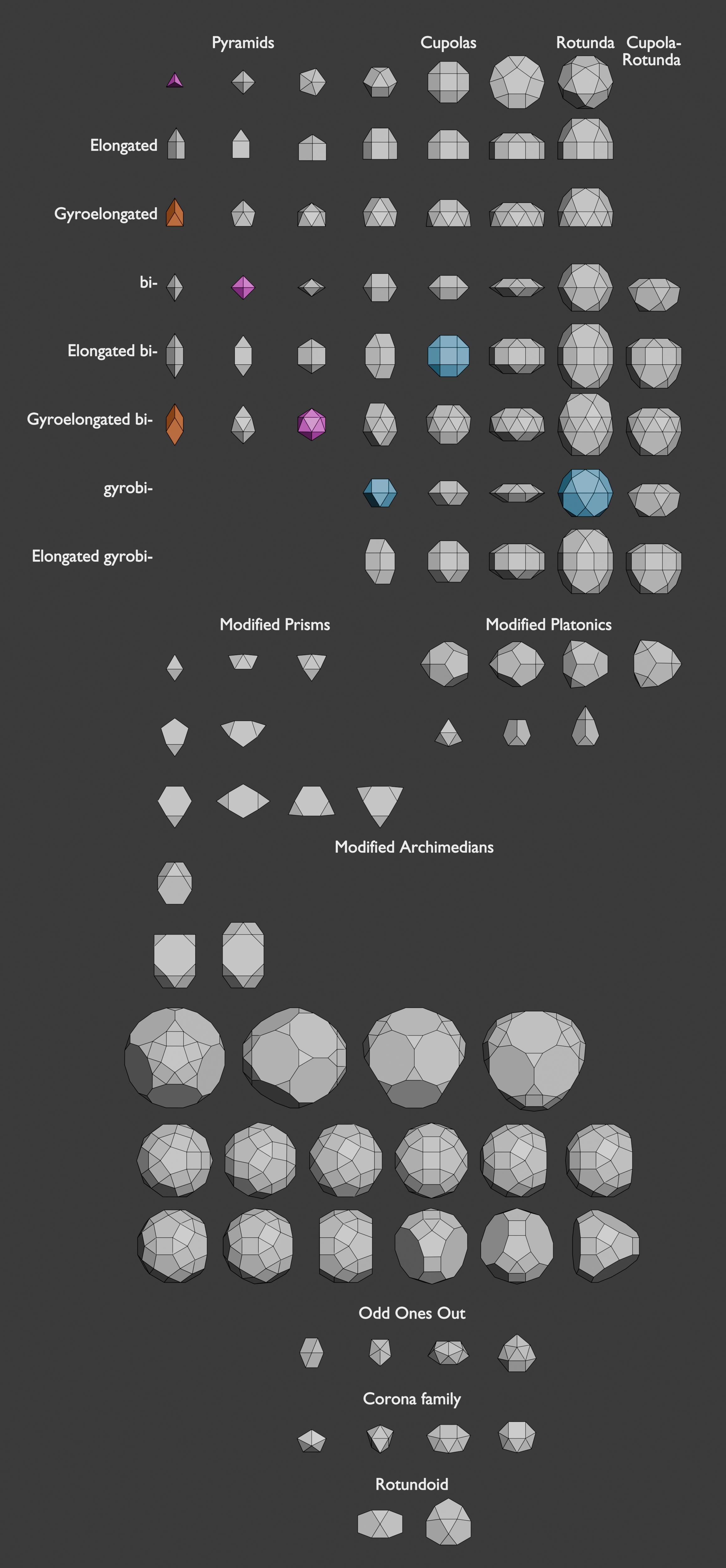
- Here's another idea: What if I provide a single image showing all 92 solids, arranged in the same manner as these tables? That would satisfy the need for visual information, without crufting up the page too much. I'll work on that... Introscopia (talk) 16:47, 8 March 2026 (UTC)
- Here's (a first pass at) the picture:
- https://introscopia.github.io/images/The_Johnsons.png Introscopia (talk) 19:51, 8 March 2026 (UTC)
- I think such a figure (maybe a bit snazzier) would be good for a poster, but not very effective for a Wikipedia article illustration. A separate image of each shape is more effective/helpful for readers. –jacobolus (t) 23:41, 8 March 2026 (UTC)
- I'm open to notes with regard to 'snazz'!
- I will push back on your contention, though. I believe a broad overview of the set like this is perfectly effective and helpful! It's a solid compromise between the present, barren state, and the previous, overly cluttered situation. Introscopia (talk) 06:12, 9 March 2026 (UTC)
- I do kind of like the idea of setting the scale of each image based on a common edge length though. –jacobolus (t) 23:44, 8 March 2026 (UTC)
- I think such a figure (maybe a bit snazzier) would be good for a poster, but not very effective for a Wikipedia article illustration. A separate image of each shape is more effective/helpful for readers. –jacobolus (t) 23:41, 8 March 2026 (UTC)
- @Introscopia. Why not merge all of those tables into one? Why not use the 92 solids illustration for the lede, instead? Why not merge the classifications of "Odd but ones", "Corona", and "Rotundoid" as miscellanea? The "rotundoid" is a new term considered as WP:NEOLOGISM. Have you tried to shrink the size of the table using horizontal and vertical scrolling bars? Dedhert.Jr (talk) 00:45, 12 March 2026 (UTC)
- > Why not merge all of those tables into one?
- small gains in space, and each part requires a different number of columns and rows, forcing them into one grid would generate a lot of awkwardness.
- >Why not merge the classifications of "Odd but ones", "Corona", and "Rotundoid" as miscellanea?
- To what end? Why reduce the specificity? Again, this categorization is what seems logical to me. The Coronas and Rotundoids are self-similar enough to be grouped together, and each of the Odds are totally unique.
- >The "rotundoid" is a new term considered as WP:NEOLOGISM.
- True. It's not in common use. I thought the construction was sufficiently neutral that it wouldn't warrant any argument. Rotund-oid: in the form of the rotunda, which is the criteria which connects them. What would you recommend instead?
- > Have you tried to shrink the size of the table using horizontal and vertical scrolling bars?
- I can't really tell what you meant here, sorry! Introscopia (talk) 01:11, 12 March 2026 (UTC)
- Well folks, I went ahead and published the edit today with the tables and a diagram I put together. Open to feedback! Introscopia (talk) 21:26, 11 March 2026 (UTC)
- @Dedhert.Jr
- About your recent edits, I like the grouping of the 3 operations videos, however, due to how long the name of that polyhedron is, I get some really awkward text wrapping artifacts: https://i.imgur.com/T83lnws.png. Maybe we just omit the name?
- Secondly, the "thumbtime" parameter does do something:
- https://en.wikipedia.org/wiki/Help:Creation_and_usage_of_media_files#Setting_a_video_thumbnail_image
- I used it to try to ensure the thumbnail was showing the most useful frame of the video, such that the viewer can get an idea of what's happening without clicking to play it. Introscopia (talk) 01:27, 12 March 2026 (UTC)
- I don't see the point of performing this expansion unless we also redirect list of Johnson solids to here. We have a list of Johnson solids here, we have a list of Johnson solids there, we have a list of Johnson solids everywhere in all of the Johnson solids articles in the navbox at the bottom of the article, and in case you missed the lists of Johnson solids in this article and in list of Johnson solids we also have lists of Johnson solids in the navboxes at the bottom of this article and at the bottom of list of Johnson solids. Do we really need 96 different places where readers can find lists of Johnson solids? —David Eppstein (talk) 02:14, 12 March 2026 (UTC)
- I don't particularly mind to merge List of Johnson solids here. I'll propose to demote it. Dedhert.Jr (talk) 02:16, 12 March 2026 (UTC)
- I don't see the point of performing this expansion unless we also redirect list of Johnson solids to here. We have a list of Johnson solids here, we have a list of Johnson solids there, we have a list of Johnson solids everywhere in all of the Johnson solids articles in the navbox at the bottom of the article, and in case you missed the lists of Johnson solids in this article and in list of Johnson solids we also have lists of Johnson solids in the navboxes at the bottom of this article and at the bottom of list of Johnson solids. Do we really need 96 different places where readers can find lists of Johnson solids? —David Eppstein (talk) 02:14, 12 March 2026 (UTC)
Propose to merge List of Johnson solids to here
Propose to merge List of Johnson solids to here. While I am proposing for Wikipedia:Featured list removal candidates/List of Johnson solids/archive1, I also suggest merging, per the last two talks above from here. By merging, tables may have a small adjustment, by removing the data of their surface area and volume, and replacing them with nets. Dedhert.Jr (talk) 02:50, 12 March 2026 (UTC)
- I agree, of course, that we have a lot of duplication at this point.
- I'm tending towards the following solution:
- Main article: prune the tables, leave only the big image. The previous version had some text below the list talking a bit about the families and their construction, maybe we add something like that back in to accompany the image.
- List: leave it alone, it has a lot of extra data which I do consider valuable, like volume and area, but which would clutter up the main article.
- Nav boxes: Gone from both.
- Introscopia (talk) 03:58, 12 March 2026 (UTC)
- Support merge per above. —David Eppstein (talk) 04:21, 12 March 2026 (UTC)
- well, whatever the decision ends up being, I went ahead and removed the navboxes. I think we all agree those were unnecessary. Introscopia (talk) 00:52, 13 March 2026 (UTC)
- @Introscopia. Then adding some vertex configurations and categorize whether each solid is composite or elementary? Some just asked for adding a 3-connected planar graph, but this is too much. Equally, all articles must have such a description. Dedhert.Jr (talk) 05:08, 13 March 2026 (UTC)
- Sorry, friend, once again I can't really tell what you mean.
- And while I'm here: I'm going to revert the edits to that info box with the three shapes, ok? I feel you reduced the clarity and readability, with no obvious upside. Introscopia (talk) 14:31, 13 March 2026 (UTC)
- @Introscopia. I think applying directly is much more understandable than saying here. Dedhert.Jr (talk) 02:44, 14 March 2026 (UTC)
- Support merge per above. —David Eppstein (talk) 04:21, 12 March 2026 (UTC)
Third solid in the first diagram
IIn the first diagram, showing three solids, the caption says that only the first is a Johnson solid, but the third solid (the orange one) seems to be just a cube, so shouldn't it be a Johnson solid too? A convex polyhedron is just a subset of satisfying certain properties — the line segments drawn on it are not part of its description, so they should not change it from being anything but a cube. Ebony Jackson (talk) 03:27, 13 March 2026 (UTC)

![[1]](http://home.att.net/~numericana/answer/j37.gif)



- Convex meant < 180 degrees for dihedral angle. Those lines represent the coplanar faces, so the cube's checkerboard faces is not a Johnson solid. And a convex polyhedron is a finitely many bounded planes. Dedhert.Jr (talk) 04:57, 13 March 2026 (UTC)
- I understand what you are saying, but it seems that you are using a definition of convex polyhedron different from the the definition on Wikipedia. According to Wikipedia, a convex polyhedron is just a bounded intersection of finitely many half-spaces, or the convex hull of finitely many points, restricted in either case to intersections or hulls that have nonzero volume. You instead seem to have in mind a definition in which a convex polyhedron is not just such a subset of space, but such a subset equipped with a collection of lower-dimensional subsets called faces. So for you, the 2 x 2 x 2 cube with six 2 x 2 faces is different from the same cube with twenty-four 1 x 1 faces, four on each side, even though as subsets of space, they are the same, hence the same in Wikipedia's definition. Ebony Jackson (talk) 06:20, 13 March 2026 (UTC)
- By the way, the definition of convex polyhedron given in the present article does not agree with the definition in the reference it cites, because it is missing the condition that the polyhedron not be contained in a plane. Ebony Jackson (talk) 06:47, 13 March 2026 (UTC)
- If you're really saying that you believe that a cube with subdivided coplanar faces is a Johnson solid, then I suppose you should submit that to some math journal! hehehe. If you're saying we should include all this stuff about 'lower-dimensional subsets' etc. in the definition, then I have to disagree. Here's a compromise, let's add the word strictly: " also known as a Johnson–Zalgaller solid, is a strictly convex polyhedron whose..."
- That keeps the definition layman-accessible, while being more precise. Introscopia (talk) 14:28, 13 March 2026 (UTC)
- Redefining convex polyhedron to include lower-dimensional subsets to allow subdivisions of faces as part of the definition is the opposite of what I'd like! I am just pointing out that according to Wikipedia's definition, a convex polyhedron does not come with subdivisions of its faces. If we are going to use a different definition in this article, we should say so.
- It may also be better to avoid the jargon "strictly convex", especially since it contradicts this definition of strictly convex.
- Perhaps we could make it easier for a layman to understand by saying something like "A convex polyhedron is the convex hull of a finite set of points in 3-dimensional space, not all in a plane. Its boundary is a finite union of polygons, no two in the same plane; those polygons are called the faces. A Johnson solid is a convex polyhedron for which the faces are regular polygons." Ebony Jackson (talk) 16:17, 13 March 2026 (UTC)
- I must disagree that that our use of "strictly convex" contradicts that definition. The extra vertices that were created in that cube in subdividing its faces are not Extreme points. Introscopia (talk) 19:22, 13 March 2026 (UTC)
- The definition says "A set C is strictly convex if every point on the line segment connecting x and y other than the endpoints is inside the topological interior of C." (I guess they meant "for all x and y in C, every point on the line segment connecting x and y other than the endpoints is inside the topological interior of C." - I'll go ahead and fix the quantifiers at that other article.) All I meant is that according to this definition, the solid cube is not strictly convex, because if x and y are different points on the same face, it is not true that all the points in the segment joining x and y other than x and y are in the interior of C. Only figures with curved boundaries (such as ellipses) have a chance of satisfying this definition of strictly convex.
- On the other hand, it does seem as if there is a different definition of strictly convex that is commonly used when convex polyhedra are thought of as a collection of polygons some of which a priori may be coplanar. I guess that is the one you are using, which is OK. Ebony Jackson (talk) 23:27, 13 March 2026 (UTC)
- Another way of stating the issue, if you want to use the characterization at Convex set#strictly convex in terms of extreme points, which says "A closed convex subset is strictly convex if and only if every one of its boundary points is an extreme point": A convex polyhedron is a closed convex subset, but it never satisfies this extra condition to be strictly convex, because any point in the middle of a face is a boundary point that is not an extreme point. Tetrahedra, icosahedra, etc. are never strictly convex according to this definition. Ebony Jackson (talk) 23:44, 13 March 2026 (UTC)
- I spelled out what "strictly convex" means, and moved the technical discussion of what "strictly convex" means for polyhedra into a footnote. I did also remove the orange cube, to avoid confusion. Ebony Jackson (talk) 22:40, 14 March 2026 (UTC)
- I must continue to disagree. The Parenthetical you added "(No two coplanar)" in the opening sentence is, sorry to be harsh, really really awful for flow and readability. "Strictly Convex" means no coplanar faces. You already admitted this yourself. There is literally no other conceivable thing the adverb 'strictly' could be doing next to the word 'convex' other than specifying that coplanar faces are excluded.
- As for the orange cube, I never liked it anyways. I do believe however the "gyroelongated triangular bipyramid" (aka the trigonal trapezohedron) would be a nice and relevant exemple to replace it with, because it is one of a few very salient gaps in the construction tree of the pyramid family of Johnsons. Introscopia (talk) 02:00, 15 March 2026 (UTC)
- Or we can say it "augmented octahedron" [7] Dedhert.Jr (talk) 05:47, 15 March 2026 (UTC)
- @Introscopia: I see what you mean about the parenthetical breaking up the flow; that's a fair criticism. I removed it (it wasn't really necessary), and added explanation to the footnote instead. @Dedhert.Jr: I added a citation to an article by A. G. Khovanskii for the fact that convex polyhedra are never strictly convex in the sense used in modern convex geometry.
- As for adding a third polyhedron image, I think the two of you know the examples better than I do, so I leave it to you. It looks as if the augmented octahedron fails the definition because some of its faces are rhombi instead of regular polygons. By the way, it looks as if some people use "augmented octahedron" to refer to a different polyhedron. Maybe there are just many kinds of augmented octahedron? I don't know the terminology well. Thank you both, Ebony Jackson (talk) 15:27, 15 March 2026 (UTC)
- Or we can say it "augmented octahedron" [7] Dedhert.Jr (talk) 05:47, 15 March 2026 (UTC)
- I spelled out what "strictly convex" means, and moved the technical discussion of what "strictly convex" means for polyhedra into a footnote. I did also remove the orange cube, to avoid confusion. Ebony Jackson (talk) 22:40, 14 March 2026 (UTC)
- I must disagree that that our use of "strictly convex" contradicts that definition. The extra vertices that were created in that cube in subdividing its faces are not Extreme points. Introscopia (talk) 19:22, 13 March 2026 (UTC)
- Perhaps we could make it easier for a layman to understand by saying something like "A convex polyhedron is the convex hull of a finite set of points in 3-dimensional space, not all in a plane. Its boundary is a finite union of polygons, no two in the same plane; those polygons are called the faces. A Johnson solid is a convex polyhedron for which the faces are regular polygons." Ebony Jackson (talk) 16:17, 13 March 2026 (UTC)
Exclusion of uniform polyhedra
In the sentence "Although there is no restriction that any given regular polygon cannot be a face of a Johnson solid, some authors require that Johnson solids are not uniform." I don't understand what "Although there is no restriction that any given regular polygon cannot be a face of a Johnson solid" is trying to say that would not already be expected. Can someone explain this to me? Should we just remove that part of the sentence and simplify it to "Some authors exclude uniform polyhedra from the class of Johnson solids."? Ebony Jackson (talk) 16:34, 13 March 2026 (UTC)
- yes, I agree it's not a great sentence. I like your suggestion, except I'd also cut the use of weasel terms like "some authors". So we either identify these authors, or cut everything:
- > A Johnson solid is a strictly convex polyhedron whose faces are all regular polygons, excluding the Platonic solids, Archimedean solids, prisms, and antiprisms. Introscopia (talk) 19:12, 13 March 2026 (UTC)
- I looked at some of the citations already in the article, and some of them do exclude uniform polyhedra, so I implemented your first suggestion to cite them in the relevant place. Ebony Jackson (talk) 00:04, 14 March 2026 (UTC)
GA time?
@David Eppstein. If the List of Johnson solids merge to this article, do you think there is a chance that this article can have GA? Definition and background, naming scheme, and list (after replacing those tables and panorama image) are done. But is there anything else? Dedhert.Jr (talk) 02:39, 14 March 2026 (UTC)
Better images and add images
@Introscopia. I like the way you arrange the 92 solids wrapped into a single illustration. Can you make another illustration for the lede, but this time, 92 solids only without compartmenting them at all? The article also need some illustrations for the last Johnson solids' nomenclatures. Many thanks. Dedhert.Jr (talk) 13:52, 25 March 2026 (UTC)
- honestly, I think another image featuring all of them in the same article would be a little excessive. But I can share the .blend file if you like.
- For the nomenclatures, you mean "lune", "corona" those terms? Yea, good idea, actually. I'll think about it! Introscopia (talk) 19:22, 25 March 2026 (UTC)
Rearranged table and some changes
Hi, I have rearranged the table as the new arrangement is very confusing and does not follow Johnson's own numbering, nor an easy way to arrange. For instance, orthobi and gyrobi should be placed together as they are different arrangements of two same cupolas and should be placed together, instead of omitting the ortho part. Also, some mistakes such as spelling of Archimedean and the labels and order of solids 47 and 48. I have thus rearranged the table. I have a suggestion that the images be split into the 92 individual Johnson solids so that a separate image need not be edited when the table is changed. I have also combined the naming into the enumeration sections as the names are specific to the three groups of Johnson solids, so that it is much easier to see how the names apply to the Johnson solids. Thank you.--Officer781 (talk) 02:13, 1 June 2026 (UTC)
- I have restored only a subset section of Johnson solids, namely the deltahedra, the chiral solids and the circumscribable solids that were removed from the old article. Only the noteworthy subsets were restored to prevent this article from getting too long. Thank you.--Officer781 (talk) 00:55, 4 July 2026 (UTC)
- I have a suggestion to classify the Johnson solids into three main groups in the image that Introscopia made, without words. In this way, it would be more flexible for the articles themselves to decide how to split more finely and spell out in the different languages. The first 48 solids have a distinct terminology (bi, elongated, gyroelongated), as do the next 35 (augmented, diminished, gyrate) and the last 9 (spheno, etc). Suggest that the main image be grouped into three boxes with the solids in each box arranged according to sequence.--Officer781 (talk) 08:42, 4 July 2026 (UTC)
Content Disclaimer
Informasi ini disarikan dari Wikipedia dan disajikan kembali untuk tujuan edukasi. Konten tersedia di bawah lisensi CC BY-SA 3.0. Kami tidak bertanggung jawab atas ketidakakuratan data yang bersumber dari kontribusi publik tersebut.
- The information displayed on this website is sourced in part or in whole from Wikipedia and has been adapted for the purpose of restating it. We strive to provide accurate and relevant information, however:
- There is no guarantee of absolute accuracy. Wikipedia is an open, collaborative project that can be edited by anyone, so information is subject to change.
- It is not intended to constitute professional advice. The content displayed is for informational and educational purposes only. For important decisions (e.g., medical, legal, or financial), please consult a professional.
- Content copyright. Wikipedia is licensed under the Creative Commons Attribution-ShareAlike License (CC BY-SA). This means that content may be reused with appropriate attribution and shared under a similar license.
- Responsible use. Any risk arising from the use of information from this website is entirely the responsibility of the user.