Talk:Hypercube

 | This article is rated C-class on Wikipedia's content assessment scale. It is of interest to the following WikiProjects: | |||||||||||||||||||||||||||
| ||||||||||||||||||||||||||||


Does anybody know how to transpose this table for better display when page is enlarged?
| m | 0 | 1 | 2 | 3 | 4 | 5 | 6 | 7 | 8 | 9 | 10 | |||
|---|---|---|---|---|---|---|---|---|---|---|---|---|---|---|
| n | n-cube | Names | Schläfli Coxeter |
Vertex 0-face |
Edge 1-face |
Face 2-face |
Cell 3-face |
4-face |
5-face |
6-face |
7-face |
8-face |
9-face |
10-face |
| 0 | 0-cube | Point Monon |
( ) |
1 | ||||||||||
| 1 | 1-cube | Line segment Ditel |
{} |
2 | 1 | |||||||||
| 2 | 2-cube | Square Tetragon |
{4} |
4 | 4 | 1 | ||||||||
| 3 | 3-cube | Cube Hexahedron |
{4,3} |
8 | 12 | 6 | 1 | |||||||
| 4 | 4-cube | Tesseract Octachoron |
{4,3,3} |
16 | 32 | 24 | 8 | 1 | ||||||
| 5 | 5-cube | Penteract Deca-5-tope |
{4,3,3,3} |
32 | 80 | 80 | 40 | 10 | 1 | |||||
| 6 | 6-cube | Hexeract Dodeca-6-tope |
{4,3,3,3,3} |
64 | 192 | 240 | 160 | 60 | 12 | 1 | ||||
| 7 | 7-cube | Hepteract Tetradeca-7-tope |
{4,3,3,3,3,3} |
128 | 448 | 672 | 560 | 280 | 84 | 14 | 1 | |||
| 8 | 8-cube | Octeract Hexadeca-8-tope |
{4,3,3,3,3,3,3} |
256 | 1024 | 1792 | 1792 | 1120 | 448 | 112 | 16 | 1 | ||
| 9 | 9-cube | Enneract Octadeca-9-tope |
{4,3,3,3,3,3,3,3} |
512 | 2304 | 4608 | 5376 | 4032 | 2016 | 672 | 144 | 18 | 1 | |
| 10 | 10-cube | Dekeract Icosa-10-tope |
{4,3,3,3,3,3,3,3,3} |
1024 | 5120 | 11520 | 15360 | 13440 | 8064 | 3360 | 960 | 180 | 20 | 1 |

More natural viewpoint
The section Faces contains this fragment:
"The number of the -dimensional hypercubes (just referred to as -cubes from here on) contained in the boundary of an -cube is


- , where and denotes the factorial of ."
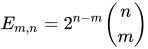
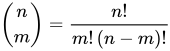

But there is no good reason to limit the counted faces to the boundary.
The n-cube is a perfectly fine polytope, and it has exactly one additional face beyond those on the boundary: its single n-dimensional face.
What's more, this corresponds to the case above where m = n, and it is easy to see that the very same formula is then equal to 1, the correct count.

Generalized hypercubes?
The first paragraph of the section Generalized hypercubes is as follows:
"In complex Hilbert space, regular complex polytopes can be defined and are called generalized hypercubes, γp
n = p{4}2{3}...2{3}2, or  ... Real solutions exist with p = 2, i.e. γ2
n = γn = 2{4}2{3}...2{3}2 = {4,3,..,3}. For p > 2, they exist in . The facets are generalized (n−1)-cubes and the vertex figure are regular simplexes."

But the meaning of all this notation is unclear and needs to be explained, if any reader is going to understand this section.
In particular, what does this mean:
  γp
n = p{4}2{3}...2{3}2
???
I hope someone familiar with this subject will make this section comprehensible.
Skeptical approach
While thinking about 4D, I tried to visualize it, but unfortunately, I wasn't successful. I tried to put it on paper, but after thinking about it carefully, it just wasn't possible. I imagined myself transported to a 2D world and trying to show the characters from there what 3D was. My first idea was to draw it for them, but a problem arose. There's no depth, no matter what I tried, I couldn't draw it in their world. To draw 3D, you need 3D in 2D; you can only draw a 2D world. After thinking about it, I remembered the hypercube, which makes absolutely no sense because why would 3D be any different and have the ability to draw higher spaces?
Can someone prove me wrong? Azorororo (talk) 18:00, 10 January 2026 (UTC)
- Are you saying that a concept cannot exist unless we can portray it? —Antonissimo (talk) 06:02, 11 January 2026 (UTC)
Content Disclaimer
Informasi ini disarikan dari Wikipedia dan disajikan kembali untuk tujuan edukasi. Konten tersedia di bawah lisensi CC BY-SA 3.0. Kami tidak bertanggung jawab atas ketidakakuratan data yang bersumber dari kontribusi publik tersebut.
- The information displayed on this website is sourced in part or in whole from Wikipedia and has been adapted for the purpose of restating it. We strive to provide accurate and relevant information, however:
- There is no guarantee of absolute accuracy. Wikipedia is an open, collaborative project that can be edited by anyone, so information is subject to change.
- It is not intended to constitute professional advice. The content displayed is for informational and educational purposes only. For important decisions (e.g., medical, legal, or financial), please consult a professional.
- Content copyright. Wikipedia is licensed under the Creative Commons Attribution-ShareAlike License (CC BY-SA). This means that content may be reused with appropriate attribution and shared under a similar license.
- Responsible use. Any risk arising from the use of information from this website is entirely the responsibility of the user.