Dragon fruit
Pitaya fruit, otherwise known as phitaya or dragon fruit, is a fruit from Central America, South America, and Asia. It has a sweet taste, a specific shape and c


Pitaya fruit, otherwise known as phitaya or dragon fruit, is a fruit from Central America, South America, and Asia. It has a sweet taste, a specific shape and color, and a texture close to a kiwi. It contains a lot of water and important minerals and nutrients.[1]
Pitaya usually refers to fruit of the genus Sternoceus, while pitahaya or dragon fruit refers to fruit of the genus Selenicereus (formerly Hylocereus). They are both in the family Cactaceae.[2] The common name in English—dragon fruit—derives from the leather skin and scaly spikes on the outside of the fruit. Depending on the variety, pitaya fruits may have sweet or sour-tasting flesh that can be red, white, or yellow in color.
It is known as “pitaya” if it comes from the very closely related Stenographers genus. The actual dragon fruit is the fruit of the cactus genus Hylocereus.[3]
Occurrence
Occuring in Mexico, South America, as well as Central America, it is possible it was introduced during the 1800s to Southeast Asian nations in Vietnam. This includes trade with the French, Cambodia, Thailand, Taiwan, Vietnam, and the Philippines, where it is an important part of their diet.[source?]
As of 2024, the countries where most of these are grown commercially for their fruit are Nicaragua, the People's Republic of China, Vietnam, and Israel.
Yellow pitaya
The yellow dragon fruit has yellow skin and white flesh. It has the highest sugar content among dragon fruits.[4] In Chinese, it is called "giraffe family" and is usually found in Hong Kong. The ripe ones have a sweet taste like sugar.
Gallery
-
 Pitaya "tree"
 -
 Plantation in Naozhou Island
 -
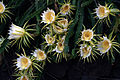 Flowering, at night
 -
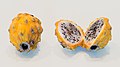 Yellow S. megalanthus
 -
 Red S. costaricensis
 -
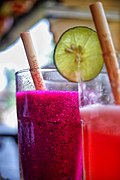 Jus buah naga, purple pitaya juice, Indonesia
 -
 Red, yellow and white fruits
 -
 Dress for a folk dance called Flor de Pitahaya "Pitahaya Flower" from Baja California Sur displayed at the Museo de Arte Popular in Mexico City


.jpg)


References
- ↑ "What Are the Health Benefits of Dragon Fruit?". Verywell Fit. Archived from the original on 2024-08-15. Retrieved 2024-08-15.
- ↑ Janick, Jules; Paull, Robert E., eds. (2008). "C". The Encyclopedia of Fruit and Nuts. Cambridge, United Kingdom: CABI (Centre for Agriculture and Bioscience International). pp. 215–216, 222–226. ISBN 978-0-85199-638-7.
- ↑ Janick, Jules; Paull, Robert E. (2008). The Encyclopedia of Fruit and Nuts. CABI. ISBN 978-0-85199-638-7.
- ↑ Emoha (2022-04-26). "Yellow Dragon Fruit – Nature's Boon For Seniors". Emoha Blogs. Retrieved 2024-08-15.

https://www.producebluebook.com/know-your-commodity/dragon-fruit/
Content Disclaimer
Informasi ini disarikan dari Wikipedia dan disajikan kembali untuk tujuan edukasi. Konten tersedia di bawah lisensi CC BY-SA 3.0. Kami tidak bertanggung jawab atas ketidakakuratan data yang bersumber dari kontribusi publik tersebut.
- The information displayed on this website is sourced in part or in whole from Wikipedia and has been adapted for the purpose of restating it. We strive to provide accurate and relevant information, however:
- There is no guarantee of absolute accuracy. Wikipedia is an open, collaborative project that can be edited by anyone, so information is subject to change.
- It is not intended to constitute professional advice. The content displayed is for informational and educational purposes only. For important decisions (e.g., medical, legal, or financial), please consult a professional.
- Content copyright. Wikipedia is licensed under the Creative Commons Attribution-ShareAlike License (CC BY-SA). This means that content may be reused with appropriate attribution and shared under a similar license.
- Responsible use. Any risk arising from the use of information from this website is entirely the responsibility of the user.