Talk:True anomaly
I believe the correct symbol for true anomaly is the greek nu (ν). The letter f is also sometimes used to distinguish it from the latin v, which is used for v

 | This article is rated Start-class on Wikipedia's content assessment scale. It is of interest to the following WikiProjects: | ||||||||||||||||||||
| |||||||||||||||||||||
.jpg)

.jpg)

symbol
I believe the correct symbol for true anomaly is the greek nu (ν). The letter f is also sometimes used to distinguish it from the latin v, which is used for velocity. I have also seen theta (θ), but I have only seen T on wikipedia. As T is also used for the period, perhaps this should be avoided. --Lasunncty 18:41, 24 October 2006 (UTC)
I concur with this. I have never seen T used for true anomaly; only ν and θ. Unless someone can provide a reference that uses this notation, I propose this article should be edited to reflect the standard nomenclature. Kemperb 23:58, 16 May 2007 (UTC)
In college, we used the notation f and ν for the true anomaly. I have never seen T, either. 130.134.81.16 19:02, 22 June 2007 (UTC)
Clarification of slight weirdness
Is it worth noting that the periapsis (the closest approach to the FOCUS) is also the point where the semi-major axis (furthest distance from CENTRE) is measured, because I was very confused for a while? Or am I just dumb? Neodymion 02:37, 7 February 2007 (UTC)
Removed material
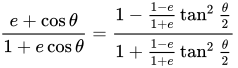
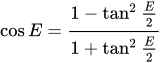
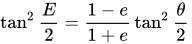
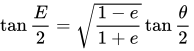
I removed the following material, originally from the ellipse article. It is the derivation of formulas relating eccentric and true anomalies; it is OK for a textbook but not for an ecyclopedia. Only the final formulas were left. All the best, --Jorge Stolfi (talk) 05:32, 11 March 2009 (UTC)
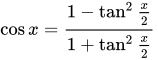
- To compute the true anomaly from the eccentric anomaly a more convenient relation can be derived using using the trigonometric identity
- One gets that
- and as
- it follows that
- As and always have the same sign it follows that and are in the same quadrant.
- One therefore has that
- The relation written in this form has singularities for and .
- But it can also be written in the non-singular form




An observation about the 'from state vectors' equation
Just wanted to add something here:
When calculating true anomaly using the following equation:
(if then replace by )
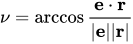


There will be an exception when as both terms cancel out, and a division by zero happens. This can happen when the orbiting object is exactly at apoapsis at low velocities, which is possible in case of a landed object having its orbital elements being calculated, or if the orbiting object's velocity is nearly zero.
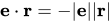
In this case, the correct answer is , but the equation will fail in a programming environment, as the result can be a NaN, or a runtime error.

Maybe it would be worth it to add this note to the article?
I don't have any sources for this though, it happened to me here and that's how I found out.
PsykomantaBrain (talk) 18:27, 3 May 2012 (UTC)
"however it does not produce the correct value"
> An equivalent form avoids the singularity as e → 1 , however it does not produce the correct value for {\displaystyle \nu \,} \nu \,:
So what values does it produce? Only a subset of the solution space? Random numbers? An approximation to 3%?
I'm currently trying to solve the eccentric => true mapping myself, so I can't help to clarify here yet.
2001:7D0:82C5:5080:A288:69FF:FE94:F2E6 (talk) 21:31, 3 July 2019 (UTC)
Error in the "From the Mean Anomaly" section?
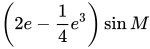
The "From the Mean Anomaly" section contains the formula:

Could someone who is an expert or who has access to the reference (I do not) please check and confirm if this is correct? It seems very odd and unlikely that a partial series expansion like this would have two terms of the third order and none of the first order. It seems much more likely to me that the second term: has an error in it and is really supposed to be only a first order term. However, the expansion and then reduction of Fourier series can be unusual sometimes, so I am not certain (and even if I am right, I still do not know the correct term to replace it with).
RBarryYoung (talk) 15:45, 28 August 2020 (UTC)
- OK, nevermind. I was able to find a more recent copy of the reference (Roy, Hilger 2005) online and confirm that the equation is correct. However there are minor errors in the text and the reference which I will correct.
Clarification on reference to image
I added the clarification needed template on the last sentence of the intro, as it references different anomolies but these are not labeled on the image. I intended to put this in my edit summary but accidentally published early, so putting it here. Andraste733 (talk) 04:35, 11 March 2023 (UTC)
- There used to be a different version of the diagram that did show all three anomalies, but it was replaced in 2010. The phrase "as shown in the image" wasn't added until 2015, however, so my guess is that they intended to mean just that the angle f can be seen in the image, not all three. Rather than changing the image again, I think that the phrase could be removed to reduce any confusion. --Lasunncty (talk) 09:42, 16 March 2023 (UTC)
Projective anomaly
@Pdmaley: The text you added about the projective anomaly might better be placed in its own article, except for the part about how it is related to the true anomaly. --Lasunncty (talk) 10:26, 16 January 2025 (UTC)
- I am unable to create a new page. If someone in the community could do so that would be a big help. The real author is in Japan and he is unable to edit Wikipedia. Pdmaley (talk) 16:08, 21 January 2025 (UTC)
Content Disclaimer
Informasi ini disarikan dari Wikipedia dan disajikan kembali untuk tujuan edukasi. Konten tersedia di bawah lisensi CC BY-SA 3.0. Kami tidak bertanggung jawab atas ketidakakuratan data yang bersumber dari kontribusi publik tersebut.
- The information displayed on this website is sourced in part or in whole from Wikipedia and has been adapted for the purpose of restating it. We strive to provide accurate and relevant information, however:
- There is no guarantee of absolute accuracy. Wikipedia is an open, collaborative project that can be edited by anyone, so information is subject to change.
- It is not intended to constitute professional advice. The content displayed is for informational and educational purposes only. For important decisions (e.g., medical, legal, or financial), please consult a professional.
- Content copyright. Wikipedia is licensed under the Creative Commons Attribution-ShareAlike License (CC BY-SA). This means that content may be reused with appropriate attribution and shared under a similar license.
- Responsible use. Any risk arising from the use of information from this website is entirely the responsibility of the user.