Talk:Trace class
Problem here with displayed formula syntax. Charles Matthews (Now fixed)

 | This article is rated Start-class on Wikipedia's content assessment scale. It is of interest to the following WikiProjects: | ||||||||||
| |||||||||||

Problem here with displayed formula syntax. Charles Matthews (Now fixed)
I believe the previous definition of trace class (in terms of A rather than |A|) was wrong; (gimme a week and I'll think of a counterexample)CSTAR 17:03, 23 Jun 2004 (UTC)
Some authors define trace-class operators as the operators for which converges (instead of |T|). See for instance Introduction to the Theory of non-Self-Adjoint Operators in Hilbert Space, by Gohberg and Krein, Theorem 8.1 p97.

Second k
The second k is a binding operator --- What logicians may consider to be a perverse notation for a lambda binder.CSTAR 23:35, 17 Nov 2004 (UTC)
- I have no idea what that means, but I guess it's not a typo, so i've reverted my edit. -Lethe | Talk
- Re: lambda binder: This is a high-fallutin' way of saying "consider ek as a function of k". A more explicit notation is

- if N happens to be the range of the index set k. Maybe I should have put that in, except that I may have been using a text-based browser (lynx) at the time I wrote that and set membership does not render.
- The expression lambda binder comes from lambda calculus originally and now is used in the theory of programming languages (for instance). CSTAR 04:21, 18 Nov 2004 (UTC)
- I think I get it. it's more precise with the binder, then, right? it makes it unambiguous that this is not a set with a single element ek but rather a set with many elements, one for each k. Also the article Free variables and bound variables was useful. -Lethe | Talk
merge with Nuclear operator
I just wrote nuclear operator when I found this article. (I had been looking for "trace-class", with the dash, and when I did not find it, I assumed there was no article :( I was vaguely contemplating expanding the other article to deal more with Banach spaces, where trace-class can be defined, but with only with some care. linas 19:08, 18 September 2005 (UTC)
- I don't think they should be merged. There is a lot more relevant material that doesn't generalize. For example Schatten p-classes (or Hilbert Schmidt operators in case p=2). Also Dixmier trace would not fit into any category related to nuclear operators.--CSTAR 20:11, 18 September 2005 (UTC)
- OK, Works for me, I'll remove the merge tag. linas 03:28, 19 September 2005 (UTC)
trace class without inner product
In finite dimensions, the trace of a linear map exists for any vector space, not just for Hilbert spaces. It is defined in terms of the natural transformation from V*⊗W to L(V,W), which is an isomorphism for finite dim. In infinite dimensional spaces there is no isomorphism, but there is still a natural injection. I wonder if it makes sense to define the trace class operators as the image of this injection. This has the advantage that it doesn't rely on the use of an inner product, nor any other topological features. It makes sense for any vector space. Another idea is to define the trace in terms of the Aut(V) invariant linear form, though this seems harder to me. -lethe talk + 01:57, 7 March 2006 (UTC)
- Hmm I can't quite tell what you are trying to say here; but it sounds like you are describing nuclear operator which is the same concept, but without the inner product. linas 14:49, 7 March 2006 (UTC)
- I don't know about nuclear operators, but I'm reading the article we have on it, and yes, it does seem similar. So let's see, my definition is this: T:V→W is trace class if there exist w∈W and f∈V* such that T=f⊗w or T(v)=f(v)w, and if V=W, then take trT = f(w). (OK, actually, not all elements of V*⊗W can be written in the form f⊗w, but the universal property of tensor products takes care of us here). Now, I guess the definition of nuclear operator looks similar, but is just more explicit. It looks like it decomposes a linear transformation into eigenspaces, making explicit use of an eigenbasis. Lemme think about whether I can show my definition includes the nuclear operator def. -lethe talk + 18:16, 7 March 2006 (UTC)
- Isn't what you are describing the class of finite rank operators V → W? Nuclear operators include these but not the other way around.--CSTAR 18:30, 7 March 2006 (UTC)
- So like, the shift operator T(en)=en+1 is not finite rank, but it can be written as ∑σn⊗en+1 which is in V*⊗W. Or is it? Maybe I have to take the completion of V*⊗W? -lethe talk + 18:41, 7 March 2006 (UTC)
- Isn't what you are describing the class of finite rank operators V → W? Nuclear operators include these but not the other way around.--CSTAR 18:30, 7 March 2006 (UTC)
- You can't use the algebraic tensor product (without completion). That's why Grothendieck in his famous paper in the early 1950s introduced topological tensor products to define operators which were like "integral" operators with a kernel (noyau) An operator with a noyau is "nucléaire".--CSTAR 18:49, 7 March 2006 (UTC)
- Yes, now I've followed the trail trace class→ nuclear operator→ Fredholm kernel→ topological tensor product→nuclear space. Thanks for the pointers. Keep an eye on their talk pages for more! -lethe talk + 19:01, 7 March 2006 (UTC)
- You can't use the algebraic tensor product (without completion). That's why Grothendieck in his famous paper in the early 1950s introduced topological tensor products to define operators which were like "integral" operators with a kernel (noyau) An operator with a noyau is "nucléaire".--CSTAR 18:49, 7 March 2006 (UTC)
- Also Schwartz kernel (aha still missing), Mercer's theorem--CSTAR 04:30, 8 March 2006 (UTC)
- At the risk of being off topic here: I think writing the matrix element M_kk as < M e_k, e_k > is quite unnatural. (Btw, < .,. > looks to me more like a duality bracket (cf "bra-ket") than like an inner product! (Admittedly, the bracket notation is also used in that article, not without protests on the talk page...)) It becomes clear in the next section why this is done, but I would prefer putting this complicated writing only there (like, "Mimicking the matrix case, where Mkk could be written <M ek, ek>, we now...") — MFH:Talk 22:34, 4 September 2007 (UTC)
Baryon number
Rather off-topic, but ... my favorite non-trace-class operator is the baryon number. Taking the integers Z as the Hilbert space, then, in a given basis, the baryon number is +1 on all positive ints and -1 on all negative ints. This operator is clearly bounded, yet clearly not trace-class. This operator has many bizarre properties; I would like to see a complete and comprehensive treatment of this somewhere, somehow, someday. linas 14:56, 7 March 2006 (UTC)
- I'm stumped. "Taking the integers Z as the Hilbert space," -- do you mean ? --CSTAR 15:02, 7 March 2006 (UTC)
- I think you might have meant a graded Hilbert space, where the grading is Z.--CSTAR 16:00, 7 March 2006 (UTC)

Isn't the baryon number is n–m on a state with n baryons and m antibaryons? So if we took , with a basis , then we could have B(en)=nen. Of course, this operator is not bounded, so maybe this isn't what you had in mind, though that's the usual baryon number that I know (the one for which B–L mod 6 is conserved in the standard model). Let's try the operator one defined by

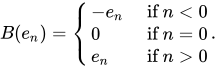
So then, OK, this is bounded. I guess it's not compact though, since the eigenvalues +1 and –1 do not have finite multiplicity. So what bizarre properties does it have? -lethe talk + 18:34, 7 March 2006 (UTC)
- The second definition was intended; sorry for being obscure and confusing you, I wasn't sure I even wanted to open this bag. One of the bizarre properties is a question of "what is the trace of B", or in physics terms, "what is the vacuum expectation value of B"? The "standard" way of answering this (in physics), is to point out that one has handy a Hamiltonian with which to fix the basis: the 's are eigenstates:

- where is taken to be the "energy" of the state . By "energy", I mean to imply that its a real number, and its positive. By convention, one orders the states by increasing energy. Physicists are happy to define, without much ado:



- One can make some general arguments as to why this is a good way to define the trace (I assume you can guess some of them.) The upshot, however, is that the actual value depends on the operator H. Consider the very simple example of
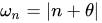
- then one finds
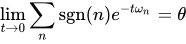
- (try it on the computer, if you don't beleive me). To make a long story short, there's something odd going on here that I can't quite put my finger on. Going back to physics, every Hamiltonian H has a different set of basis functions, but those for one should be a linear combination of those for another, if we assume that these are a "complete set of states". Let me stop here, for now. I find the situation mind-bending and intellectually unsatisfying, I'm "missing something", some grand theorem that ties things together. FWIW, these sums occur in various "important" and poorly understood physics problems. linas 01:50, 8 March 2006 (UTC)
- then one finds
Is trace really continuous in the weak operator topology?
Can somebody explain me what I get wrong in the following? Let's fix an orthonormal basis in H (n=1,2,...). Let be an operator which sends to 0 for i=1,2,...,n-1,2n,2n+1,... and is identity for n other .


Now, sequence
- consists of trace class operators
- converges to the 0 operator in the weak operator topology
- Tr(A_n) diverges to infinity
while the article claims "It [Trace] is continuous in the weak operator topology". Where lies the problem? Sirix 22:13, 30 September 2007 (UTC)
- you seem to be right. although the article doesn't say this directly, it certainly implies it. i think the mistake was mine. thanks for catching it. Mct mht 23:16, 30 September 2007 (UTC)
Antecedent
In the sentence
- It is continuous in the weak operator topology and satisfies properties 1 and 2 above.
I can't figure out what properties 1 and 2 are supposed to be. -- Walt Pohl (talk) 05:11, 14 February 2008 (UTC)
- Neither can I. They were in some previous version of the article. Too many editors.--CSTAR (talk) 06:22, 14 February 2008 (UTC)
I've deleted this sentence. I've also added a section about the Lidskii's theorem. I couldn't figure out how to make the reference section enumerate the two sources properly (sorry, I am a beginner with wiki!) --Spectral Theorist (talk) 22:42, 22 December 2008 (UTC)
Tr |A|
The article employs (defines!) a compound notation "Tr |⋅|" before defining Tr or |⋅|. In fact, the absolute value of a bounded operator is never defined or linked in the article. Is it just sqrt(A* A)? A link would be great.
In any case, wouldn't it make more sense to separate the two equalities

and
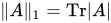
using the first one to perform the actual definition of trace-class, followed by the definition of Tr wherever valid, and adding the second one afterwards as a remark?
Or the other way around, define Tr for nonnegative self-adjoint operators first, and use it to define and trace-class.

The difficulty is that Tr for trace-class operators and Tr for nonnegative self-adjoint operators have roughly co-equal status. Neither is really logically prior, and the domains of definition are not nested; rather, they agree on the intersection of their domains of definition. It's just like taking integrals of integrable functions versus nonnegative measurable functions.
Content Disclaimer
Informasi ini disarikan dari Wikipedia dan disajikan kembali untuk tujuan edukasi. Konten tersedia di bawah lisensi CC BY-SA 3.0. Kami tidak bertanggung jawab atas ketidakakuratan data yang bersumber dari kontribusi publik tersebut.
- The information displayed on this website is sourced in part or in whole from Wikipedia and has been adapted for the purpose of restating it. We strive to provide accurate and relevant information, however:
- There is no guarantee of absolute accuracy. Wikipedia is an open, collaborative project that can be edited by anyone, so information is subject to change.
- It is not intended to constitute professional advice. The content displayed is for informational and educational purposes only. For important decisions (e.g., medical, legal, or financial), please consult a professional.
- Content copyright. Wikipedia is licensed under the Creative Commons Attribution-ShareAlike License (CC BY-SA). This means that content may be reused with appropriate attribution and shared under a similar license.
- Responsible use. Any risk arising from the use of information from this website is entirely the responsibility of the user.