Talk:Tonelli–Shanks algorithm
It is written that in the special case where p equals 3 modulo 4, then the solution is simply:

 | This article is rated Start-class on Wikipedia's content assessment scale. It is of interest to the following WikiProjects: | ||||||||||
| |||||||||||

the case where p = 3 mod 4
It is written that in the special case where p equals 3 modulo 4, then the solution is simply:

I don't get why. Is it supposed to be obvious? --Grondilu (talk) 14:01, 20 June 2012 (UTC)
- Yes. Square it, and apply Euler's criterion.—Emil J. 14:41, 20 June 2012 (UTC)
alberto tonelli needs enwiki biop (from itwiki)
Alberto Tonelli needs a enwiki translation. He has an article on the itwiki, a small one that doesn't mention he first came up with the important Tonelli-Shanks modular square root algorithm. There are three algorithms to take a modular square root and Tonelli's is as good as any of them. It's actually a rather important algorithm, since public key cryptography uses modular arithmetic. Endo999 (talk) 02:13, 28 August 2017 (UTC)
dickson's work on tonelli says the algorithm will work on mod p^k
I'm not a professional mathematician but I just read Dickson's "History of Numbers" [1] where it says on page 215-216 that
- A. Tonelli[2] gave an explicit formula for the roots of

Perhaps some mathematician should work out if the Tonelli algorithm takes modular square roots for powers of primes as well as for primes This Wiki article says the algorithm only works for prime modula.
After reading the Dickson text a couple of times on p215,216 I came across this formula for the square root of .

- when , or and
- for then
- where
- for then





Noting that and noting that then



So Tonelli's math does seem to take modular square roots of prime powers! Endo999 (talk) 03:17, 2 September 2017 (UTC)
Here's another equation: and


Endo999 (talk) 06:36, 30 August 2017 (UTC)
On page 215-216 of the Dickson book, the equation is given of Tonelli's:
- where and ;

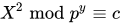

Using and using the modulus of the math follows (in mathematica):


Mod[1115^2, 23 23 23]=2191

Mod[1115^2, 23]=6
PowerMod[6, 1/2, 23]=11

Mod[11^(23 23) 2191^((23 23 23 - 2 23 23 + 1)/2), 23 23 23] =1115
Thus Tonelli's work can work for a 3 mod 4 prime power. Endo999 (talk) 20:23, 11 September 2017 (UTC)
References
- ^ "History of the Theory of Numbers" Volume 1 by Leonard Eugene Dickson, p215-216 read online
- ^ "AttiR. Accad. Lincei, Rendiconti, (5), 1, 1892, 116-120."
The algorithm makes no sense at all when

I suppose that should rather read ? And the introductory sentence is more than confusing as well. The "multiplicative group" would perhaps be , and of course all operations and comparisons in that ring are modulo . --Hagman (talk) 09:09, 10 February 2018 (UTC)


Completely agreed. There are further issues: several times when computing the order of the multiplicative group modulo , the order is given as instead of the correct . I think this should be flagged for fixing - it's factually incorrect as written on the page at present. --Anonymous Coward, 19:35, 5 November 2018 (UTC) — Preceding unsigned comment added by 97.115.75.203 (talk)


Error in first line of 'core ideas'?
> Given a non-zero n and an odd prime p, the Euler's criterion tells us that n has a square root (i.e., n is a quadratic residue) if and only if
I don't know about this stuff, but this seems wrong in one or more ways. First, "has a square root" has to be wrong, as every integer "has a square root". I think it means an integer square root? Secondly, I don't think that's true either, but only "modulo p". I think maybe a quadratic residue is only sensible "modulo p"? At least, based on my understanding from the first sentence of "Quadratic residue" wikipedia page. — Preceding unsigned comment added by 134.134.139.74 (talk) 21:44, 22 February 2018 (UTC)
- I have linked quadratic residue in that sentence since it is the first occurrence. And yes, it is modulo p. I think the lead makes that clear. It is the first sentence after the lead. PrimeHunter (talk) 22:30, 22 February 2018 (UTC)
About the Tonelli formulas
This is a bit confusing:
The Dickson reference shows the following formula for the square root of .
- when , or (s must be 2 for this equation) and such that
- for then
- where
- for then

Noting that and noting that then
[....]
One should probably say (using the notation in Dickson's "History of the theory of numbers"):
The Dickson reference shows the following formula for the square root of .

- when is prime, where and is odd, thus is odd
- for , where then
- if :
- if :
- if :
- ,
- where is an integer such that is a quadratic residue of , and is a non-residue.
- We may take if is not divisible by , but if is divisible by , while neither nor are divisible by .
- ,
- if :
- for , where then








In the following we set , and such that , and then





[....] — Preceding unsigned comment added by 88.76.118.122 (talk) 23:09, 9 June 2019 (UTC)
Content Disclaimer
Informasi ini disarikan dari Wikipedia dan disajikan kembali untuk tujuan edukasi. Konten tersedia di bawah lisensi CC BY-SA 3.0. Kami tidak bertanggung jawab atas ketidakakuratan data yang bersumber dari kontribusi publik tersebut.
- The information displayed on this website is sourced in part or in whole from Wikipedia and has been adapted for the purpose of restating it. We strive to provide accurate and relevant information, however:
- There is no guarantee of absolute accuracy. Wikipedia is an open, collaborative project that can be edited by anyone, so information is subject to change.
- It is not intended to constitute professional advice. The content displayed is for informational and educational purposes only. For important decisions (e.g., medical, legal, or financial), please consult a professional.
- Content copyright. Wikipedia is licensed under the Creative Commons Attribution-ShareAlike License (CC BY-SA). This means that content may be reused with appropriate attribution and shared under a similar license.
- Responsible use. Any risk arising from the use of information from this website is entirely the responsibility of the user.