Talk:Sign function

 | This  level-5 vital article is rated C-class on Wikipedia's content assessment scale. level-5 vital article is rated C-class on Wikipedia's content assessment scale.It is of interest to the following WikiProjects: | ||||||||||
| |||||||||||


Undefined?
The textbook "Calculus- a complete course" by Robert A. Adams says that sgn(x) is equal to 1 if x > 0; equal to -1 if x < 0 and that it is undefined when x is equal to 0; that is to say that:
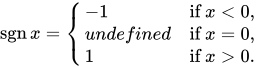
The explanation is verbatim "The value of the sgn(x) tells whether x is positive or negative. Since 0 is neither positive nor negative, sgn(0) is not defined." This makes sense seeing as how the sign function is x/(abs(x)), and when x = 0 one would get 0/0. This directly contradicts this article, which both has a dot at (0,0) and states that:
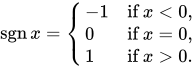
Someone mentioned above that since the signum function is a generalized function, sgn(0)=0 can apply but that doesn't mean that it is true. If somebody knows anything about this, I'd like this to be disambiguated and (if wrong) fixed. A small explanation about 'why' it isn't undefined would also be nice if somebody understands that. --BiT (talk) 14:25, 10 November 2008 (UTC)
- This, this, this and this page from Matlab are sources that sgn(0) is defined, but isn't a published textbook more reliable than some articles on the internet? --BiT (talk) 14:32, 10 November 2008 (UTC)
Leaving it undefined at 0 makes the derivative make more sense (as it too would be undefined at x=0). —Preceding unsigned comment added by 142.162.24.209 (talk) 04:59, 5 February 2009 (UTC)
Leaving it undefined at 0 makes no difference for the derivative since limits are defined to require an approach from both sides. Defining the sgn to be 0 at 0 allows for a more fluid definition of the matrix determinant in terms of the Leibniz formula. Doing so allows the sum to be taken over all arrangements up to N, and not just all permutations. It makes more sense from a combinatorial point of view. Antares5245 (talk) 00:20, 14 December 2009 (UTC)
- Ancient post, but here goes, first the complicated answer: The two functions are equivalent under the L2 norm since they differ in only one point. This implies for example that the fourier series for both is the same. One possible reason to favor the sgn(0)=0 convention is that the fourier series for sgn(x) converges (pointwise) to 0 in x=0. Making a distinction though between the two functions is mostly irrelevant. Almost everyone uses the zero convention or states explicitly what the behaviour at zero is.--217.84.27.165 (talk) 11:13, 13 November 2011 (UTC)
Algebraic representation
As far as I can tell, the entire point of the section on algebraic representation is "couldn't we express the signum function without using a conditional?" In other words, the basic definition of signum has a three-way switch using the condition brace; can we do it using normal (non-conditional) mathematics?
It seems like it could be simplified as or , but I suppose that would be undefined when x is 0. (This would lend credence to the above suggestion that signum be undefined when x is 0.)


Failing that, I don't really see the point of this section. It doesn't cite any sources to show where this complicated formula came from. The fact that it requires n be a certain number of decimal digits is mathematically messy and requires more special cases than the simple definition of signum in the first place. What is the point / use of this formula? —MattGiuca (talk) 07:17, 25 August 2011 (UTC)
- I thought just the same. Your comment got no response in 3 months, so I deleted the section. Stephanwehner (talk) 07:01, 3 December 2011 (UTC)
Citation needed?
Really? Is a citation really needed for the derivative? Surely this is a basic calculation. It follows trivially from the line below it about the Heaviside step function(which doesn't say citation needed).--217.84.27.165 (talk) 11:21, 13 November 2011 (UTC)
- The same thought occurred to me - that this is essentially the definition of the delta function. However, it could be that mathematicians have scruples about differentiating a discontinuous function, which I lack. Perhaps KlappCK [1] could explain the problem? --catslash (talk) 00:05, 14 November 2011 (UTC)
- The purpose of a citation here is to increase the reliability of the article and to solidify it's relation to other functions. I have had to derive the result myself, starting with the Heaviside step function, so I am comfortable with the definition, but this page isn't just for me, or either of you, for that matter. Furthermore, the derivative is not universally defined (if you have ever used Mathematica, D[Sign[x],x] returns Sign'[x] because it does not "know" the derivative of the sign function). However, one could point to the definition for the sign function in terms of the Heaviside step function [2] and then to the definition of the Heaviside step function's derivative [3] in a footnote showing how these two pieces of information and simple differentiation yield the result with a link to said footnote next to definition in the body of the article. This would seem satisfactory to me, anyway. KlappCK (talk) 20:09, 27 December 2011 (UTC)
- As an aside here, I believe that it may be beneficial for overall readability to move the definition of the sign function in terms of the step function up about the definition of the derivative of the sign function and use the former definition to derive the latter.KlappCK (talk) 20:29, 27 December 2011 (UTC)
- I made the changes I had proposed. See what you think.KlappCK (talk) 21:25, 27 December 2011 (UTC)
Article title
Isn't "signum function" the original and still most common name for this function? I think the lead section of the article should be changed to something like: "In mathematics, the signum function (from signum, Latin for "sign") is an odd mathematical function that extracts the sign of a real number. This function is also sometimes called the sign function, although this may lead to confusion with the sine function. In mathematical expressions, the signum function is often represented as sgn."
Also, I think the article title should be "Signum function", not "Sign function". Isheden (talk) 16:59, 7 March 2012 (UTC)
Fourier transform
I introduced a minus sign in the Fourier transform of the function. The former redaction was
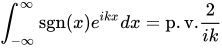
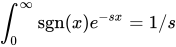
I have crossed several sources showing this is incorrect and that k should be changed to -k either on the left hand side or on the right hand side. For instance Wolfram[1] tells us the Laplace transform is , so replacing s by -ik and doubling the value to extend the integral to gives the correct result. I also checked from a French course giving a complete derivation for the Fourier transform of the Heaviside distribution and chose to change the convention for the Fourier transform on the left hand side. I do not have access to the article given as a reference. If indeed the former result was correct, please revert. Mathieu Perrin (talk) 13:19, 3 March 2020 (UTC)

Can we add a function that applies to any number?
Faster than Thunder (talk) 05:33, 10 January 2022 (UTC)

- I think the Complex signum generalisation covers this in terms of z = a + bi; unless adding the explicit a + bi form would make it easier for more readers who come across it here. NeilOnWiki (talk) 07:16, 24 June 2024 (UTC)
Modified structure
I've tried to group the various properties into smaller sections, which I hope may make sense to different kinds of reader. Eg: many aspects of the signum function are likely to be accessible to a wider readership than the vagaries of calculus might be (let alone distributions and Fourier transforms). NeilOnWiki (talk) 16:29, 10 May 2024 (UTC)
Just for information: I'm in the process of editing the newly created sub-section that has the title "Differentiation" (which I may rename). The first paragraph refers to the weak derivative of the absolute value function, then goes on to say "the resultant power of x is 0". As far as I can tell, this is a non-sequitur, which was added at this edit date before the weak derivative text was inserted. NeilOnWiki (talk) 11:13, 12 May 2024 (UTC)
Missing definition that is useful in signals processing - was deleted after I added it
Using the Dirichlet integral it is possible[1] to define the signum function in a way that is useful when calculating the Kramers–Kronig relations: ~2026-30984-85 (talk) 21:31, 23 May 2026 (UTC)

- In case the ProofWiki was the discarded reason, here is there another proof of the formula: using the Fourier Transform of the function as shown in the place 311 of the Table of Transforms for Distributions, one-dimensional:
- By splitting the transform in real and imaginary terms by Euler's formula, and using that is a even function, the formula follows:
- (don't know why there are ":" on the last formula, I didn't placed them there) ~2026-30984-85 (talk) 01:52, 24 May 2026 (UTC)


- ^ Talk:Sign function at PrfWiki

Content Disclaimer
Informasi ini disarikan dari Wikipedia dan disajikan kembali untuk tujuan edukasi. Konten tersedia di bawah lisensi CC BY-SA 3.0. Kami tidak bertanggung jawab atas ketidakakuratan data yang bersumber dari kontribusi publik tersebut.
- The information displayed on this website is sourced in part or in whole from Wikipedia and has been adapted for the purpose of restating it. We strive to provide accurate and relevant information, however:
- There is no guarantee of absolute accuracy. Wikipedia is an open, collaborative project that can be edited by anyone, so information is subject to change.
- It is not intended to constitute professional advice. The content displayed is for informational and educational purposes only. For important decisions (e.g., medical, legal, or financial), please consult a professional.
- Content copyright. Wikipedia is licensed under the Creative Commons Attribution-ShareAlike License (CC BY-SA). This means that content may be reused with appropriate attribution and shared under a similar license.
- Responsible use. Any risk arising from the use of information from this website is entirely the responsibility of the user.