Talk:Negative number
Added rules for division (in quite simplistic terms, since this is the same as multiplication -- same sign -> positive result, different signs -> negative

 | This  level-4 vital article is rated B-class on Wikipedia's content assessment scale. level-4 vital article is rated B-class on Wikipedia's content assessment scale.It is of interest to the following WikiProjects: | ||||||||||
| |||||||||||

Through 2003
Added rules for division (in quite simplistic terms, since this is the same as multiplication -- same sign -> positive result, different signs -> negative result).
I get the point that the article is meant to be understood easily, but can't we just refer to things by their names? Using words like "dividend" and "divisor" (for division) or "factors" (for multiplication) makes much more sense to me than exhaustively mentioning "if you add a positive number to a negative number"... you get the idea. ;) --doshell
Explaining sign interactions in multiplication, division and exponential functions cannot be entirely illustrated by concrete examples. The resultant sign from multiplication when both are positive or one is positive and the other is negative can be illustrated so long as one uses the positive factor to give the cardinal value to the implied repeated addition or subtraction operation, or in other words, -5 x 2 = -5 + -5 = -10, or 10 ÷ -2 = 10 - 2 - 2 - 2 - 2 - 2 = 0 (the answer being contained in the number of the negative numbers required to get the result of zero for division).
In binary computation the multiply, divide and exponent operations are performed precisely as I show above, except instead of the reordering that I demonstrate in order to have a positive real number as the counter for the corresponding negative number to perform the calculation, integer math functions in discrete logic arithmetic logic units, the logic operator XNOR (the negation of XOR) is applied to the sign bits of the two numbers being operated upon, an operation also called even parity, the result stored in the sign bit register, both are converted to the positive sign (usually indicated by 1 for positive or 0 for negative on the last bit of the byte/word/longword, the sequence of additions or subtractions performed and the sign bit altered at the end as determined beforehand by the even parity operation on the sign.
When both signs are negative, as for the example -8 ÷ -2, one cannot perform an operation without performing first a common factor elimination (of -1) or negation of the numbers on both sides of the operator, such as -8 ÷ -2 = -1 x 8 ÷ -1 x 2, but again, deriving a positive sign via even parity or XNOR on the sign must still be performed, and the rules listed for multiplication and division include a logic operation on the signs of even parity.
The fact that the rule for sign of the product of multiplication, division and exponents requires a second rule for the negative pair that is contrary to a simple and operation directly points at the fact that these operations on negative numbers are arbitrary and break from the fundamental consistency of these operations. One rule applies to both being positive, another rule when one is negative and the other positive, and a third rule if both are negative. The expression of sign as a binary vector matrix or compound value (like a coordinate space with a magnitude and a sign) is implied but for some reason not expressly stated. Also, it points to the fact that negative numbers are notional and time binding, that is, one can only practically demonstrate negative numbers either through reversal of the sequence of operations (see above where I illustrate the atomic subtraction operations implied in division) that is required when performing a division.
Negative numbers relate to either one of two things in multiplication/division/exponents, either the repeated subtraction of a division operation or the repeated addition of negative numbers (or subtraction of positive numbers) of a multiplication involving one negative number. The rule about even parity of real numbers and odd parity of imaginary numbers in multiplication, division and exponents is about maintaining a consistent effect of the repeated addition of the factors. Odd parity in real numbers operations indicates an odd number of negative signs in the expanded atomic addition and subtraction that produces the multiplication/division/exponent, and gives you a negative result. Even parity gives you a positive result. As I mentioned in the previous paragraph, sign is really a one bit coordinate indicating the direction to perform the operation (subtract or add) grouped with the number attached to it.
Thus -8 is the same as -1 x 8, and when you explain it this way you see that it is no more artificial and beyond the construct of simple addition or its temporal obverse, subtraction, than the √-1 radical of imaginary numbers. The rule in real numbers of using even parity on sign combinations makes the evaluation of this expression not-a-number or impossible to evaluate, but the way it works is that with imaginary numbers, instead of even parity for signs, the signs are combined based on odd parity. Odd parity evaluates to negative when both signs are the same, the exact opposite of even parity. Odd parity versus even parity (which are calculated by XOR and XNOR) is the fundamental difference in sign combination rules between real and imaginary numbers. Sign combination rules are arbitrary and separate from the cardinal numbers in the operation. The sign amounts to a single binary digit as a second coordinate in a two dimensional phase space splitting the field into a complementary pair of 1 dimensional phase spaces in which the direction of addition is reversed. -10 - 10 is the same as -10 + - 10.
— Preceding unsigned comment added by 109.149.204.234 (talk) 22:51, 23 January 2013 (UTC)
This situation cannot be understood as repeated addition, and the analogy to debts doesn't help either. The ultimate reason for this rule is that we want the distributive law to work:
- (3 + (-3)) · (-4) = 3 · (-4) + (-3) · (-4).
The left hand side of this equation equals 0 · (-4) = 0, while the right hand side equals -12 + [(-3) · (-4)]; for the two to be equal, we need (-3) · (-4) = 12.
I didn't understand the above, so I just cut it and pasted it. I hope the sections on arithmetic with negative numbers are correct, as well as clear, now. Someone really ought to check me, because in my haste I could easily make a non-negative number of errors :-) --Ed Poor 20:58 Dec 5, 2002 (UTC)
Makes sense to me. Follow the brackets carefully, Ed. negative * negative always did make sense to me as a repeated addition when I was a kid. 2 * -3 means "two lots of -3", -6, and since this can be also written as -3 * 2, it seemed logical to interpret this as "-3 lots of 2". hm. years since I thought about this stuff... -- Tarquin 10:26 Dec 6, 2002 (UTC)
Removing:
Multiplication of a number by -1 changes its sign. This is called negation, and may be expressed by placing a minus sign in front of a number or a quantity in brackets:
- -1 × 5 = -5
- -1 × -8 = -(-8) = 8
- -1 × (3 + 4) = -(3 + 4) = -7
In fact, negation is equivalent to multiplying a number by -1:
- -5 = -1 × 5
This equivalence can be used to simplify multiplication involving negative terms:
- -6 × 3 = (-1 × 6) × 3 = -1 × (6 × 3) = -1 × 18 = -18 (if you have a debt of $6, and then your debt is tripled, you end up with a debt of $18.)
Multiplication of two negative numbers yields a positive result:
- -3 × -4 = (-1 × 3) × (-1 × 4) = (-1 × -1) × (3 × 4) = 1 × 12 = 12, or more simply,
- -3 × -4 = -1 × (3 × -4) = -(-12) = 12
since negation was something I remember had to be proven in analysis, I'm not entirely sure how correct it is to just blankly state it. Restoring Axel's version for now, until he's back to maybe take the best of both & merge. -- Tarquin 11:15 Dec 6, 2002 (UTC)
- Doesn't this just follow from 0*x = (1 + (-1))*x = x + -1*x = 0, so that -1*x is guaranteed to be the additive inverse (i.e., negation) of x, denoted by -x? Chas zzz brown 11:32 Dec 6, 2002 (UTC)
- That's nothing. I'm waiting for the AE/BE argument to start about whether it should be math or maths... Maybe we should just use mathematics all the time to be safe. ;) --Dante Alighieri 11:18 Dec 6, 2002 (UTC)
- Yup, you're right, Chaz. It's hard to determine how axiomatic to be in covering what the lay readers takes to be a very basic topic. -- Tarquin
Hold on. I really don't think it makes much sense to merge Positive number and Nonnegative into Negative number. They're not the same thing, after all. I don't expect to read about positive numbers in an article called "negative number". Evercat 13:03 21 May 2003 (UTC)
- There is no doubt they are not the same thing. How about the title negative and positive number? -- Taku 13:08 21 May 2003 (UTC)
- That would be better. Perhaps Negative and positive numbers is grammatically better. Still, I rather prefer seperate articles for them, all linking to one another... Evercat 13:11 21 May 2003 (UTC)
- Since wikipedia is an encyclopedia, I think it makes more sense one article talks about negativity of number. Currently the article is nothing more than a bunch of definitions and properties, but we certainly want to discuss when the concept of negative is introduced, notations and other stuff. I don't think positive number article can grow more than a mere dictionary entry. (I don't mean to impose my will but just trying to justify why I did. We can discuss this.)
-- Taku 13:17 21 May 2003 (UTC)
noo!! the example at the bottom uses two-complement!! if the leftmost bit is used to express the sign (wich it seldom does in processors!) it cannot express -128 but only -127. there is also two zero's, -0 and 0, wich makes some operations quiet odd: -3+4 = 0, wich is wrong..? :P
- I thought the example I put is quite typical. If I remember correctly, char of C can express -128 to 127 because there are 255 distinct numbers. There should be only one zero. -- Taku 19:15 21 May 2003 (UTC)
- That's in two's complement. In one's complement, a negative number is represented as the complement of the value. Thus, the top bit is "1" if the value is negative. A weird thing about one's complement is that there are two representations for zero (all zeros and all ones). One's complement is much less common today, but it's still important historically -- Dwheeler 19:30 21 May 2003 (UTC)
- This seems quite interesting. If you can, don't hesitate to add this scheme (called one's complement?). The article certainly doesn't have to be limited to one mechanism. -- Taku 22:00 21 May 2003 (UTC)
- A more detailed discussion is already in Integral data type, and this article ("Negative and positive numbers") links to it.
Negative and positive numbers... hm... so that's like numbers except 0.
- Zero, the square root of zero, the cube root of zero, zero squared. ;) --Dante Alighieri 19:25 21 May 2003 (UTC)
Dante, you little sound sarcastic, but really I didn't notice numbers except 0, but then do you have any idea how to name this article? Topics like representation of negative and positive numbers in computers look weird if they are located in negative number article. -- Taku 21:51 21 May 2003 (UTC)
Why not put all this information on number? -- Minesweeper 22:01 21 May 2003 (UTC)
- Good point. Why not? Any objection? -- Taku 22:02 21 May 2003 (UTC)
- All this detail about how to add and subtract negative and positive numbers would be a burden in "Number". However, cross-links sure make sense. Having this as a separate article makes it easier to reference specifically the issue of + vs. -.
- Then what about negativity or even the concept of negative number. If possible, we certainly want to add about the history of negative numbers. -- Taku 22:27 21 May 2003 (UTC)
- Yes. It sounds like there's many good reasons to leave this as a separate page. -- Dwheeler 22:30 21 May 2003 (UTC)
I would like to rename this to negativity because I knew negative and positive numbers sound like any number but zero, which is not the intent of this article. Any objection? -- Taku 22:57 21 May 2003 (UTC)
To me negative number would make more sense than negativity, for one thing because the latter does not make it perfectly clear that mathematics is the subject. Negativity (mathematics) seems overly complicated. Michael Hardy 00:08 22 May 2003 (UTC)
- But what about "I don't expect to read about positive numbers in an article called "negative number" by User:Evercat. He has a point. It seems little weird the article negative number has a lot of mention about positive numbers. But the trouble we invented a concept positive number after invension of negative numbers. Without the concept of negative number, we don't have positive numbers. Then a compromise, how about negative and non-negative numbers? Sounds strange? -- Taku 02:24 22 May 2003 (UTC)
- I think it's fine where it is. The discussion of where zero falls is natural for an article called "negative and positive numbers". Evercat 14:24 22 May 2003 (UTC)
They're called signed numbers! -- Toby Bartels 04:14 6 Jun 2003 (UTC)
I revert new move since there seems no agreement with it yet. -- Taku 04:21 6 Jun 2003 (UTC)
I was bold since (unlike some page moves) it could be undone if somebody didn't like it (as you don't). But I'd like to hear your opinions of disagreement too! -- Toby Bartels 04:42 6 Jun 2003 (UTC)
First of all, I have never heard of signed numbers. I mean is it really a popularly accepted term? Do you have evidence? If you do, I have no trouble to restore your contribution myself. -- Taku 04:48 6 Jun 2003 (UTC)
I hear it often enough -- though this is hearsay. There's some evidence in the article itself, where people other than me used the term. But I should provide some documentary evidence of use outside of computer science too, so I'll go look some up. -- Toby Bartels 09:58 11 Jun 2003 (UTC)
I really don't see why this page exists at all. Initially it was about negative numbers. What was wrong with that?? Then it became negative and positive numbers, until someone pointed out that it was a bit silly that it excluded zero (ohh year that was me). Now it's about er .. what ? er... numbers. Content should be moved to either number or integer where negative numbers can be discussed in context. The stuff about binary representation of negative numbers is already well covered in Computer numbering formats. The use of links where appropriate should suffice. Mintguy 16:39 6 Jun 2003 (UTC)
- You seem to be correct about the computer representation (although Computer numbering formats needs to be broken up). Signed numbers are a separate concept from simply integers, since one may consider signed or unsigned numbers of other sorts (like rational, real, cardinal, etc). This article could talk about the common issues, while Integer would deal with the specific properties of Z (like its special position among rings). -- Toby Bartels 09:58 11 Jun 2003 (UTC)
Agreed. Could we have a simple page title back, ie negative number? -- Tarquin 18:56 6 Jun 2003 (UTC)
- While I like Signed number, I also see no reason why Negative number and Positive number can't also exist separately. And maybe when all the material specific to those articles, to Integer, and to Computer numbering formats is taken out, there'll be very little left of Signed number (or whatever you want to call it), in which case it can be folded into Number. -- Toby Bartels 09:58 11 Jun 2003 (UTC)
- Though strage title, I think having a separate article about the concept of negative numbers in math or its representation does make sense. I don't think negative and positive is part of number. Breaking up the article to two articles doesn't make sense. Any article in wikipedia is an encyclopediac article, which means we want to discuss not just what it is, but also more about history, significance in society and so on. Unfortunately there are a lot of overlaps between Computer numbering formats and other wikipedia articles. Rather than moving stuff here to it, it should be more reasonable to move stuff from there to here as we break up the article. -- Taku 21:30 11 Jun 2003 (UTC)
Computer numbering formats. Actually It is a really good written article but the trouble is that the article is rather isolated from the rest of well-cultivated wikipedia articles. The stuff about binary represention is vital because the article should not be limited to that in math but that in general cases. Besides, in the future we might want to add portions for example history of concept of negative and positive. Actually I don't have much trouble to rename this to simple negative number but then what about positive number then? Are people suggesting split it off into two articles? Honestly I really don't like a current ugly title but I don't know a better one. Actually it is rather silly to discuss a lot about naming because unlike dictionaries, in encyclopedia articles, the article tends to be more general, thus, sometime the title also tends to be complex. For example, political status of Taiwan or something (I don't remember the current name). -- Taku 22:04 6 Jun 2003 (UTC)
I don't think the title of this article is as important as its contents: the discussion of 1-complement, 2-complement etc. does not belong here, only a link. After all, that is a discussion of numerals for negative numbers in the binary system, not of negative numbers themselves. What we desparately need however is a history section. AxelBoldt 15:04, 29 Sep 2003 (UTC)
Classification of 0
Mathematically, 0 is neither positive nor negative. However, in naive English it is common to use the word "positive" to include 0. Any comments about this?? 66.245.1.229 19:30, 6 Nov 2004 (UTC)
- It may or may not be naive, but it would certainly be confusing and misleading to call zero a positive number. If I say that "I have visited Paris a positive number of times" I would mean I have done it at least once. --Henrygb 22:32, 17 Nov 2004 (UTC)
- People don't use their languages correctly many times. But I think it is unnecessary to mention such misuses in too much detail. -- Taku 01:38, Nov 18, 2004 (UTC)
- Did you mean to say "naive English" or was that supposed to be "native English?" As a native English speaker, I've never heard anyone refer to zero as a positive number, except when discussing the mathematical classification, in which case they were simply wrong. -- Foof 03:04, 6 February 2006 (UTC)
It's increasingly common in mathematics to distinguish, in general, between positive and strictlyt positive objects, abolishing the slightly awkward term non-negative (for example, a complex number is usually neither negative nor positive nor 0. In order of increasing generality, the possibilities are:
- a linear order with 0. The usual terminology is positive, negative, zero, as in the article.
- a partial order with 0. There are now elements that are incomparable to 0, and being non-negative no longer means being positive or 0. That's why for complex numbers, the longer term "nonnegative real number" is sometimes used.
- several partial preorders with 0. That's the tricky one. It's not at all uncommon these days, and there is usually no good way to say "an element that is nonnegative in every individual preorder".
To illustrate (and to give me some practice with tables, but don't tell anyone I wasn't perfect before), consider the space R2 (that's just maths-speak for tuples of real numbers):
| Element | "old" terminology | "new" terminology | "new expanded" terminology |
| (1,1) | positive | positive | strictly positive |
| (1,0) | ? | positive | varies |
| (0,0) | zero | zero or positive or negative | zero or positive or negative |
| (0,-1) | ? | negative | varies |
| (-1,-1) | negative | negative | "strictly negative" |
| (1,-1) | ? | ? |
Now, it turns out that in such general cases, it usually turns out that there are many useful theorems about the "new" positive elements; sometimes there are useful theorems about the "new expanded" strictly positive elements, including or excluding the (1,0) case depending on which object you deal with. The set of "old positive" elements is usually far less interesting, and when it is interesting, there is virtually always a set of preorders such that it becomes the "strictly positive" set, and the positive set will be interesting then, too!
In short, many mathematicians, including myself, think it is an unfair accident of history that "positive" excluded the zero case. It is also questionable etymologically (it is quite possible to put zero apples on a table. It's much harder with -1 apple, particularly if there aren't any on it to begin with).
I definitely think that this should be discussed in an article linked to from positive. It is also worth mentioning that 0 is "positif", in French, and that this practice has spread through adoption of French terminology.
Finally, since this is something that people argue about a lot until they finally go find a mathematician who is subsequently annoyed at being asked again, it's a convention. Mathematicians tend not to feel strongly about which convention you use, though they do feel strongly about wasting a lot of time because you used a nonstandard convention without telling them. Still, it is a convention, and if you prefer another one, just state so clearly and move on.
RandomP 00:30, 1 May 2006 (UTC)
As I see here some discussion has already been held about the topic of positivity of zero. One ting hasn't been mentioned yet, namely the fact that the current definition is inconsistent: "A positive number is a real number that is greater than zero, such as 2. Zero itself is neither positive nor negative." Since a is greater than b means (by defenition of order, whether it's total or partial) that , the first part of the definition tells us that, since , 0 is a positive number, a statement that is contradicted in the next sentence. If wikipedia indeed is in favor of not calling 0 a positive number (I myself would say it is), this could be corrected by changing 'greater than zero' in 'strictly greater than zero'. What about it? HSNie (talk) 18:56, 29 May 2009 (UTC)


- No inconsistency. You got the definition of greater wrong. What you put in was greater than or equal. Dmcq (talk) 23:03, 29 May 2009 (UTC)
- I'm pretty sure I'm not mistaken in that. One of the first pages of my book on order/lattice theory even mentions it as a common misconception among non-mathematicians to think that greater than means > instead of . HSNie 23:22, 30 May 2009 (UTC) —Preceding unsigned comment added by HSNie (talk • contribs)
- That is simply not true. If you do find a book saying something like that please give a reference to it. In mathematics greater than corresponds to the sign > and excludes the case of them being equal, greater than or equal corresponds to ≥. See Inequality Dmcq (talk) 01:43, 31 May 2009 (UTC)

bad jokes and other non...negatives
no comment on the following :
- "Division is similar to multiplication"
- "If both have different signs"
some comments on the folllowing :
- nonnegative can be defined as desired, but "non negative" has (imho) the meaning of "not negative" and is thus invariably defined once "negative" is defined. For example, an imaginary number is not negative.
- in the context of "nonnegative matrix" I think one should include not only links but also comments to what is commonly called a positive matrix (for which the associated quadratic form takes ony nonnegative values)
I don't want to impose my ideas and thus don't make changes since this might be controversal, and I risk to be too axiomatic: I would call nonnegative all elements that are not less than zero (in any group equipped with a partial order), so this is not always the same than "positive or zero"; and suggest to specify "nonnegative reals" or "nonnegative integer" etc. in order to get the "usual" (particular) meaning.
But if someone feels an inspiration, I strongly suggest to make the adequate changes. — MFH: Talk 13:16, 28 September 2005 (UTC)
First usage of negative numbers
From the current article:
- "Negative numbers were not well-understood until modern times. As recently as the 18th century, the Swiss mathematician Leonhard Euler believed that negative numbers were greater than infinity..."
This seems unfairly closed-minded. The convention that −1 < 1 is natural if you want an ordered group, but some uses of negative numbers demand a different ordering: see negative temperature. Melchoir 01:08, 11 February 2006 (UTC)
Diophantus
Diophantus's rejecting 20x+4=0 as a meaningful equation is cited as an evidence of knowledge of negative numbers in Greece. This is absurd, since it is a clear evidence to the contrary. It's like saying that somebody rejecting square root of negative numbers is an evidence that he knows imaginary numbers. deeptrivia (talk) 03:18, 17 February 2006 (UTC)
off the current topic slightly. can anyone prove the existance of negative numbers? i dnt mean prove as in negative temperatures i mean prove lik u would prove the quadratic equation by using completing the square or prove the sum to infinity for a geometric series.
- The short answer is yes, but the longer answer is long indeed. After all, what do you mean by "existence"? One construction of negative numbers is given by the "Formal construction of negative and non-negative integers" section of this article. If you want a thoughtful explanation of what it all means, I think you'll get an excellent response if you ask on Wikipedia:Reference desk/Mathematics. Melchoir 17:50, 9 June 2006 (UTC)
In fact, Diophantus knew about negative numbers (or better: quantities) and calculated with them, he just did not accept them as a (final) result, as he found a negative result as absurd or useless. This is very well shown in: "Negative Größen bei Diophant?" (2007) written by Klaus Barner. Unfortunately, it is not written in English but in German, which might be the reason for it seemingly not being very popular. Isabella G. Bashmakova is said to have shown it (i.e. that Diophantus knew negative numbers), too (though I haven't read her book, yet). It would be great, if anybody speaking english better than me amended the article in this respect. —Preceding unsigned comment added by 91.36.93.115 (talk) 12:51, 23 August 2010 (UTC)
Minus numbers?
Terminology is important. It's time for a rant.
If I Google "negative number" I get 2,470,000 hits, and all of them are coherently talking about negative numbers. If I Google "minus number" I get 53,100 hits. Even of those, I grow suspicious: out of the top 10 hits, only 4 are actually talking about negative numbers; another 4 are using "minus" as a verb, and the other 2 are incomprehensible.
So I Google "negative numbers" with an s, and this time I get 3,060,000 hits, and all of them are coherently talking about negative numbers. But "minus numbers" gets 17,000 hits, and even then the very top item is an incomprehensible PDF technical sheet in all caps; below that is a subject-line of some student asking "dr. math", and further below we find such gems as "NBA Plus Minus numbers for the last 30 days!". On the next page there are three more "plus/minus" phrases.
I conclude that virtually no one says "minus numbers", including the British; that even in the rarity when they do use the phrase it's even odds on what they mean; and of that tiny minority who actually use it to mean "numbers less than zero", they're either double-talking pedagogues or just confused.
If we search Wikipedia itself, it gets even better: all of the bolded phrases at the top are used throughout the project, even "non-positive numbers". "Minus numbers" turns up nothing.
Even if we assume that all the searches are lying to us: I've read mathematics books at all levels; I've read research articles written from all over the world; I've even read the literature for elementary school teachers. They all say "negative number", and more importantly, none of them says "minus number". If anyone has a reliable source that says "minus number" for a number less than zero or naught, please cite it and educate me. Until then, there is no need to encourage or even acknowledge confusing and truly obscure terminology. Melchoir 05:48, 23 March 2006 (UTC)
- The usage is not all that obscure. The first page of a Google Book search turns up several usages, some of which seem like they could be called a reliable source:
- [1] Practical Statistics Simply Explained by Russell A Langley - Mathematics - 1971 - 399 pages. Page 61 - "Remember that a minus number multiplied by another minus number gives"
- [2] Basic Ac Circuits by Clayton Rawlins, John Clayton Rawlins - Technology - 2000 - 541 pages. Page 400 - "There is no real number which when squared results in a minus number."
- [3] Statistics Explained: A Guide for Social Science Students by Perry R Hinton - Mathematics - 1995 - 256 pages. Page 31 - "if you calculate a z score and it turns out to be a minus number, all this means is that the score is less than the mean."
- [4] Conduct of Monetary Policy (pursuant to the Full Employment and Balanced Growth Act of 1978,... by Finance, and Urban Affairs United States. Congress. House. Committee on Banking - 1980 - 199 pages. Page 157 - "... argue that in a noninflationary situation with lower interest rates it should not — we should, consistent with price stability, have a minus number in M1."
- This should show that in fact the phrase "minus number" is sometimes used to mean the same thing as "negative number". Its popularity may be due to having one less syllable.-R. S. Shaw 06:44, 23 March 2006 (UTC)
- Wow, I'm surprised to see that in a technology book published in 2000. Well, again on Google book search, "minus numbers" gets 139 pages while "negative numbers" gets 14000 pages; they're not even on the same level. The relative authority of the books that show up in those two search results is also pretty evident to me. Melchoir 07:34, 23 March 2006 (UTC)
I saw (and corrected) a claim on the decimal page that +5 means "plus five" and -8 means "minus eight". I think that this should be mentioned on this page, just to tell people that it is incorrect. Also, I'm going to add a discussion of -.
Superscript notation
The article claims
- In order to avoid confusion between the concepts of subtraction and negation, often the negative sign is written as a superscript:
I've not come across this before, so I'm a bit doubtful. I've seen the notation where a bar over the number represents negation, and I've seen various people write (well, define) negative numbers like this:
....99999 is -1 ....99998 is -2 ....99990 is -10
(particularly if you use some other symbol to mean "nines all the way to the left", this notation makes some things more consistent; it's also the equivalent of the two's-complement notation used by most computers).
But I can't see I've seen the negative sign as a superscript before, and if it's used "often", I should have. Is this specific to some education setting?
RandomP 14:09, 23 September 2006 (UTC)
- I've seen it before, but it isn't done "often" in my estimation; it's rare, or at most occasional. I first saw it 30 years ago; it's used for negative numbers in the APL programming language. The APL documentation as I remember flogged the raised sign as a wonderful thing invented by Iverson for APL, but in my opinion it was mainly used because the APL syntax needed a separate symbol in order to be able to parse its expressions (which are unusual). I've never seen the raised minus in any context not connected with APL (except this article).
- I think the usage in the article should be reduced to a single example, and the "often" changed. -R. S. Shaw 18:59, 23 September 2006 (UTC)
- I believe the raised sign is pretty common in early education, where the target audience is easily confused. Melchoir 19:11, 23 September 2006 (UTC)
- I think it looks really odd and should be changed. With proper use of brackets and/or multiplication symbols I don't see how confusion could arise. --CompuChip 09:53, 24 November 2006 (UTC)
I agree with Melchoir, the superscript notation is usefull in early education where "#--#" could easy confuse a person (I've found that "#-(-#)" doesn't help much). In many contexts, a shorter dash for negation verses subtraction is used (like on calculators). The superscript notation also serves to keep the signs distinct (so they don't appear to be the same dash).
I was once taught to write my signs as superscript in primary school, and warned that I'll probably only see it as a normal minus sign because typewriters (remember those?) couldn't do superscript. I was reading this page because I was starting to question my own recollection. This page could afford a separate section on notation, covering that and various financial notations and maybe other natural and artificial languages and some history. --217.140.96.21 (talk) 11:31, 3 April 2012 (UTC)
A question on terminology
I am a native Dane, but teach math in English at highschool level. I have a problem with terminology.
In Danish, "-5" and "-x" are read aloud as "minus fem" and "minus x", not "negativ fem" and "negativ x". How's that in English?
Many students would read "-5" as "negative 5", but that's nonsense to me as 5 is not negative. I.e., I understand "negative as a property, and 5 does not have that property. Am I right?
Also, many students would read "-x" as "negative x", but again, I'd understand that as "a negaitve x" (i.e. x<0), and that's of course something else. Am I right? Or am I at least right to the extent that "negative x" would be ambiguous?--Niels Ø 14:07, 2 December 2006 (UTC)
- Almost everyone says "minus x". A small number of people say "negative x" because they think it sounds cool or because they are acting in Hollywood movies. --Zerotalk 14:40, 2 December 2006 (UTC)
Thanks for the reply! Are there perhaps other opinions? How about "-5", is that also nearly always "minus 5"? When many of my students (being taught all over the World, and in many different languages, before I get them) say "negative 5" and "negative x", is that a primary school thing, or what?
And should some of this go into the article somehow?--Niels Ø 15:21, 2 December 2006 (UTC)
- In my experience (American), both "minus 5" and "negative 5" are common, with "minus" more frequent, I'd guess mainly because it is a syllable shorter. "Negative 5" makes perfect sense to me, essentially being the name of the number 5 units less than zero. While "negative" is essentially always a property, "minus" seems more like the operator to me. "-" is always "minus" in "7 - 5", and "7 - ( - 5 )" would be "7 minus negative 5".
- With an unknown, "-x", the situation is different because the "-" in that context is always an operator, never part of the name of a number. Thus with a variable it is almost always "minus", never "negative". For "y - (-x)" one might use "minus" for both, or maybe "the negation of" for the second "-". -R. S. Shaw 06:16, 3 December 2006 (UTC)
I'm a graduate from an American university and in my experience, "negative 5" is much more commonly used than "minus 5." At least, no mathematics professor I've ever had has ever used the term "minus" for anything but subtraction. Occasionally, a non-professional might use the term "minus" for that purpose, but very informally. Five away from zero, to the left, is NEGATIVE (not minus, unless you're in the 4th grade), five away from zero to the right is POSITIVE (not plus). -Laikalynx 03:06, 21 December 2006 (UTC)
That last comment is interesting. My experience is as a graduate student hearing lectures in theoretical physics at Oxford university in England, and everyone here says "minus 5". The word negative would be used to say that the quantity x is negative, if it equals minus 5. On the other hand, we say "6 minus minus 5 is 11", whereas in the usage of the last comment, we could say, more clearly, "6 minus negative 5 is 11". But if we really want to be that clear, we also have available "6 subtract minus 5 is 11". — Preceding unsigned comment added by 86.177.83.238 (talk) 09:03, 6 July 2011 (UTC)
- It looks to me that the "-" is as part of the number as the "5." You wouldn't normaly break up other symbol combinations (like 23 becoming "two three" instead of "twenty-three"), so why seperate the negative sign. Also, in many contexts, negative (negation) and minus (subtration) use a different sign. — Jaxad0127 06:21, 24 January 2007 (UTC)
There cant be a -X. Say that was supposed to mean -9. The -9 is the variable. So that would be negative negative 9. There is no -(Random Variable Here) —The preceding unsigned comment was added by 65.80.7.142 (talk • contribs) 1:56, 9 July 2007 (UTC).
- If -X was supposed to be -9, then X would be 9, not -9. Negating variable names is quite common and the basis for subtraction itself. — Jaxad0127 04:10, 16 July 2007 (UTC)
math
is 0.1 a non-negative number —Preceding unsigned comment added by 24.176.17.147 (talk) 20:53, 16 January 2008 (UTC)
- Yes. FilipeS (talk) 14:01, 3 July 2008 (UTC)
it must be since it is higher than 0, any number higher than 0 is not negative 0.1 is 0 with .1 added so it is .1 above zero therefore .1 above being negative —Preceding unsigned comment added by 84.173.223.235 (talk) 07:13, 10 October 2008 (UTC)
Suggested move: Negative and non-negative number → Sign (mathematics)
Since Wikipedia prefers a single noun in titles. FilipeS (talk) 14:02, 3 July 2008 (UTC)
I don't think that should be done. The current title is a little clumsy, but does get closer to a clear statement of the subject. I'd prefer "Negative numbers" (or maybe "... number"); I presume this was previously used or at least discussed, and that the pedants won out and established the current title. -R. S. Shaw (talk) 06:29, 6 July 2008 (UTC)
Oppose The proposed title doesn't seem to be as clear as is the current one. And "Negative number(s)" is inappropriate, as the article covers both negative and positive numbers. Carl.bunderson (talk) 04:18, 9 July 2008 (UTC)
The Process of Causing Negative - Terminology
If I want to give the inverse of something (as in x changed to 1 / x) I am 'inverting' it. If I want to give the negative of something (as in x changed to -x) I am ... negatating it? ??? —Preceding unsigned comment added by 58.165.41.140 (talk) 05:15, 16 November 2008 (UTC)
- "Negating" Jowa fan (talk) 03:50, 24 January 2010 (UTC)
Brahmagupta stated in Brahmasputhasiddhanta
Has anybody noticed these two paragraphs? Do they belong in the article? Katzmik (talk) 18:05, 14 January 2009 (UTC) More specifically, I was puzzled by the following contention:
- "Great mathematicians such as Euler, Laplace and Cauchy were unable to provide a complete answer. Hermann Hankel proved using complex numbers that Brahmagupta was right"
Katzmik (talk) 18:08, 14 January 2009 (UTC)
- It sounds like nothing more than overly flowery language to me. — Carl (CBM · talk) 18:35, 14 January 2009 (UTC)
- I am puzzled by the implication that Euler, Laplace and Cauchy could not figure out something that brahmagupta did. Katzmik (talk) 18:42, 14 January 2009 (UTC)
- I would be more concerned about exactly how Hankel proved it using complex numbers (maybe using polar form?). My guess is that the original author here meant to say that, before there were field-theoretic proofs that -1^2 = 1 and before there were concrete models of the negative numbers, it was difficult to justify why -1^2 = 1. A source for that opinion would be nice, though, so we can attribute it to somebody in particular. — Carl (CBM · talk) 18:59, 14 January 2009 (UTC)
- I am puzzled by the implication that Euler, Laplace and Cauchy could not figure out something that brahmagupta did. Katzmik (talk) 18:42, 14 January 2009 (UTC)
- It is just wrong. Euler for instance said - by - gave + just the same as + by + gave + and gave as reasoning that a single - by + gave -. And this idea of proof is a strange one too. It cannot be proved because it is a rule you are defining. It is perfectly easy to define funnymult where - funnymult - gives -. What one has to show is that a definition or set of axioms including -ve numbers and multiplication works out easier and more intuitive with the rule. The problems people like Carnot had were with the whole idea of an actual negative number existing. Dmcq (talk) 19:31, 14 January 2009 (UTC)
- Great, I am glad someone more knowledgeable than myself stepped in. Please feel free to delete questionable material. Katzmik (talk) 19:35, 14 January 2009 (UTC)
- It's trivial to prove that if 1 is the multiplicative identity of a field F then, in F, (-1)^2 = 1. I have no idea when the terminology necessary for this proof was developed. — Carl (CBM · talk) 19:50, 14 January 2009 (UTC)
- I agree with Katzmik, this also seems quite bizarre to me. Parts of it are correct, Carnot did raise objections to negative numbers, and I have read places that Euler did not take the usual order on the numbers, putting negative numbers as larger than positive numbers. But I think he was adept at multiplying them. I will look through my history references in a day or two and try to put something more accurate. Unfortunately, I don't have the time today. Thenub314 (talk) 08:53, 15 January 2009 (UTC)
- It's trivial to prove that if 1 is the multiplicative identity of a field F then, in F, (-1)^2 = 1. I have no idea when the terminology necessary for this proof was developed. — Carl (CBM · talk) 19:50, 14 January 2009 (UTC)
The historical information should be moved to the proper subsection. Bo Jacoby (talk) 09:23, 15 January 2009 (UTC).
- The bit about Euler thinking negative numbers are greater than positive is probably from things like his -1 = 1 + 2 + 4 + 8 ... where he played round with formulae. It's that sort of explorative thinking that led to much of modern mathematics. Having a projective rather than absolute infinity is the same sort of thing. I can't imaging him having the least bit of a problem with negative numbers when he treated complex numbers so well! Dmcq (talk) 12:13, 16 January 2009 (UTC)
- I'm fine with just removing the material under discussion until it's clarified. But I'll point out that it did not claim that Euler had any problem with complex numbers or negative numbers, only that he did not have a full explanation for why -1^2 = 1. For example, Argand diagrams (the plane model of complex numbers) were not introduced until after Euler's death. — Carl (CBM · talk) 13:06, 16 January 2009 (UTC)
- I have an issue with the whole idea of proving -1^2 = 1. The formal construction section is much more correct I feel. Multiplication is extended to negative numbers in a straightforward and useful way. The result cannot be proved except as a result of the definition. At that rate we might as well say people didn't really understand negative numbers until he twentieth century and probably in the future mathematicians with their standards will say we didn't understand them. Dmcq (talk) 18:00, 16 January 2009 (UTC)
- I'm fine with just removing the material under discussion until it's clarified. But I'll point out that it did not claim that Euler had any problem with complex numbers or negative numbers, only that he did not have a full explanation for why -1^2 = 1. For example, Argand diagrams (the plane model of complex numbers) were not introduced until after Euler's death. — Carl (CBM · talk) 13:06, 16 January 2009 (UTC)
- I removed the rubbish - the source book was pushing a viewpoint according to other books. I also removed the bit about proof and just said justification instead. Dmcq (talk) 12:57, 28 January 2009 (UTC)
- Ironically we ran into an edit conflict. I was going to ask you what you fund odd about this proof:
- In any ring, -1(-1+1) = 1· 0 = 0. But also -1(-1+1) = -1·-1 + -1·1= -1·-1 + -1. So -1·-1=1. The result for arbitrary products of negative numbers in an ordered ring follows by a sort of linearity, since -a = -1·a.
- In what way is this "as the result of a definition"? To apply this to integers does not require that one know how the integers are defined, only that one believe that the integers satisfy enough of the axioms of an ordered ring. — Carl (CBM · talk) 13:03, 28 January 2009 (UTC)
- You are defining that multiplication of negative numbers follows the rules of a ring. If we had that a times b is 0 if either a or b is negative that would also be consistent with the rules for the multiplication for non-negative numbers. It is because we want the rules for negative numbers to be nicer than that that they are defined the way they are. It isn't a question of belief. It is a question of justifying a definition. The only proving one could do is that saying it is a ring is consistent Dmcq (talk) 13:58, 28 January 2009 (UTC)
- "If we had that a times b is 0 if either a or b is negative that would also be consistent with the rules for the multiplication for non-negative numbers." It would seem to violate that 1 is the multiplicative identity, or the rule that the product of two non-zero numbers is not zero.
- You are defining that multiplication of negative numbers follows the rules of a ring. If we had that a times b is 0 if either a or b is negative that would also be consistent with the rules for the multiplication for non-negative numbers. It is because we want the rules for negative numbers to be nicer than that that they are defined the way they are. It isn't a question of belief. It is a question of justifying a definition. The only proving one could do is that saying it is a ring is consistent Dmcq (talk) 13:58, 28 January 2009 (UTC)
- Ironically we ran into an edit conflict. I was going to ask you what you fund odd about this proof:
- It is true, I guess, one could say that because it isn't possible to use small blocks to visually represent multiplication of negative numbers, thus every fact about multiplication of negative numbers is up for grabs. But I think that's a pretty impoverished take on the role of intuition in understanding arithmetical operations. I expect that, however multiplication is "defined", 1 will be the multiplicative identity, the operation will be distributive, etc. — Carl (CBM · talk) 14:24, 28 January 2009 (UTC)
- The original text and the citation I moved said Euler for instance didn't understand the product rule and that it was later proved. The book said it was only understood intuitively. That was just nonsense. What I wrote may not be very sensible but shows the idea of proof is just silly. It seems with you 'intuitive' understanding that you wouldn't qualify either! ;-) Dmcq (talk) 20:00, 28 January 2009 (UTC)
- I think you're right about that. — Carl (CBM · talk) 21:03, 28 January 2009 (UTC)
- The original text and the citation I moved said Euler for instance didn't understand the product rule and that it was later proved. The book said it was only understood intuitively. That was just nonsense. What I wrote may not be very sensible but shows the idea of proof is just silly. It seems with you 'intuitive' understanding that you wouldn't qualify either! ;-) Dmcq (talk) 20:00, 28 January 2009 (UTC)
- It is true, I guess, one could say that because it isn't possible to use small blocks to visually represent multiplication of negative numbers, thus every fact about multiplication of negative numbers is up for grabs. But I think that's a pretty impoverished take on the role of intuition in understanding arithmetical operations. I expect that, however multiplication is "defined", 1 will be the multiplicative identity, the operation will be distributive, etc. — Carl (CBM · talk) 14:24, 28 January 2009 (UTC)
Alternative Representation
I have fixed the part near the beginning where it says that in accounting negative numbers may be alternatively represented by placing them in parenthesis or writing them in red. An anonymous users, presumably not understanding the "alternative" part, added a sentence which said that negative numbers always must have a minus sign. This made the statement incorrect and contradictory. Chappell (talk) 22:15, 20 November 2009 (UTC)
Remove superscript minus
The article uses an overline minus to denote the negative sign. I don't believe that is in any way a common practice. I can see the good intent behind it but I don't believe wikipedia is supposed to set standards only reflect what is out there.
I therefore intend to replace these with a normal minus using a bracket if necessary to emphasise the number is a negative number. That is a convention I've seen a number of times. Any thoughts about that? Dmcq (talk) 11:18, 22 November 2009 (UTC)
- Thanks Jowa fan, I had forgotten to get round to it. Dmcq (talk) 12:12, 24 January 2010 (UTC)
Plus and minus sign
I just noticed that the article does not mention the plus or minus signs. Not once. It's like a book written without using the letter 'e'. I think I'll break this very strange habit in the article. Dmcq (talk) 12:12, 24 January 2010 (UTC)
Split suggestion
Right now this article covers negative numbers, including their arithmetic and history, positive numbers, sign and its generalizations, the operation of negation, and so forth. This seems like far too many ideas for one article, and I propose splitting this article as follows:
- An article covering negative numbers, emphasizing their elementary properties.
- An article on the concept of sign in mathematics.
- A short article on the algebraic operation of negation.
- Possibly a short article on positive numbers or positivity (conceivably just a disambig page).
I have already created the first three proposed articles, using much of the material from this article:
What do you think? Jim (talk) 21:59, 24 October 2010 (UTC)
- I don't think much of the idea at all. It might be an idea to rename this article as Negative number, but I really don't see the point of the other two articles. So overall I think all three are superfluous. Dmcq (talk) 22:08, 24 October 2010 (UTC)
- In some sense, what I am proposing is not very different from renaming this article to "Negative number", though I chose to frame the proposal as a split. The suggestion is to rename this article as well as relieve it from the burden of covering the general concept of sign. (Right now, part of the reason it needs the longer name is that this article covers both topics.) If you look at negative number and sign (mathematics), you can see what I'm proposing for the content of those two articles. Jim (talk) 22:51, 24 October 2010 (UTC)
- The Sign (mathematics) article may have a point okay. I think negation should just point to negative number or perhaps the sign article or subtraction. I know the Plus and minus signs article distinguishes between negative number, negating and subtracting but I'm not certain an article is needed on all three - there a big bit in its talk page with people even disputing there a distinction between them. Dmcq (talk) 13:51, 31 October 2010 (UTC)
- I agree that the Negation (algebra) article is the least important of the three, though I think it would be better to keep it. If you nominate it for deletion, we could ask the opinion of the folks on Wikipedia talk:WikiProject Mathematics. Jim (talk) 18:11, 31 October 2010 (UTC)
- All three articles seem useful to me. Paul August ☎ 20:09, 31 October 2010 (UTC)
Requested move
I think my previous proposal was far too complicated to generate a consensus. Instead I am proposing a straightforward move:
Move?
- The following discussion is an archived discussion of a requested move. Please do not modify it. Subsequent comments should be made in a new section on the talk page. No further edits should be made to this section.
The result of the move request was: page moved per discussion. A merge of some kind may be in order, but until that's decided, this seems to be a well-supported improvement to the name of this article. - GTBacchus(talk) 01:26, 14 December 2010 (UTC)
Negative and non-negative numbers → Negative number — Relisted. Vegaswikian (talk) 02:55, 8 November 2010 (UTC) This title is much clearer, and will be less off-putting for mathematically unsophisticated readers. Most of the content of the article is about negative numbers, and non-negative numbers can be covered in other articles. Jim (talk) 01:18, 31 October 2010 (UTC)
- Nobrainer move - Slight rewording to the intro if it happens, tho. D O N D E groovily Talk to me 04:17, 31 October 2010 (UTC)
- Support. Paul August ☎ 07:01, 31 October 2010 (UTC)
- Support. Non-negative numbers get covered by the law of excluded middle. Diego Moya (talk) 12:59, 31 October 2010 (UTC)
- Support, yeah I hate unnecessarily long names. Dmcq (talk) 13:40, 31 October 2010 (UTC)
Support. Nobrainer indeed. Hans Adler 22:34, 2 November 2010 (UTC)- Merging into sign (mathematics) per Amakuru is better. Hans Adler 11:52, 8 November 2010 (UTC)
- Move to "Positive and negative numbers". The article is about the feature of a number to be either positive or negative. It is not just about negative numbers. "Positive numbers" already redirects to this article. Vanjagenije 01:54, 4 November 2010 (UTC) Link to User:Vanjagenije and User talk:Vanjagenije are missing from user's signature and have been provided here
- This kind of misses the point - the main problem with the current title is that is a wordy title for a subject with a short name. Your proposal has the same problem. D O N D E groovily Talk to me 02:38, 4 November 2010 (UTC)
- Don't You think it would be kind of weired to move this article to "Negative number"? In that case "Positive number" would be redirect to "Negative number"! I don't think that's Ok. Vanjagenije 14:10, 4 November 2010 (UTC) Link to User:Vanjagenije and User talk:Vanjagenije are missing from user's signature and have been provided here
- Kinda weird, sure, but it takes a person using the search box (for positive number) to the exact topic they're looking for, so I don't see a problem with it. D O N D E groovily Talk to me 14:32, 4 November 2010 (UTC)
- Don't You think it would be kind of weired to move this article to "Negative number"? In that case "Positive number" would be redirect to "Negative number"! I don't think that's Ok. Vanjagenije 14:10, 4 November 2010 (UTC) Link to User:Vanjagenije and User talk:Vanjagenije are missing from user's signature and have been provided here
- This kind of misses the point - the main problem with the current title is that is a wordy title for a subject with a short name. Your proposal has the same problem. D O N D E groovily Talk to me 02:38, 4 November 2010 (UTC)
- Oppose "non-negative" is the opposite of "negative" The law of excluded middle does not exclude the other half of the scale, this is not just about zero, its also about all the positive numbers as well. This article seems to cover negative numbers, non-negative numbers, positive numbers, non-positive numbers, and zero. I suggest positive, negative and zero 76.66.203.138 (talk) 04:49, 5 November 2010 (UTC)
- The policy for article names WP:TITLE says they should be common names for the topic, not that they should describe it exactly. If one wanted to describe articles exactly one would start writing articles in te title. Dmcq (talk) 10:10, 5 November 2010 (UTC)
- Support in principle but Positive number must not redirect to Negative number. That would be ridiculous. We'll have to hive it off into a separate article if the move goes ahead. — Amakuru (talk) 08:05, 8 November 2010 (UTC)
- Comment - I've just noticed that the whole article covers basically the same subject matter as Sign (mathematics), which is IMHO a more encyclopedic term than "Negative and non-negative numbers" anyway. The choice should (IMHO again) therefore be between merging all content from this article into that one and making all redirects point to Sign (mathematics), or splitting Negative number and Positive number into their own dedicated articles. — Amakuru (talk) 08:10, 8 November 2010 (UTC)
- (Or, as a third choice, this article could be moved to Negative number with Positive number redirecting to Sign (mathematics)). — Amakuru (talk) 08:12, 8 November 2010 (UTC)
- Comment - I've no problem with them both pointing at sign, but if negative number is kept I think positive number should point to it. The concept of a positive number only exists because of negative numbers, they'd just be 'numbers' with no qualification otherwise. Dmcq (talk) 13:15, 8 November 2010 (UTC)
- I'm not sure that the "complement of A only exists because A exists" argument is grounds for "complement of A" to be a redirect to "A". Obviously each case can be judged on its merits, but in general I find the logical fallacy of redirecting to an opposite to be worse than any perceived gain. For example, should Lesser ape be a redirect to Great ape, because the term "lesser ape" only exists to define those apes that are not great apes? And should Black and white television redirect to Color television because the only reason we refer to it as "black and white" is to differntiate it from the more modern color version? I wouldn't have thought so, in either case. — Amakuru (talk) 14:53, 8 November 2010 (UTC)
- The topics you indicated are interesting in themselves and have articles about them. Positive numbers aren't worth making an article about separate from negative numbers. The question is where positive number should point at. Dmcq (talk) 18:56, 8 November 2010 (UTC)
- I would doubt that comment, since historically, there's been a belief amongst the common people that positive numbers are the only kind of numbers that really exist... although those people are also counting magnitudes as positive numbers. 76.66.203.138 (talk) 06:19, 13 November 2010 (UTC)
- The topics you indicated are interesting in themselves and have articles about them. Positive numbers aren't worth making an article about separate from negative numbers. The question is where positive number should point at. Dmcq (talk) 18:56, 8 November 2010 (UTC)
- Comment - I think that regardless of whether the renaming happens, positive should redirect to sign, not to this page. At the moment it looks as though negative is treated as the more fundamental concept, from which positive is derived. If anything, the reverse should be the case. Jowa fan (talk) 02:57, 11 November 2010 (UTC)
- Alternate proposal: Merge with Number line
How about just merging this article into Number line? Right now that article is fairly short, and essentially duplicates what is in this one anyway. Number line, if interpreted broadly as anything related to the number line, including all numbers found on it, arguably includes everything covered in this article and discussed above. Then we would have Negative number, Positive number, Non-negative number and Non-positive number all redirect to the appropriate heading of that article, with each idea having its own concept briefly described, similar to what is done at Number. --Born2cycle (talk) 00:13, 8 December 2010 (UTC)
- In fact, Sign (mathematics) could be merged/redirected into Number line too. --Born2cycle (talk) 00:15, 8 December 2010 (UTC)
- Support. The concept of a negative number certainly deserves an article, and the current title fails WP:PRECISION if this is to be that article. This is a much better way forward than any of the merge proposals IMO. A little refactoring would be good to support the move, and that will be more progress. Andrewa (talk) 17:07, 12 December 2010 (UTC)
- The above discussion is preserved as an archive of a requested move. Please do not modify it. Subsequent comments should be made in a new section on this talk page. No further edits should be made to this section.
Lack of Detail in History
I have been investigating negative numbers in quadratic equations for a school project and I just can't sort out the history. Some people don't allow negative coefficients, and that means you can't have a single method of solution. Others don't use negative numbers in the calculations, which is almost the same thing. Others throw out any square roots of negative numbers, and others discard any negative solutions. All these things are different and clearly happened at various times in history but when and who committed them? For example, Brahmagupta used negative numbers, but does that mean he allowed negative coefficients? And he allowed negative solutions, it says in this article, which is an interesting comment because it almost implies that he had found both solutions, but I thought that had to wait for Bhaskara. I would like the article to sort this out. The quadratic equation is the most important historical use of the (non) use of negative numbers, so it represents a good focus. 86.177.83.238 (talk) 09:17, 6 July 2011 (UTC)QuadGirl
Misuse of sources
This article has been edited by a user who is known to have misused sources to unduly promote certain views (see WP:Jagged 85 cleanup). Examination of the sources used by this editor often reveals that the sources have been selectively interpreted or blatantly misrepresented, going beyond any reasonable interpretation of the authors' intent.
Please help by viewing the entry for this article shown at the page, and check the edits to ensure that any claims are valid, and that any references do in fact verify what is claimed.
I searched the page history, and found 13 edits by Jagged 85 (for example, see this edits). Tobby72 (talk) 16:38, 19 January 2012 (UTC)
The relationship between rules of sign in multiplication, division and exponent operations and Boolean logic
The rule about real number negatives exactly matches up with the truth table of Logical equality also referred to as XNOR if you define positive as true and negative as false. The exact opposite operation occurs when dealing with imaginary numbers, which are based on the formula of the square root of a negative, and is identical to the truth table of Exclusive or with the same assignment of true and false as real numbers. The relation of signs in multiplication (and division) also mirrors even and odd Parity (mathematics), respectively. — Preceding unsigned comment added by 109.149.204.234 (talk) 21:46, 23 January 2013 (UTC)
Question on correctness - Negative number#History
[...] In Hellenistic Egypt, the Greek mathematician Diophantus in the third century A.D.[...].
Should this be B.C. or is A.D. correct? Thanks, Marasama (talk) 19:42, 28 October 2014 (UTC)
- A.D. is correct. Double sharp (talk) 09:22, 8 April 2016 (UTC)
Negative numbers in popular culture
The examples section seems a bit excessive (not one but three game shows?). It's heading in the direction of so many "popular culture" sections, where editors start playing "I spy" with the article subject.
But as for the claim of negative debits on a card: There is no such thing in accounting. The terminology and methods of accounting predate the acceptance of negative numbers. There are debits and credits, both positive. For any given account, one decreases the balance and the other increases it, with the type of the account determining which does which. My own credit card statement lists reductions of the balance (such as refunds) with a "CR"; they are reductions in an asset of the bank. My checking statement lists refunds also as credits; they are increases in a liability of the bank. While I did slip up in my edit summary, the claim in the article is wrong. 73.71.251.64 (talk) 06:13, 17 November 2019 (UTC)
- This is an article on mathematics, not accounting. In the context of a credit card statement, where the amount you owe is represented as a "balance" (a positive number), a payment or refund is a negative quantity. This is with respect to the frame of reference of the statement. How the accountant of the bank might maintain their books is a different matter.
- More generally, negative and positive are relative concepts. The negative of a negative is positive. So, it doesn't make sense to argue whether something is absolutely positive or absolutely negative.
- Including a tricky example like this in fact illustrates that point. -- Kautilya3 (talk) 11:05, 17 November 2019 (UTC)
- I agree with the above. And the example seem accurate and useful to me. Paul August ☎ 17:30, 17 November 2019 (UTC)
- This is not an article on accounting, but it makes an uncited claim in the context of accounting. So to explain my removal of the claim, I have to talk about accounting. There is no distinction between the accounting position of a bank and what it puts on its statement. The statement is the accounting position of the bank. What the customer would consider their asset (a deposit obligation) is stated as a bank liability. (There's a whole class of scams built on exploiting people's confusion on this subtle point.) My bank statements contradict the claim in the article, and as yet nobody has offered any source to verify it. From Understanding the Financial Score (2007): "By convention, accountants never enter negative numbers in accounting records. That is, a decrease in an asset is not effected by a 'negative debit entry' but rather by a credit entry." The example is not accurate, and therefore not useful. 73.71.251.64 (talk) 20:24, 17 November 2019 (UTC)
- Once again, you are bringing in "accounting conventions". We don't care about accounting conventions. This is a mathematics article, and this is a rather obvious mathematical fact. Please desist from edit warring. -- Kautilya3 (talk) 12:41, 19 November 2019 (UTC)
- This is not an article on accounting, but it makes an uncited claim in the context of accounting. So to explain my removal of the claim, I have to talk about accounting. There is no distinction between the accounting position of a bank and what it puts on its statement. The statement is the accounting position of the bank. What the customer would consider their asset (a deposit obligation) is stated as a bank liability. (There's a whole class of scams built on exploiting people's confusion on this subtle point.) My bank statements contradict the claim in the article, and as yet nobody has offered any source to verify it. From Understanding the Financial Score (2007): "By convention, accountants never enter negative numbers in accounting records. That is, a decrease in an asset is not effected by a 'negative debit entry' but rather by a credit entry." The example is not accurate, and therefore not useful. 73.71.251.64 (talk) 20:24, 17 November 2019 (UTC)
- Again, the text in question makes a claim about how transactions are reported on an account statement. It's a claim about accounting. You can't just declare it accurate in some other imaginary domain. You've offered a source that says credits can be indicated by a minus sign, which is true (sometimes before and sometimes after the number, BTW); it doesn't say anything about negative debits. There's an edit war only to the extent that you're restoring a claim to the article that is directly contradicted by relevant sources. 73.71.251.64 (talk) 18:21, 19 November 2019 (UTC)
- The source is indeed talking about an account statement. Nowhere does it talk about "accounting" (imaginary domain?). Minus sign is indeed used to indicate a negative number. The exact statement in the source is:
Debits/Credits A debit is the amount charged to your account. A credit is a payment made to reduce your debt. Credits are identified by a negative (—) sign.
- My understanding is that a credit is a negative debit. What is your understanding? Why is a negative sign mentioned? -- Kautilya3 (talk) 19:18, 19 November 2019 (UTC)
- Again, the text in question makes a claim about how transactions are reported on an account statement. It's a claim about accounting. You can't just declare it accurate in some other imaginary domain. You've offered a source that says credits can be indicated by a minus sign, which is true (sometimes before and sometimes after the number, BTW); it doesn't say anything about negative debits. There's an edit war only to the extent that you're restoring a claim to the article that is directly contradicted by relevant sources. 73.71.251.64 (talk) 18:21, 19 November 2019 (UTC)
- Your understanding is based on reading something into the source that it doesn't say. A credit is an adjustment that represents money a party owes to someone else (so in a bank-mediated refund, money is due from the refunder, and then the bank, to the customer). A minus sign is stated because it's used as one possible way of marking a credit, but it doesn't make the credit a "negative debit." Account statements are not a distinct field of knowledge. They are an application of accounting, and if you don't want me to talk about accounting, please suggest a subject and relevant sources that support the example. 73.71.251.64 (talk) 20:46, 19 November 2019 (UTC)
- The source says "negative sign". -- Kautilya3 (talk) 23:16, 19 November 2019 (UTC)
- It doesn't say "negative number" or "negative debit" and I wonder if you're even open to any constructive compromise here. 73.71.251.64 (talk) 03:07, 20 November 2019 (UTC)
- The source says "negative sign". -- Kautilya3 (talk) 23:16, 19 November 2019 (UTC)
- Your understanding is based on reading something into the source that it doesn't say. A credit is an adjustment that represents money a party owes to someone else (so in a bank-mediated refund, money is due from the refunder, and then the bank, to the customer). A minus sign is stated because it's used as one possible way of marking a credit, but it doesn't make the credit a "negative debit." Account statements are not a distinct field of knowledge. They are an application of accounting, and if you don't want me to talk about accounting, please suggest a subject and relevant sources that support the example. 73.71.251.64 (talk) 20:46, 19 November 2019 (UTC)
It's pretty bold to insist that the status quo has to be maintained for claims that are contradicted by published sources, and I don't believe that any policy requires that. However, the subheading is "Finance" so I have requested comment from WikiProject Finance & Investing. 73.71.251.64 (talk) 03:33, 20 November 2019 (UTC)
Looks like no opinions either way are forthcoming from that project. I take the position that (1) accounting sources are relevant to an example headed "Finance" that uses accounting terminology and (2) a subjective feeling that text is accurate contrary to sources is not a proper reason to keep it in place. Anyone who thinks otherwise may go raise the issue in a Wikipedia forum of their choice. 73.71.251.64 (talk) 18:04, 25 November 2019 (UTC)
Definition
The essential definition of a negative number is that it represents an opposite. The problem with using "less than" to define negative is that it is a circular definition. The definition of "less than", in most books, is that a < b if and only if a - b is negative. We need some idea of what a negative number means before we can understand how it is possible for anything to be less than zero, an idea that is counterintuitive. The clearest way to understand negatives is as opposites. Rick Norwood (talk) 11:48, 2 May 2021 (UTC)
- a<b is generally defined as a preceding b in an ordered (or partially ordered) set. This definition does not rely on negative numbers. Indeed, it works for sets such as {0,1,2,3} or temperatures in Kelvin where negative numbers do not occur, and even for applications such as alphabetical order where no numbers appear at all. Certes (talk) 12:09, 2 May 2021 (UTC)
- To me, the idea of "less than" seems more primitive/intuitive than "opposite". Everyone knows (and has always known, it would seem to me) that one apple is less than two apples. And in fact if we want to know how much more three apples are than one, we take one apple away (i.e subtract) and see that there are two apples left. After one plays around with subtraction awhile the question arises what happens when you try to subtract b from a when a < b? For me the key idea is that negative numbers are the solutions of the equations x = a-b where a < b. Paul August ☎ 16:08, 2 May 2021 (UTC)
Of course, you are entitled to your opinion. But you ask the average person on the street if anything is less than zero, and see what they say. On the other hand, ask them a few opposites: the opposite of left, the opposite of up, the opposite of addition, and my bet is every one will be able to answer.
In any case, Wikipedia relies on standard sources, and the math books I teach out of define a negative number as an opposite. Knowledge of the number line seems to me slightly more advanced, known mainly to people who have taken some math in college. The reason the negative numbers go to the left on the number line is because Descartes happened to write the positive numbers going to the right, and the opposite of right is left. The charge on the electron is negative because Ben Franklin happened to think electricity flowed in one direction, and the electrons actually flow in the opposite direction. When the electron was discovered by Thompson in 1897, more than a hundred years after Ben Franklin flew his kite, it was arbitrarily assigned a negative value just to make the commonly used equations work. Rick Norwood (talk) 11:35, 3 May 2021 (UTC)
- I agree with Rick Norwood. There is a "primitive/intuitive" notion of less than within a positive domain (cardinals, ordinals, lengths, areas,...). But there is nothing "less than" 0 in those domains. You have to say, let us imagine that there is a number 1 less than 0 and another one 1 less than it and so on, in order to get negative integers. That is one way to do it of course. This is the conception of mathematics as an invention, which is frankly revisionist history.
- But negative numbers weren't invented. Long before there were any "negative" numbers, there was debt-numbers and asset-numbers, going-forward and going-backward, going-right and going-left, increasing and decreasing etc. It took a Brahmagupta to put the debt-numbers and asset-numbers along with zero into one whole and say, "let us call these things integers". He was unifying rather than inventing.
- Paul August would be hard put to figure out how an electron's charge is supposedly less than that of a proton. Or, how a south pole is less than a north pole. He says let us take a partially ordered set (without saying wher the set came from). I say, let us take a commutative group. No "less than" there! -- Kautilya3 (talk) 14:27, 3 May 2021 (UTC)
- @Kautilya3: I think you've conflated some of Certes, comments with mine. Paul August ☎ 15:25, 3 May 2021 (UTC)
- To "take a commutative group", we need a set (and an operation). My example of {0,1,2,3} above would work well (with addition modulo 4). It's still true that 1<2 without a negative number in sight. Certes (talk) 15:44, 3 May 2021 (UTC)
- And 2 < 1 since 2+3 = 1.
- As for "negative" numbers, the concept isn't useful in this case since every element can be regarded as both positive and negative. -- Kautilya3 (talk) 16:41, 3 May 2021 (UTC)
Whether negative numbers exist
- My first experience of anything leading to a negative number was way back when I was in infants' school around year 1950; where we were told that the answer to an arithmetic problem such as "subtract 5 from 3" was "[it] won't go" or "5 won't go into 3". Anthony Appleyard (talk) 10:20, 5 December 2021 (UTC)
Negative increase
What does that exactly mean? --Backinstadiums (talk) 22:10, 31 January 2022 (UTC)
- It highlights a way mathematics can deal with decreases, by treating them as increases of negative amount. If a formula describes the effect of an increase by n, substituting −n into the same formula often describes a decrease by n correctly. Could that idea be expressed more clearly but still concisely? Certes (talk) 23:34, 31 January 2022 (UTC)
- I think it could. I'll give it a try. Elsewhere in the article, the word "increase" always describes a change from a smaller number to a larger. For example, the change from - 10 to - 3 is an increase. Rick Norwood (talk) 12:52, 1 February 2022 (UTC)
Wiktionary cites three sources, all extremely marginal. You can, these days, find a reference for almost anything. We need to limit ourselves to reliable sources. Rick Norwood (talk) 12:34, 28 February 2022 (UTC)
'Negative' versus 'opposite'
I think the introduction is excellent for using the "opposite" concept in introducing negative numbers. For someone who doesn't yet have a firm grasp on negative numbers, this approach is a very good way of helping them along with understanding.
It can be carried too far, though. While "a negative number represents an opposite" is a good introduction, further along we need to remember that "a negative number represents an opposite" is, more accurately, short for "a negative number represents an opposite with respect to addition". Mathematics has other opposites, such as reciprocal as an opposite with respect to multiplication. Indeed, 'opposite' is not the same as 'negative', and some of the later sections discussing aspects of negative numbers need to use 'negative of' and not 'opposite of'. -- R. S. Shaw (talk) 18:46, 13 April 2022 (UTC)
This is a point often badly taught in grade school and still misunderstood by some college students. A negative number represents the opposite of a positive number. If, for example, +10 represents a ten dollar profit, then -10 represents a ten dollar loss. The reciprocal is not an opposite. 1/10 does not represent the opposite of a profit.
An opposite is not the same as negative, as the writer above knows and says. If a number is positive, then the negative number with the same absolute value is its opposite. But just as the opposite of a positive number is a negative number, the opposite of a negative number is a positive number. And zero is its own opposite: a zero dollar profit is exactly the same as a zero dollar loss. Rick Norwood (talk) 11:58, 14 April 2022 (UTC)
R. S. Shaw reverted my addition to the article, and restored a version based on his misunderstanding of the proof that every number has one and only one opposite. Here is what he wrote, and after I corrected what he wrote, he reverted my correction.
- "Let x be a number and let y be its negative. Suppose y′ is another negative of x. By an axiom of the real number system

- And so, x + y′ = x + y. Using the law of cancellation for addition, it is seen that y′ = y. Thus y is equal to any other negative of x. That is, y is the unique negative of x."
The problem begins with the first sentence. "Let x be a number and let y be its negative." This naturally leads to confusion, since not every number has a "negative" which is negative. For example, if we say "negative negative ten", that describes positive ten, but students naturally get confused being told that the "negative" of a negative is positive. On the other hand, if we say "the opposite of an opposite is the number we started with", most people find that easy to understand.
I hope this clears things up. I will restore my correct proof. Rick Norwood (talk) 12:05, 14 April 2022 (UTC)
- Yes, "negative" is ambiguous here: 123 is the negative of –123, but 123 is not a negative number. We need an unambiguous synonym for the first sense, but "opposite" may not be the best choice. How about negation (in sense 1)? Better suggestions are welcome!A negative is one type of opposite. A +$10 credit is the opposite of a –$10 debit: it restores the original balance. A reciprocal is another type of opposite. A ×2 doubling is the opposite of a ×½ halving: again, it restores the original value. Addition and multiplication implement "opposite" differently. Other, less common, interpretations of "opposite" exist too: consider positive integers as house numbers on a uniform street, where 1 is opposite 2, 3 opposite 4, etc. and crossing the street twice takes you back home. Certes (talk) 12:18, 14 April 2022 (UTC)
- Agree entirely. Negative numbers are not inherently "negative". They are just negations (opposites) of the numbers we chose to call positive. For example, the northern hemisphere has positive latitudes and the southern hemisphere has negative latitudes. It could well have been the other way. -- Kautilya3 (talk) 14:07, 14 April 2022 (UTC)
- Numbers can map to the real world in different ways. Some are symmetrical and arbitrary: we could just as easily make south positive. Others aren't: I can own 100 books but not –100. Some fall in between: we could say that a millionaire owes –1,000,000 but it's simpler not to. A few we get wrong, such as the charge on the electron. But, although the words are arbitrary, the concepts aren't. Numbers are inherently positive or negative, and we can distinguish the two easily. For example, negative is the sign of the product of two numbers of differing signs. Certes (talk) 18:19, 14 April 2022 (UTC)
- Agree entirely. Negative numbers are not inherently "negative". They are just negations (opposites) of the numbers we chose to call positive. For example, the northern hemisphere has positive latitudes and the southern hemisphere has negative latitudes. It could well have been the other way. -- Kautilya3 (talk) 14:07, 14 April 2022 (UTC)
- I think part of the above is showing some of the difficulty of using the bare word opposite. The word has very broad general application, and hence is very dependent on context. Its use in the lead works because the lead carefully sets the context, beginning with the simple statement that a negative number "represents an opposite" and then carefully describing in what way it is an opposite.
- Its use in other, less explicit contexts can be problematic because the very wide range of general opposite usages have a much greater chance of being evoked. What is the opposite of something? Nothing. What is the opposite of a number? A letter, er... a shortage, er... a fraction, ... What is the opposite of zero? Nonzero. (Oops, that's a problem: in some contexts, the opposite of zero is not nonzero but instead is zero.)
- I agree that the phrasing "Let x be a number and let y be its negative" could be confusing to some, but using the word opposite can also be confusing. Since this is in a section trying to be more formal, we should try to do better. The subsection is also problematic in that it invokes some axiom from some unnamed system of axioms (and, like me, you may have doubts that the statement is simply a reiteration of an axiom). To reduce the problems, I suggest using the term "additive opposite" in this subsection, something like this:
- The additive opposite of a number is unique, as is shown by the following proof.
- We define an additive opposite of a number as a value which when added to the number sums to zero.
- Let x be a number and let y be its additive opposite. Suppose y′ is another additive opposite of x. By definition:
- And so, x + y′ = x + y. Using the law of cancellation for addition, it is seen that y′ = y. Thus y is equal to any other additive opposite of x. That is, y is the unique additive opposite of x.
- Any comments about this proposed change? --R. S. Shaw (talk) 22:14, 14 April 2022 (UTC)
- Yes, we need a clear term which is to addition as reciprocal is to multiplication. I don't think there's a single word for that. The most common term seems to be additive inverse (random citation). Certes (talk) 22:57, 14 April 2022 (UTC)
- I considered using additive inverse, it being the conventional term, but went with additive opposite since that had a bit of continuity with the intro and some seemed to think use of opposite was good and perhaps essential in this passage. - R. S. Shaw (talk) 20:41, 15 April 2022 (UTC)
- Yes, we need a clear term which is to addition as reciprocal is to multiplication. I don't think there's a single word for that. The most common term seems to be additive inverse (random citation). Certes (talk) 22:57, 14 April 2022 (UTC)
The correct technical term is "additive inverse", but the way negative numbers are used every day is to represent opposites: in finance and in temperature, to give just two common examples. In the Merriam-Webster Dictionary, the third definition of negative is "something that is the opposite or negation of something else". Their definition of "reciprocal" does not mention opposite.
Clearly, many people have strong opinions on this subject, but as a teacher, I find that using "opposite" for "additive inverse" and "reciprocal" for "multiplicative inverse" help students to understand mathematics. To give just one example, to teach the quadratic formula as "The opposite of b plus or minus the square root of the quantity b squared minus four ac, the whole thing over two a," helps students avoid mistakes that are all too common when the formula is taught "negative b plus or minus ... ". Rick Norwood (talk) 11:33, 15 April 2022 (UTC)
- I was taught "minus b plus or minus ...". I understood that the first "minus" means unary minus and is positive if b<0. (In isolation, "minus" is also ambiguous, this time with subtraction, but the context clarifies its meaning here.) Certes (talk) 12:02, 15 April 2022 (UTC)
- I studied mathematics and physics in the 1980ies, when I started to read and speak English in a scientific context, and worked in research until about 2010. I never ever met anyone at any confenrece or read any book or article that used the term "negative one" for -1 or "negative x" for -x. And I never ever met anyone who had a problem understanding that "minus" can be a unary or a binary operator or even seeing a problem there, provided this person had at least some basic understanding of arithmetic. Then I started to watch YT math videos, and suddenly this phrase was everwhere. Can anyone tell me where it came from? It must have been "invented" by someone. (Probably an "education expert" who "discovered" it as a problem and forced it into (US?) schools…) Hjm (talk) 03:42, 3 October 2022 (UTC)
I, also, as an undergraduate, was able to figure out the difference between an unary minus and a binary minus. But I was never taught the difference. Most of my students were never taught the difference, and some can't figure it out, so I explain it to them. But, as students in the US are taught less and less in K through 12 (some states require they be lied do -- it's the law here in Tennessee, and I was lied to as long as I went to public schools. I had to go to a private school to lean the truth) I have to be careful to explain more and more basics. For example, I have to teach calculus students that 2/4 reduced to lowest terms is 1/2. Rick Norwood (talk) 14:18, 15 April 2022 (UTC)
- @R. S. Shaw:, I changed "opposite" to "additive inverse" in that passage. It is improper to use "opposite" there since it doesn't have a definition. Thanks to Rick Norwood for the suggested correction. -- Kautilya3 (talk) 17:43, 15 April 2022 (UTC)
Opposite does have a definition. In every case, a minus sign represents an opposite, and I cited a dictionary reference. But the mathematical meaning of opposite is "additive inverse", so that is right, too. Rick Norwood (talk) 12:00, 16 April 2022 (UTC)
Adding Exponent and root onto the calculation section
What do you think? Exponent and root is a key part of mathematic too.--218.250.135.170 (talk) 04:37, 1 October 2022 (UTC)
Exponent and root
As base of exponent, if the index is even, it will be positive. If the index is odd, it will be negative It’s because multiplying any negative numbers for odd number times, there is always one negative sign left


But if even, there is no left
As radicand of root, if the degree is odd, it will be negative Since negative number to the power of odd number will always be negative number Solve: For even, there is no anwser for real number, however there is one with imaginary unit . The formula for negative redicand with even index For exponent with negative index or root with negative degree, the result is their positive anwser’s inverse fraction. It’s because
![{\displaystyle {\sqrt[{3}]{-125}}=5}](https://wikimedia.org/api/rest_v1/media/math/render/svg/4c634a293a641d996da0077c8694c2eb63709a9a)


![{\displaystyle {\sqrt[{y}]{-x}}=i{\sqrt[{y}]{x}}}](https://wikimedia.org/api/rest_v1/media/math/render/svg/9ec3268994fb97e8557785d23b9cfc6da5a7b0a4)
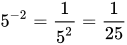
![{\displaystyle {\sqrt[{-3}]{8}}={\frac {1}{\sqrt[{3}]{8}}}={\frac {1}{2}}}](https://wikimedia.org/api/rest_v1/media/math/render/svg/0763794040d9f447ac590579c91ec783f31ad385)
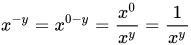
- This explanation is not clear, therefore not suitable for Wikipedia. Rick Norwood (talk) 10:54, 1 October 2022 (UTC)
- Beyond language issues, the approach of the presentation is not easy enough, and this should not go in. Additionally, I don't think a section on powers and roots should be added to the article, as that is more advanced than appropriate for the fully-spelled-out type of explanation of arithmetic operations being presented. The arithmetic descriptions are for readers who need basic description for basic operations as an introduction or as a refresher. Using powers and roots is a level beyond the basic operations, and is not appropriate for the article, especially since it raises even further complications such as complex numbers. ---R. S. Shaw (talk) 19:36, 1 October 2022 (UTC)
Diophantus, Hellenistic?
"In Hellenistic Egypt, the Greek mathematician Diophantus in the 3rd century AD…" But the pages Hellenistic period and Ptolemaic Kingdom both agree that this period ends by 30 or 31 BC, three centuries before Diophantus. I am not enough of an historian and not sufficiently fluent in English to change this. Sorry to leave this to others. --Dominique Meeùs (talk) 10:37, 22 January 2023 (UTC)
- I am also not enough of an expert to feel confident about the precise terminology used by historians. But this was Roman Egypt, part of the Roman Empire but with local people speaking Egyptian or Greek. The literate mathematicians of the day were all writing in Greek (indeed my understanding is that most mathematical writing throughout the Roman Empire was in Greek). To quote that Roman Egypt article,
"The division between the rural life of the villages, where the Egyptian language was spoken, and the metropolis, where the citizens spoke Koine Greek and frequented the Hellenistic gymnasia, was the most significant cultural division in Roman Egypt, and was not dissolved by the Constitutio Antoniniana of 212, which made all free Egyptians Roman citizens.There was considerable social mobility however, accompanying mass urbanization, and participation in the monetized economy and literacy in Greek by the peasant population was widespread."
–jacobolus (t) 05:58, 23 January 2023 (UTC)
Negative numbers
More confusion about negative numbers, which I've had to revert twice. The edit I have twice reverted says "In mathematics, a negative number represents the opposite of a number." The confusion in this is between the idea of "the opposite of a number" and "a number with an opposite value". If something is the opposite of a number, it is clearly not a number at all. A negative number is a number. It is a number whose value is the opposite of the value of a positive number, so when we add a negative and a positive number with the same absolute value, the sum is zero, the additive identity. It is absurd to say that the number that is negative is the "opposite of a number". The two numbers are opposites of each other, just as a left hand and a right hand are opposites of each other. To say that a left hand is the opposite of a hand would be absurd. Rick Norwood (talk) 10:31, 12 September 2023 (UTC)
- I wonder what other sources we can find with clear accessible definitions / explanations. I don't think the current "a negative number represents an opposite" is really the most obvious either. Maybe something like "In mathematics, a negative number represents the opposite of a positive number; together the two numbers sum to zero. ..." –jacobolus (t) 15:34, 12 September 2023 (UTC)
"Minus number" listed at Redirects for discussion
 The redirect Minus number has been listed at redirects for discussion to determine whether its use and function meets the redirect guidelines. Readers of this page are welcome to comment on this redirect at Wikipedia:Redirects for discussion/Log/2026 May 2 § Minus number until a consensus is reached. SomeRailfan (talk) 16:28, 2 May 2026 (UTC)
Content Disclaimer
Informasi ini disarikan dari Wikipedia dan disajikan kembali untuk tujuan edukasi. Konten tersedia di bawah lisensi CC BY-SA 3.0. Kami tidak bertanggung jawab atas ketidakakuratan data yang bersumber dari kontribusi publik tersebut.
- The information displayed on this website is sourced in part or in whole from Wikipedia and has been adapted for the purpose of restating it. We strive to provide accurate and relevant information, however:
- There is no guarantee of absolute accuracy. Wikipedia is an open, collaborative project that can be edited by anyone, so information is subject to change.
- It is not intended to constitute professional advice. The content displayed is for informational and educational purposes only. For important decisions (e.g., medical, legal, or financial), please consult a professional.
- Content copyright. Wikipedia is licensed under the Creative Commons Attribution-ShareAlike License (CC BY-SA). This means that content may be reused with appropriate attribution and shared under a similar license.
- Responsible use. Any risk arising from the use of information from this website is entirely the responsibility of the user.