Talk:Modular arithmetic

| This is the talk page for discussing improvements to the Modular arithmetic article. This is not a forum for general discussion of the subject of the article. |
Article policies
|
| Find sources: Google (books · news · scholar · free images · WP refs) · FENS · JSTOR · TWL |
Archives (index): 1, 2Auto-archiving period: 12 months  |
 | This  level-4 vital article is rated C-class on Wikipedia's content assessment scale. level-4 vital article is rated C-class on Wikipedia's content assessment scale.It is of interest to the following WikiProjects: | ||||||||||
| |||||||||||


Recently reverted text insertion
Hopefully, the following I added won't be reversed and deleted in future. If k a ≡ k b (mod n), then a ≡ b (mod n/gcd(k,n)). Particularly, k is coprime with n, then gcd(k, n) = 1, and so a ≡ b (mod n).
Example 1. and , and so --Karho.Yau (talk) 15:56, 24 March 2022 (UTC)


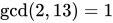

- This was reverted because it is too complicated to be useful in this article. In fact, it is too complicated for most people to verify. If you want to reinsert it, then first discuss it here and demonstrate why it is important.—Anita5192 (talk) 16:04, 24 March 2022 (UTC)
Primary topic discussion in progress for Modulo (disambiguation)
Hi all! I have started a discussion for the primary topic of Modulo (disambiguation), under the guise of a requested move, at Talk:Modulo (mathematics)#Requested move 28 December 2022. I don't propose to directly affect this page, but this page is listed upon that disambiguation page. Please visit the discussion there and contribute! Thanks —WT79 (speak to | editing analysis | edit list) 16:08, 28 December 2022 (UTC)
Does the glyph for congruence about a modulus have a name?
If not, I personally propose the “Threequals.” 2001:56A:FCFE:E200:C4EB:EB76:3964:B88F (talk) 07:51, 2 December 2023 (UTC)
- Yes. The symbol is called the triple bar.—Anita5192 (talk) 13:57, 2 December 2023 (UTC)
- Stupid name. Threequals is way better. 2001:56A:FCFE:E200:C09:49E7:BAD5:1973 (talk) 21:01, 2 December 2023 (UTC)
- Some use "equivalent to," although I suppose this may be colloquial in usage. 67.170.223.108 (talk) 06:27, 15 April 2024 (UTC)
- Stupid name. Threequals is way better. 2001:56A:FCFE:E200:C09:49E7:BAD5:1973 (talk) 21:01, 2 December 2023 (UTC)
user:D.Lazard rejects modulus 1
user:D.Lazard rejects the modulus 1 with the argument: "1 is never used as a modulus, and extending the definition to would make nonsensical some of the listed basic properties listed below".
I agree that the change does not carry much of a fluidum. But it is correct and even useful at least e.g. for certain generic theorems.
And I could not find one(¬1) basic property listed in the article which becomes nonsensical. I asked him to show me one, if not all, of the listed basic properties which become nonsensical.
However, I would add a statement to the paragraph "Integers modulo n" telling that

is the 1-elementic trivial group.
Nomen4Omen (talk) 08:25, 4 February 2024 (UTC)
- Nomen4Omen changed into in the definition given in the first line of § Congruence, with the edit summary "the trivial modulus 1 is anyway a modulus". This sounds as WP:OR as no evidence is provided that 1 is considered as a possible modulus in standard textbooks. Also, such a change requires to verify that all properties listed in the article remain correct after the change. This has clearly not been done, as one of the properties begins with "If c ≡ d (mod φ(n)), where φ is Euler's totient function, ...". This sentence is wrong with both definitions, as it implies a congruence modulo 1 when n = 2 and modulo 0 when n = 1.


Another terrible mistake of D.Lazard: φ(1) = 1 (and ≠ 0, see Euler's totient function)
- So the change does not improve the article, although the first line of the section requires some attention.
- As congruences modulo 0 and 1 are commonly considered (even in this article), it seems that 0 and 1 are rarely considered as moduli. So I suggest to change the beginning of the section into
Given a nonnegative integer n, two integers a and b are said to be congruent modulo n, if there is an integer k such that a ≡ b (mod n). This is denoted a ≡ b (mod n). If n > 1, it is called a modulus.
- Clearly, such a change would require an update of the article for testing when n < 2 must be explicitly excluded. (This is implicily excluded when n is supposed to be prime or composite.)
- By the way, the integers modulo 1 are more than the "1-elementic trivial group". They form the zero ring. I'll ass this to the article. D.Lazard (talk) 11:26, 4 February 2024 (UTC)
- Two sources cited in the article define congruence for n any positive integer.[1][2]—Anita5192 (talk) 16:20, 4 February 2024 (UTC)
- I agree that congruences may and should be defined modulo any nonnegative integer, but this does implies that 0 and 1 may be called moduli. This is the motivation of the above suggested formulation. D.Lazard (talk) 19:24, 4 February 2024 (UTC)
- User:D.Lazard mixes up "0 and 1" as moduli — and does not realize that 0 really never is a modulus, whereas 1 may happen to be. -Nomen4Omen (talk) 10:22, 5 February 2024 (UTC)
- WP:personal attacks about my supposed understanding of mathematics are not an argument in this discussion. On the opposite, they weaken your position. Please remove them. If you remove the preceding post I would agree that you remove also my answer. D.Lazard (talk) 18:50, 5 February 2024 (UTC)
- Clearer — and critics wrt. User:D.Lazard's emotions removed. -Nomen4Omen (talk) 19:13, 5 February 2024 (UTC)
- WP:personal attacks about my supposed understanding of mathematics are not an argument in this discussion. On the opposite, they weaken your position. Please remove them. If you remove the preceding post I would agree that you remove also my answer. D.Lazard (talk) 18:50, 5 February 2024 (UTC)
- User:D.Lazard mixes up "0 and 1" as moduli — and does not realize that 0 really never is a modulus, whereas 1 may happen to be. -Nomen4Omen (talk) 10:22, 5 February 2024 (UTC)
- I agree that congruences may and should be defined modulo any nonnegative integer, but this does implies that 0 and 1 may be called moduli. This is the motivation of the above suggested formulation. D.Lazard (talk) 19:24, 4 February 2024 (UTC)
- Two sources cited in the article define congruence for n any positive integer.[1][2]—Anita5192 (talk) 16:20, 4 February 2024 (UTC)
References
- ^ Long, Calvin T. (1972). Elementary Introduction to Number Theory (2nd ed.). Lexington: D. C. Heath and Company. p. 76. LCCN 77171950.
- ^ Pettofrezzo, Anthony J.; Byrkit, Donald R. (1970). Elements of Number Theory. Englewood Cliffs: Prentice Hall. p. 87. ISBN 9780132683005. LCCN 71081766.
Disambiguation with Modulo
@D.Lazard, The purpose of the hatnote {{About}} is to clearly distinguish between closely-related articles so the reader knows where to go, not to perfectly define the topic of the article.
The current definition "about computation modulo a fixed integer" does not clearly distinguish the articles. First, "modulo" is not a common-language word outside of mathematics. Second, both articles are meaningfully about computation.
The clearest difference between these two at a glance is either (a) that one involves an equivalence relation, while the other is a function, or (b) the notation used: "a (mod m)" or "mod(a,m)"
Unless you or someone else has a better idea, the "about" hatnote should be reverted back to one of these. But in any case, the current description is not helpful to the average reader and needs to be changed. Farkle Griffen (talk) 22:39, 18 December 2024 (UTC)
"Residue class" listed at Redirects for discussion
 The redirect Residue class has been listed at redirects for discussion to determine whether its use and function meets the redirect guidelines. Readers of this page are welcome to comment on this redirect at Wikipedia:Redirects for discussion/Log/2025 January 22 § Residue class until a consensus is reached. 1234qwer1234qwer4 23:20, 22 January 2025 (UTC)
Misleading discussion in the lead
I think the lead should be rewritten, because at present it is misleading. The operations are the usual operations of arithmetic. What is different is the equivalence relation congruence instead of equality. To say that the operations are not the usual operations is incorrect. To say that numbers "wrap around" is misleading.—Anita5192 (talk) 22:56, 19 March 2025 (UTC)
- I also think that the lead should be adjusted. Presently it is too simplistic. It should be mentioned that the congruence is congruence or equivalence in remainder of division. 109.166.136.27 (talk) 23:25, 21 March 2025 (UTC)
- The congruence is similar to the equality of two expressions. If unknown operands are present in one side of the congruence, the congruence is also an equation. Similarly the equivalence of boolean propositional expressions is part of boolean equations, where the unknown is the truth value of propositions. Thus not only equality is involved in equations. 109.166.136.27 (talk) 23:38, 21 March 2025 (UTC)
- A congruence is not an equality. Otherwise we would not call it a congruence; we would call it an equality.
- And this article is not about boolean propositional expressions.—Anita5192 (talk) 23:44, 21 March 2025 (UTC)
- Doesn't have to be an equality to form an equation. If unknown operands are present, then it is an equation. 109.166.136.27 (talk) 23:57, 21 March 2025 (UTC)
- Unknown operands can appear in modular addition and multiplication. Finding them is equation solving. 109.166.136.27 (talk) 23:58, 21 March 2025 (UTC)
- Unknowns do not make a congruence an equation. "Equation" implies "equality."—Anita5192 (talk) 00:51, 22 March 2025 (UTC)
- Unknowns are the essential ingredient of equations. The term is equation solving for finding unknowns in any equations, either based on equality or on congruence/equivalence (having triple bar as symbol). 109.166.136.27 (talk) 07:47, 23 March 2025 (UTC)
- Unknowns do not make a congruence an equation. "Equation" implies "equality."—Anita5192 (talk) 00:51, 22 March 2025 (UTC)
- A congruence can be thought of as an equivalence relation between numbers, in which case the operations are the usual operations of arithmetic and the congruence is not an equation. Alternatively a congruence can be thought of as a relation between equivalence classes of numbers, in which case the operations are not the usual operations of arithmetic and the congruence is an equation. Number theorists tend to see it in the former way, while algebraists often take the latter view. Neither is objectively wrong. JBW (talk) 01:04, 31 July 2025 (UTC)
Residue definition
The term "residue" is nowhere defined in the current article. The word is used as if the reader already understands it.
A brief definition (e.g. the residue mod n of a number is the remainder when the number is divided by n i.e. it is the value of that number mod n) would be helpful to the lay reader. Mr. Swordfish (talk) 00:12, 27 April 2025 (UTC)
- Residue and residue class are both defined in the Congruence classes section.—Anita5192 (talk) 03:46, 27 April 2025 (UTC)
- Ok, I see it now. It's kinda buried and is the seventh instance of the term "residue" in the article. Seems to me that either moving it up in the article to come before other usage or starting the section of Residue classes with the definition would be an improvement.
- I came to the article via re-direct to the Residue classes section and had to look around to see what was being discussed.
- The current definition in the article:
- Consequently, (a mod m) denotes generally the unique integer r such that 0 ≤ r < m and r ≡ a (mod m); it is called the residue of a modulo m.
- is perfectly readable if you are used to reading math but introduces too many variables to be easily understood if you are not. The short description at the disambigulation page Residue is a bit brief, but understandable by most readers:
- A remainder in modular arithmetic
- I'm not wed to my suggested definition above, but something similar would help the article be more readable to the lay audience, i.e.
- the residue mod n of a number is the remainder when the number is divided by n i.e. it is the value of that number mod n
- That is, a simpler definition that's featured more prominently would improve the article. Mr. Swordfish (talk) 13:27, 27 April 2025 (UTC)
Claim about Gauss
I'm a big fan of Gauss, and the claim may be true that "modular arithmetic was developed by Carl Friedrich Gauss in his book Disquisitiones Arithmeticae" but this needs to be cited. LaurentianShield (talk) 02:07, 18 January 2026 (UTC)
Congruence example
Current text states:
In modulus 12, one can assert that:
38 ≡ 14 (mod 12) because the difference is 38 − 14 = 24 = 2 × 12, a multiple of 12. Equivalently, 38 and 14 have the same remainder 2 when divided by 12.
I think this is incorrect because 14 is larger than 12. I suggest this should be rewritten as follows: 38 ≡ 2 (mod 12) because the difference is 38 − 2 = 36 = 3 × 12, a multiple of 12. Equivalently, 38 and 2 have the same remainder 2 when divided by 12. ~2026-34741-68 (talk) 12:33, 24 June 2026 (UTC)
- In "38 ≡ 14 (mod 12)", this is to the congruence sign that (mod 12) applies. You are confusing this notation with "38 mod 12 = 14 mod 12 = 2. Incorrect formula would be 38 ≡ (14 mod 12) and 38 = (14 mod 12). D.Lazard (talk) 14:24, 24 June 2026 (UTC)
Content Disclaimer
Informasi ini disarikan dari Wikipedia dan disajikan kembali untuk tujuan edukasi. Konten tersedia di bawah lisensi CC BY-SA 3.0. Kami tidak bertanggung jawab atas ketidakakuratan data yang bersumber dari kontribusi publik tersebut.
- The information displayed on this website is sourced in part or in whole from Wikipedia and has been adapted for the purpose of restating it. We strive to provide accurate and relevant information, however:
- There is no guarantee of absolute accuracy. Wikipedia is an open, collaborative project that can be edited by anyone, so information is subject to change.
- It is not intended to constitute professional advice. The content displayed is for informational and educational purposes only. For important decisions (e.g., medical, legal, or financial), please consult a professional.
- Content copyright. Wikipedia is licensed under the Creative Commons Attribution-ShareAlike License (CC BY-SA). This means that content may be reused with appropriate attribution and shared under a similar license.
- Responsible use. Any risk arising from the use of information from this website is entirely the responsibility of the user.