Talk:Information
JA: I ran into some problem in trying to dis-equivocate a number of the terms in the first paragraph. Somebody redirected mental stimulus to cognition, which i

| This is the talk page for discussing improvements to the Information article. This is not a forum for general discussion of the subject of the article. |
Article policies
|
| Find sources: Google (books · news · scholar · free images · WP refs) · FENS · JSTOR · TWL |
| Archives: 1 |
 | This  level-3 vital article is rated C-class on Wikipedia's content assessment scale. level-3 vital article is rated C-class on Wikipedia's content assessment scale.It is of interest to the following WikiProjects: | |||||||||||||||||||||||||||||||||||||||||
| ||||||||||||||||||||||||||||||||||||||||||


 | This article is substantially duplicated in one or more external publications. Since these publication(s) copied Wikipedia, rather than the reverse, please do not flag this article as a copyright violation of the following source:
|
Introduction
JA: I ran into some problem in trying to dis-equivocate a number of the terms in the first paragraph. Somebody redirected mental stimulus to cognition, which is too broad for what's intended there -- rather than list the whole panoply from sensation to perception to cognition, I just took a sample out of the middle, and dabbed to stimulation to cover the raw stimulus aspect, for now. And representation gives a disambig page, the closest of which items would ordinarily be knowledge representation, but that page as currently written is a bit too specific to library science. I will work on a more generic representation article as a separate issue. Jon Awbrey 14:46, 17 January 2006 (UTC)
The lead paragraph was very good up until mid January 2011 (actually April 18, 2013). What happened? Is someone trying to redefine information? Information is not a medium of communication. It is not the communication or understanding of a message. It is not the meaning of a message. It is simply symbols and the relationship between the symbols that make up information. See the symbols page. It defines a symbol as a piece of information recognized by association, resemblance, or convention. Information is made of symbols. Why does that need to be made more difficult than it is? Claude Shannon measured information. He did not measure the medium or the methods or the meaning. He measured the amount of information as a pure quantity. Everything that has been added to the lead paragraph and this article in general in the last two months should be considered for its own Wikipedia page. It appears to be very interesting, but it is not about information it is more about the interpretation of information, the meaning conveyed by the information. —Preceding unsigned comment added by 97.65.82.66 (talk) 22:14, 10 March 2011 (UTC)
- I strongly disagree. The first sentence of this article as it stands now (March, 2013) is fundamentally wrong, and should be fixed as soon as possible! A sequence of bytes or whatever other specific material form used to represent information is not information: it is data. Information is the interpretation of the data: it is the meaning of a message (or of data, in general), not the message itself. The same sequence of bytes can contains completely different information, and the same information can be conveyed by completely different sequences of bytes. Various specialized uses of the term information exist; for instance, in Shannon-style information theory, the term is used as a shorthand for measure of the amount of information that data may contain, but the distinction between information and data is fundamental. Rp (talk) 09:46, 20 March 2013 (UTC)
- I agree that the first sentence still seems wrong (information is that from which data can be derived)--and also creates a tautology: the link to data leads to a statement that data is that from which information can be derived. 207.157.94.123 (talk) 15:55, 8 October 2014 (UTC)
Thanks Edeani (talk) 23:32, 5 December 2018 (UTC)
The controversial claims of Roy Frieden
I am concerned about edits related to the controversial claims of B. Roy Frieden (Prof. Em. of Optical Sciences at the University of Arizona). As an anon, he has edited this and other articles as the data.optics.arizona.edu anon:
- 150.135.248.180 (talk · contribs)
- 16 June 2006 states controversial claims as established fact in Extreme physical information
- 16 June 2006 adds "Physics actually derives out of information, through the principle of Extreme physical information " to Information.
- 6 June 2006: adds cites of his papers to Extreme physical information
- 23 May 2006 adds uncritical description of his own work in Lagrangian and uncritically cites his own controversial book
- 20 May 2005 confesses IRL identity
- 22 October 2004 attributes the uncertainty principle to the Cramer-Rao inequality, which is potentially misleading
- 21 October 2004 adds uncritical mention of his controversial claim that the Maxwell-Boltzmann distribution can be obtained via his "method"
- 21 October 2004 adds uncritical mention of his controversial claim that the Klein-Gordon equation can be "derived" via his "method"
- 150.135.248.126 (talk · contribs)
- 9 September 2004 adds uncritical description of his work to Fisher information
- 8 September 2004 adds uncritical description of his highly dubious claim that EPI is a general approach to physics to Physical information
- 16 August 2004 confesses IRL identity
- 13 August 2004 creates uncritical account of his work in new article, Extreme physical information
- 11 August 2004 creates his own wikibiostub, B Roy Frieden
It is important that mention of Frieden's work in the WP clarify that his claims are by no means universally accepted by his peers. I am very disturbed that he is stating his claims as established fact, when they are actually by no means universally accepted:
- Binder, Philippe M. (2000). "Physics from Fisher Information: A Unification (a review)". American Journal of Physics. 68: 1064–1065. (favorable)
- Kibble, T. W. B. (1999). "Physics from Fisher Information: A Unification (a review)". Contemporary Physics. 40: 1999. (the reviewer has some positive comments but concludes that Frieden's work is "misguided")
- Case, James (2000). "An Unexpected Union---Physics and Fisher Information". SIAM News. July 17. eprint (highly favorable)
- Matthews, Robert (1999). "Physics and Fisher Information (a review)". New Scientist. January. unauthorized electronic reprint
- Physics from Fisher Information: A Unification (a review) from Cosma Shalizi (Computer Science, University of Michigan) (highly critical)
- Physics from Fisher Information (a review) from R. F. Streater (Mathematics, Kings College, London) (highly critical)
- Physics from Fisher Information thread from sci.physics.research, May 1999 (mostly critical)
- Fisher Information - Frieden unification Of Physics thread from sci.physics.research, October 1999 (mostly critical)
---CH 07:11, 19 June 2006 (UTC)
Comments
In the section "Information as a message", the second paragraph states the following,
...in requiring the existence of a definite sender, the "information as a message" model does not attach any significance to the idea that information is something that can be extracted from an environment, e.g., through observation, reading or measurement.
This statement is misleading in its implication of a "sender" as being separate from the environment. The concept of a "sender" or "source" has no specification to who or what is sending or supplying information. Therefore, the implication of the above statement is unjustified and thus leads to an inconsistency. This statement should either be clarified or revised. JAT, 30 July 2006 —The preceding unsigned comment was added by 128.227.13.162 (talk • contribs) 21:04, July 30, 2006 (UTC)
This image is no good?
Sorry, I thought that this was a novel idea for an image for the "information," article? I added it and somebody reverted it. If the general consensus is that it's a bad idea, I'll have the iamge deleted, but I thought I'd just ask, as I think articles without images are ugly. Robocracy 06:57, 21 November 2006 (UTC)

- What does 'The word, "Wikipedia", in binary' mean? I'm guessing that it's the binary representation of the ASCII codes for "Wikipedia", but it makes no sense as it is (and I don't think that the commas belong there either). --66.81.125.112 21:37, 22 December 2006 (UTC)
- In addition to agreeing with the previous comment, the gradient is a little annoying. Understandably, one would like to have a little stylistic flair, but the rendering in this image clearly draws too much attention to itself and merits at least a change to be a little more subdued. dr.ef.tymac 16:47, 6 February 2007 (UTC)
- i came to this talk page precisely to see if there was a discussion on the picture, as i am not in favor of it being here. I looked at the article's contents to see if it could be moved down from the top of the page, but couldn't find any suitable spot. So, i say: remove. --Jerome Potts (talk) 23:34, 21 November 2007 (UTC)
- No comment on whether or not the picture should be in the article, I leave that to others to decide. However, I have edited the image because it is incorrect. ASCII is properly a seven-bit code, whereas the previous image showed eight bits. If you want to show eight bits you can't call it ASCII. ASCII data is commonly stored on computers in eight bits because seven is just way too inconvenient. Originally the eighth bit was used to store the parity bit, used for error checking, but the internet has its own system (IP) for doing this and the parity bit is no longer needed and can be used for other purposes. Codes which make use of the eighth bit to code additional characters are generally known as extended ASCII but there are several versions of this. Not sure I fully understand the comments above on the style of the image. If you explain to me what you want done I can probably help. SpinningSpark 10:13, 4 June 2009 (UTC)

- I came here to ask what possible value the following image could have. "Information embedded in an abstract mathematical object with symmetry breaking nucleus." I'll be honest, when I saw that image, I came here to try to figure out if it was vandalism of some videogame that someone managed to sneak in here. There's no link to the article, or to another article explaining it. There's no part of the article that points to it. I googled the caption, and I can't find anything sensible. As near as I can tell, this is just a meaningless picture someone thought was cool, and managed to write a misleading caption for. If I'm wrong, please someone provide some more details, or a link to an appropriate article that explains it, so that someone who sees that can actually learn something useful from it. If not, please get rid of it.
- Six years later - agreed; I've removed that image. Omphalographer (talk) 00:50, 20 April 2025 (UTC)
Standard definition of Information from ISO
Wiener information definition counter: The information is the information, the information is the material, the energy, the information and the attribute indication (identification).
Counter Shannon information definition: The information is definite increase —Preceding unsigned comment added by 124.254.23.217 (talk) 05:02, 1 October 2008 (UTC)
From ISO TR-9007 from 1983 and 1986
Definition of Information: Any kind of knowledge about things, facts, concepts, etc. of a universe of dis-course that is exchangeable among users. Although exchangeable information necessarily will have a representation form to make it communicable, it is the interpretation of this representation (the meaning ) that is relevant in the first place.
I do not see this definition on this page and would like to introduce it.
Steven van 't Veld
[email protected] —The preceding unsigned comment was added by 80.61.45.38 (talk) 00:23, 24 January 2007 (UTC).
I would go further back to look for a definition... "Information is the minimum required by the user to make a decision, it is the result of a structured query on data" One mans data is another mans information and vice versa, data is produced constantly but it is in the user and the questions the user asks that it becomes information... 87.102.44.114 02:06, 5 February 2007 (UTC)
- This is not definition, it is just handwaving. ISO, a body of engineers, is incompetent in such a basic scientific topic as the definition of information. Information should be rigorously defined by the SI comitte, either as an abstract construct, like the seconds of time derive from the speed of light or as an artifact, like the platinum master kilogramm kept under glass cage in Paris.
- As long as you fail to show me the SI "master etalon" of information, I dare to say infomation does not exist per se or maybe it is just our cloudly commodity perception of multiple phenomena, which we cannot yet differentiate due to the weakness of human senses. 91.83.17.127 (talk) 22:03, 22 June 2008 (UTC)
- Nonsense. If that first really is an ISO defintion, and it's sourced, it should be in the article. If it's just commentary on some other topic, it probably shouldn't be in the article. I'd need to look at the reference to be sure. — Arthur Rubin (talk) 06:38, 23 June 2008 (UTC)
Major Cleanup
I see quite a few problems with this article, quick example:
If you accept that information can be defined merely as a pattern, does it not follow that neither utility nor meaning are necessary components of information? Surely a distinction must be made between raw unprocessed data and information which possesses utility, value or some quantum of meaning. Information may indeed be characterised as a pattern; it is a necessary condition, but not sufficient.
The first part has a triple negative and makes no sense. That aside, information as a pattern has nothing to do with utility. Information doesn't require utility. Also, what is "a quantum of meaning" anyway?
Information can be a tough article, but we can do it. 76.23.14.222 08:22, 9 April 2007 (UTC)
To me it appears that information more than merely a pattern. Wshen we write "Tree" the writing is merely a pattern. The pattern will differ for different laguages but the information is the same.Obviously a code of translation is required for converting a pattern into information. Ultimately information can only reside as pattern (coupled with a translation code) in the four dimentional wosrld we know of. Where exactly information resides is a mystery. (ambi 15:28, 24 July 2007 (UTC))induvasan
Additional Information Concepts
There are some physics concepts related to information that might be worth some evaluation and consideration for this page.
- Claude Shannon said that we can know (have information about) the past but we cannot control (influence change on) it and we can control the future but we cannot know it.
- Information Entropy is the negative of Thermodynamic Entropy. As Information Entropy decreases Thermodynamic Entropy increases.
- The force for (Physical) change is (Physical) information.
- The amount of information transferred in a physical interaction is quantized (a whole number). —Preceding unsigned comment added by 97.65.82.66 (talk) 19:17, 11 March 2011 (UTC)
- The information that can be known about a given volume of space-time is directly proportional to the surface area of a space-time sphere of the same volume.
- As we get farther away from a past event the amount of information that can be known about that event decreases.
—Preceding unsigned comment added by 74.96.166.191 (talk) 01:06, 11 March 2011 (UTC)
Unreferenced article
This article appears to be based on an unreferenced entry by User: Tomos at 12:01, 22 March 2003. [1]
It is still unreferenced! Please discuss.
--Andrewrutherford 13:01, 18 August 2007 (UTC)
New article request
Hi there, I'd like to suggest a new article on the full history of information handling/management/techonology (details). I'm not knowledgeable enough to do it myself, but contributors here probably are. Thanks, JackyR | Talk 18:04, 4 December 2007 (UTC)
information precision
inverse Shannon’s information definition: information is increase of determinacy.
Wiener information definition counter: The information is the information, the information is the material, the energy, the information and the attribute indication . Deng‘s definations.
information precision should be defined in this article. I hope that someone can do so. Jackzhp (talk) 18:58, 13 January 2008 (UTC)
I would like to add a definition that information is work done on matter by energy. Examples abound in biochemistry. Anabolic chemical reaction require energy to build complex molecule (like protein enzymes from amino acids). Enzyme systems are thus built up during growth and development. These systems contain large amounts of information that provide function. During atrophy or severe illness, these molecules and information can be broken down, releasing energy for heat or use by ATP systems. The thermodynamis (calories in/calories out) have been well worked out. To argue that this information is work is thus supported by thermodynamic consideration.
The rejection of this addition on grounds that it sounds like intelligent design failed to understand this biochemistry as science (verifiable by empiric methods) and instead supposed it is religous in nature. I have no such intent. I consider the formation of matter into shapes and functions that provide information part of natural (not supernatural) evolution. Khobler (talk) 02:48, 17 August 2008 (UTC)
- We need a source for the information that that particular structuring is called information, as it's not quite the same as other definitions. I am sorry about the Intelligent Design reference, but the concept of "conservation of information" applied to irreducible complexity is exactly the ID argument.
- Also, what you wrote seems confused as to whether the "information" is complexity or energy density. It is not necessarily the case that more complex structures have more stored energy. — Arthur Rubin (talk) 03:16, 17 August 2008 (UTC)
Thanks. Apology accepted...I see your point. I'll have to dig up a reference for Ludwig Boltzmann's often quoted statement that entropy is the opposite of information. I am suggesting a definition of information in the physcical universe as properties (color, shape, etc.,) and functions evident from various formations of matter shaped by energy (Big Bang and since). Some of this will have meaning and usefullness to humans, but that is irrelevant to the idea that this information and function is in the physical world. In that sense, complexity can be related to information as implied by Boltzmann. Khobler (talk) 13:24, 17 August 2008 (UTC)
Bias and/or lack of sources in "Information as an influence which leads to a transformation"
Some people argue that the fact that DNA records meaningful information means life must have come about because of a conscious mind, the exact opposite statement of what this article says —Preceding unsigned comment added by 75.11.13.28 (talk) 18:17, 9 September 2008 (UTC)
Information Booth
An editor used the term "information booth" on another Wiki page. Perhaps this term should somehow be included?--MurderWatcher1 (talk) 17:36, 18 December 2008 (UTC)
What is Information?
Dear all,
This article reflects general confusion about what is information. Although this page should not be used to discuss the topic, we have to reach a sort of agreement to start cleaning up the mess the article is currently in.
First of all, Wiener changed the sign in Shannon’s equations turning information entropy into information. Consequently, we have the whole industry and quite a multitude talking about “information” rather than patterns. And the fact is that our machines work with patterns without a meaning. And humans need to tell to the machine how to interpret a pattern. If a programmer makes a mistake and interprets “abcd” string as 32 bit integer, for example, the program will spit out a lot of nonsense. In short, “gqvklurx” that would be “highly informative” in IT cannot be considered seriously when we are trying to explain what is information. I think that all of IT related uses of term information need to be disambiguated with this pointed out.
That said, each pattern is potential information. However, if we cannot assign a meaning to a pattern, it remains what it was - a pattern. For example, Etruscan inscriptions are definitely patterns, but they do not give us a clue what they say. Etruscan inscriptions did mean something to Etruscans long time ago, but they mean nothing to us. And the meaning is not like a bird sitting on a branch waiting for us to catch it.
Kolmogorov did an excellent effort to mathematically describe (the impact of) information, although he was mostly looking at patterns (bit-strings). His major premise was that information shortens bit-strings required to describe something, so he was looking at mathematical ways that shorten bit-strings.
This “shortening” is at the core of information. Patterns with meanings about something we already know are not informative. Patterns with meanings we do not know and that do not impact other stuff we already know are of little, if any, informative value. Only patterns with meanings that challenge stuff we already know can be informative.
Only a pattern with a meaning that tells us that the sun doesn’t go around earth, but rather other way around can be informative. Ptolemaic system could have been made to work even today, but Copernicus, Galileo and Kepler made things much simpler, i.e. shorter.
I hope that we can reach an agreement here.
Kind regards, Damir Ibrisimovic (talk) 01:32, 17 February 2009 (UTC)
- Dear all,
- I am glad that my intervention had an impact. The article is now in much better shape. However, I do think that there is a need for a segment or for few sentences in the “As Message” segment regarding Kolmogorov complexity. If in doubt, please contact folk who maintain Kolmogorov complexity article. This is important since there is no better math currently available re information. A link to the mentioned article would also be in order.
- Kind regards, Damir Ibrisimovic (talk) 09:09, 16 January 2010 (UTC)
Back to Basics - A Proposal
I see some good work on information to date, but I also see the aftermath of too many comment wars. Resulting scope is too broad and somewhat irregular. So let's attack it with an open mind, and get back to basics. My suggestions:
- open with a basic, plain-language defintion that is based on concepts of "representation" and "abstraction", intuitive enough for the vast majority of readers
- introduce data as a syn. of information
- introduce knowledge as a product of information plus context, citing T.Stewart (2001)
- introduce data relationships and metadata as a means by which information can be further described, possibly quoting Codd
- remove scientific/academia sections with refs to math, entropy, physics in favor of existing information theory posts, which already cover the material thoroughly
- keep entymology
- keep list of "related terms" but in a subsection - it's supporting, not primary
- condense discussion of patterns, messaging, records and sensory aspects into less scientific treatment, to make material more intuitive and accessible; would keep some scientific references in, but only where they can be wiki link'd elsewhere
- make obvious connections to the modern commercial workplace, linking to information technology and knowledge management practices
I'm not going to bite this off without a general mandate to proceed, as I see a risk of pushback. Just my two cents, but I think Wikipedia needs information to be a strong post. Let me know.
JonesC-NC (talk) 04:02, 9 April 2009 (UTC)
- Whatever we do, it should be based on sources; either follow the general development of a source or two, or lay out alternative meanings backed by alternative sources. It's not obvious whether the approach you describe above is based on sources, or whether it's your own organization based on your own conceptions. We've tried that approach already; it can't really make a lot of people happy, or survive the many different viewpoints that will warp it around if it's not tied down by sources. Dicklyon (talk) 04:24, 9 April 2009 (UTC)
- It would all be supported by sources; I guess you're saying anything posted that is coherent, well written and supported by sources has a chance of survival? If so, fair enough, let me see what I can come up with, maybe on an incremental basis (section at a time) JonesC-NC (talk) 13:33, 9 April 2009 (UTC)
- Yes, that's sort of what I'm saying; also, though, that it helps if the overall organization can be justified in terms of a source, when you're doing a major re-org. Not necessary, but can help. Dicklyon (talk) 14:46, 9 April 2009 (UTC)
Suggested definition of Information
Link: http://en.wikipedia.org/wiki/User:Faustnh/On_the_definition_of_Information --Faustnh (talk) 17:50, 21 April 2009 (UTC)
My Book
Information (edit | talk | history | protect | delete | links | watch | logs | views)
I am posting below the substance of a series of exchanges between me and your editors on the subject of listing my book, The Nature of Information, in the Further Reading section of the Wikipedia article on Information. I was advised to contact you. Would you please review this situation, and, if you deem it appropriate, list my book as requested in the Further Reading section of your article on Information.
Your consideration will be much appreciated.
Paul Young
If you would like to see a list of the scholarly references to this work, it can be found at "Google Scholar" by typing "The Nature of Information Paul Young". There are thirty-four references on four "Google Scholar" pages.Natureofinformation (talk) 19:52, 4 June 2009 (UTC)
"I recently listed my book, The Nature of Information (Greenwood Publishing Group, 1987) to the list of further reading on the Wikipedia "Information" page. I now find it has been deleted. This work has been cited as a major reference on information by a number of prominent scientists, not least of whom was physicist, John Archibald Wheeler. The complete list of references can be found in a Google Scholar search for "The Nature of Information by Paul Young". Can you please tell me why this reference was deleted, and if there is anything that can be done to reinstate it. This is a work that deserves to be on a page for further reading on the subject of Information.
I would appreciate any help you can be on this matter.
Sincerely,
Paul YoungNatureofinformation (talk) 19:37, 3 June 2009 (UTC)
- For a start I would change my username as it is against our username policy. You may request a username change at Wikipedia:Changing username. Not sure about the book and why it was removed someone will give you more info on that soon. BigDuncTalk 19:42, 3 June 2009 (UTC)
- your addition was removed (according to the user removing it) because you have a conflict of interest and it was interpreted as spam, if you wish to re-add your book please gain a consensus on the articles talk page: Talk:information. All the best SpitfireTally-ho! 19:45, 3 June 2009 (UTC)
I do not know what conflict of interest your editor is referring to, since it was not specified. All I am trying to do it add a legitimate reference to your article on Information, one that ought to be there. Your lack of specificity in this area makes it difficult for a contributor to know how to respond. I would argue that the Wikipedia Information page is itself fairly incomplete and lacking in significant references, so for some unknown editor to eliminate my listing without even giving me a clear reason for it is counterproductive to what Wikipedia is supposed to be. I can live without the reference; it's no big deal. But I say again that the book belongs on that list. Thank you for your consideration. Paul YoungNatureofinformation (talk) 20:13, 3 June 2009 (UTC) —Preceding unsigned comment added by Natureofinformation (talk • contribs) 20:10, 3 June 2009 (UTC)
- As suggested above, the best approach would be for you to go to the Talk:Information page and leave a comment there regarding your book and how it would benefit the article to have it included. Often, when a new editor arrives and immediately starts placing links into articles, it is a sign that the person in question is attempting to use Wikipedia for promotional purposes, which is not its role. There is also a clear conflict of interest policy that you should read - it will give you some useful information to avoid such issues. Again, drop by the article talk page, and discuss the insertion with editors there - if the consensus is that the inclusion is a benefit to the article, then it won't be a problem. Cheers. Tony Fox (arf!) 20:15, 3 June 2009 (UTC)
- I thought you might not understand what I meant, so I left links for your convenience, just click on the blue text in my above comment, thanks SpitfireTally-ho! 20:19, 3 June 2009 (UTC)
Thank you very much for your thoughtfulness, Mr. Fox; it is much appreciated. However, it is not worth all that trouble to me. I believe the book should be listed because it belongs there. I'm not willing to press the point, nor argue for its inclusion. I say with no arrogance intended that it is to the detriment of the Wikipedia article on Information that it will have failed to list one of the seminal works on the subject of the identity of information. Thanks again.Natureofinformation (talk) 20:30, 3 June 2009 (UTC)
- It is possible due to your username that it was deemed as spam a quick look at google books and it appears that it might warrent its addition but I make no judgement on it. BigDuncTalk 20:40, 3 June 2009 (UTC)
- Dear Mr. Young , please do not waste the time of the good people at this page with this drivel. Of course your link is spam and was quite rightly reverted. The second sentence of the linked page unequivocally states that the page is selling something, further down I read that "All major credit cards are accepted securely via PayPal". This is the very definition of spam. You waste the time of at least half a dozen volunteers who have reviewed you contribution and taken the trouble to reply to your complaints and then have the nerve to say "it is not worth all that trouble" when advised how you should proceed. There is no right to have sites listed in our external links, in fact the default position is not to put in a link unless there is a good reason, from the external links guideline we should not include,
- Any site that does not provide a unique resource beyond what the article would contain if it became a Featured article.
- That is, even if your site was not contravening the rules about promotion and payment it still would not be acceptable. In short, you are in contravention of multiple Wikipedia policies and guidelines including WP:COI, WP:SPAM, WP:EL and WP:UN. Please give it a rest before an administrator blocks you. SpinningSpark 21:10, 3 June 2009 (UTC)
I posted two links - one was a listing of the book in the Further Reading section. The other was in External Links, a link to the website that sells a paper that is a distillation of the book. I understand the reason for the link to the website being blocked, and have no problem with it. However, the listing for the book itself was nothing but a reference to the existence of the book and its publisher. There was no reason for this to be removed. They are two separate issues. Your inability to distinguish between the two listings demonstrates a poverty of intellect. And your arrogant, patronizing tone toward me does Wikipedia no credit. It is an excellent example of drivel. I say again, the Wikipedia article on Information lacks a reference to one of the seminal works in the field. Block away.Natureofinformation (talk) 21:53, 3 June 2009 (UTC) —Preceding unsigned comment added by Natureofinformation (talk • contribs) 21:49, 3 June 2009 (UTC)
- Mr.Young, please be civil, and stop the personal attacks. You have stated that your external link that you put in was inappropriate, and Spinningspark was addressing that. The reason that the listing was removed was probably because of your inappropriate external link, and the user who reverted it probably assumed that both additions were spam, and removed them accordingly.FingersOnRoids 22:16, 3 June 2009 (UTC)
It is astonishing that you would accuse me of personal attacks, when your previous editor referred to my request to have my book listed as drivel. Again, I say, the fact that your editors could not discriminate between the two listings I posted does Wikipedia no credit. I am not trying to sell Wikipedia anything. If you don't think my book belongs on the Further Reading list, don't list it. But attacking me and then accusing me of attacking you is sheer hypocrisy.Natureofinformation (talk) 22:23, 3 June 2009 (UTC)
- I have to agree about the unidirectional warning. But that is a distraction; let's not get bogged down with that. We all agree now the external link isn't appropriate. So all that's left is the addition in "Further Reading". If you do not want to pursue this, then I guess that's done too. If you change your mind, Tony Fox's advice above is spot on. I see you've visited WP:Changing username, and you've been given two (!) welcomes with some useful links. Seems we might be done here, except for a reminder to those who've been here a while to not bite the new editors. --Floquenbeam (talk) 22:57, 3 June 2009 (UTC)
- Yes. I think Spinningspark was a little hard and things easily escalate on the Internet. Natureofinformation only added the book to one article and didn't readd it when it was removed but came here to discuss instead. People are not blocked for that. And Natureofinformation requested a new user name right after being asked here, but it was rejected because the wanted name had already been taken. Some administrators can be quick to block promotional names so please make a new request. It's obvious to Wikipedia editors that a book author has a strong conflict of interest in Wikipedia's sense when adding their book to an article, but outsiders may fail to follow the link and not realize what Wikipedia means. They could for example think that the book itself was claimed to have been written with a conflict of interest. Note that Wikipedia has almost 3 million articles and the editors of Information who can be reached at Talk:Information are probably better suited to evaluate the book than the people who happen to see your posts here. If you still think the book should be added then I really suggest you bring it to Talk:Information. You are right there is a difference between the book itself and a website selling the book or something about it. A technical note: The article history [2] shows your website edit was automatically tagged as "possible conflict of interest" by our software. If an editor of the article sees that and confirms the tag is justified (which it was) then it's common to revert the whole edit(s) without spending time examining the details for salvageable parts which there are usually none of. Remember there are millions of articles and unfortunately a lot of people who add bad things to them. PrimeHunter (talk) 23:18, 3 June 2009 (UTC)
Primehunter - Your courtesy and thoughtfulness are much appreciated, as are your explanations. All I can say is that having my book listed as a reference in the Wikipedia article on Information, where I think it belongs, and will help enrich the reference potential of Wikipedia's article, has turned out to be a lot more trouble than I anticipated. I will contact Talk: Information. Many thanks for your help.Natureofinformation (talk) 19:41, 4 June 2009 (UTC)
Definition: definitely give up!
> Standard definition of Information from ISO TR-9007 from 1983 and 1986: Any kind of knowledge about things, facts, concepts, etc. of a universe of dis-course that is exchangeable among users. Although exchangeable information necessarily will have a representation form to make it communicable, it is the interpretation of this representation (the meaning ) that is relevant in the first place.
Information is apparently impossible to define, since any definition would be a piece of information itself and nothing can validly define self in science, a vicious cycle. (Contrast that with YHWH, who said "I am who I am" or "I am the one who exists", depending on the translation. To resolve the paradox, one could maybe suggest all material, energy and information that exists, i.e. the whole Universe is part of God.) 82.131.133.206 (talk) 22:28, 18 April 2011 (UTC)
links
I guess you guys know, but the recent link war was specifically about making "all first links on Wikipedia eventually lead to Philosophy". I found this as a circular reference, then noted that people were editing the heck out of it, trying to change the first link. This whole thing is gonna cost you guys some time, I'm afraid.. all over wikipedia..
- The insertion of finite into the lead in the xkcd related philosophy edit war is simply wrong. There is no reason that information cannot be an infinite sequence of symbols. Gamma2delta (talk) 14:51, 26 May 2011 (UTC)
- I'm not sure that's correct. An algorithm can produce an infinite string of symbols from a finite amount of information (e.g. PRINT SQRT(2)), but a sequence containing an infinite amount of information can't exist in reality. As a mental concept, sure, but a real one would violate conservation of energy (see Maxwell's Demon) Maniacmagee (talk) 14:43, 4 July 2011 (UTC)
- This is one of the things page protection is for. Too bad Randall Munroe is getting credit for the games currently afoot. They started before he mentioned this nonsense in his webcomic, but unfortunately that did give it more exposure to the lulz-wanking demographic. He seems to be a bright mature individual in some respects, but this isn't the first time he has trolled Wikipedia from his distant roost. __ Just plain Bill (talk) 16:28, 26 May 2011 (UTC)
definition
The lede has an incorrect definition of information. Shannon would define it as a change in entropy. That means any change in probabilities. He would say that a sequence of symbols can convey information, but the sequence itself is not the information. Nor is a sequence of symbols the only way to convey information. If you walk into a room, you immediately gain information about its temperature, by direct translation of that analog value into an analog firing rate of nerve cells in your skin, with no sequences of symbols involved. You can even respond to the temperature without ever translating into words or a sequence of symbols. Of course, it's possible to later translate the temperature into symbol sequences, but the information remains information whether you make that translation or not.
A technical definition: information is any change in a probability distribution due to observations, such that the sum or integral of (p log p) changes.
An informal definition: information is intangible ideas or concepts or knowledge or memes.
Either of those would be better than saying that "technically" it's a sequence of symbols, when no reliable source can be found that says that. — Preceding unsigned comment added by 109.171.137.221 (talk) 20:41, 28 May 2011 (UTC)
- Do you have a reference for these definitions? We don't do original research here. --Kvng (talk) 03:31, 31 May 2011 (UTC)
- The article starts "Information in its most restricted technical sense is an ordered sequence of symbols that record or transmit a message". That's original research. There are no dictionaries or textbooks that say that. Symbols can convey information, but no reliable source says the symbols themselves are the information, nor that symbols are the only way to convey information. It would be better if the original research were removed from the first sentence of this article.
- Unless you consider Wikipedia a reliable source :-) 97.65.82.66 (talk) 23:31, 18 February 2014 (UTC)
- The article starts "Information in its most restricted technical sense is an ordered sequence of symbols that record or transmit a message". That's original research. There are no dictionaries or textbooks that say that. Symbols can convey information, but no reliable source says the symbols themselves are the information, nor that symbols are the only way to convey information. It would be better if the original research were removed from the first sentence of this article.
- The technical definition above is what you'll find in every textbook on information theory: information is change in entropy, and entropy is the sum or integral of p log p. The informal definition is a summary of what dictionaries say. For example. The American Heritage Dictionary 4th edition gives 7 definitions, which are knowledge, facts, data, numerical measures of uncertainty, and a legal definition ("a formal accusation of a crime"). Merriam Webster 3rd Unabridged gives 8 definitions, which are knowledge, intelligence, something received through informing, news, advice, facts, figures, data, a signal, the process by which knowledge is impressed on the mind, propositions, a numerical measurement of uncertainty, plus legal, obsolete, and genetic definitions. Any of these sources would be preferable to the unsourced speculation that is currently in the first sentence of the article. — Preceding unsigned comment added by Bitonic (talk • contribs) 18:45, 1 June 2011 (UTC)
- A user above said that the definition from ISO TR-9007 is: Any kind of knowledge about things, facts, concepts, etc. of a universe of discourse that is exchangeable among users. All of these sources are describing the same concept. — Preceding unsigned comment added by 109.171.137.221 (talk • contribs) 19:06, 1 June 2011 (UTC)
- The technical definition above is what you'll find in every textbook on information theory: information is change in entropy, and entropy is the sum or integral of p log p. The informal definition is a summary of what dictionaries say. For example. The American Heritage Dictionary 4th edition gives 7 definitions, which are knowledge, facts, data, numerical measures of uncertainty, and a legal definition ("a formal accusation of a crime"). Merriam Webster 3rd Unabridged gives 8 definitions, which are knowledge, intelligence, something received through informing, news, advice, facts, figures, data, a signal, the process by which knowledge is impressed on the mind, propositions, a numerical measurement of uncertainty, plus legal, obsolete, and genetic definitions. Any of these sources would be preferable to the unsourced speculation that is currently in the first sentence of the article. — Preceding unsigned comment added by Bitonic (talk • contribs) 18:45, 1 June 2011 (UTC)
The definition references Bateson, specifically: "Gregory Bateson defines "information" as a "difference that makes a difference"." However according to this analysis from Birmingham University[1], he did not. This analysis concludes that Bateson, in the essay referenced in the current Wikipedia entry, applies the difference definition to "a bit of information" and later "the elementary unit of information", and explains why this difference (no pun intended) is critical. Psheld (talk) 08:14, 31 December 2015 (UTC)
References
- ^ Sloman A, Bateson did not define "information" as "a difference that makes a difference", 24 Jan 2011
Talking past each other, scope too broad
This is like writing an article about force or work. Information has a technical definition in computer science and information theory, but it also has other dictionary definitions and other connotations. Most of the disagreement and philosophizing here is simply a failure to agree what the article is about. In analogy to the WP treatment of work, I suggest we make an article called "Information (computer science)" and link searches for Information directly to the disambiguation page. This article could remain as a summary of the various uses of information, which it mostly is already.
Also, a note about the computer science definition: Information is in fact well defined, and the article (not to mention the talk page) is littered with original research and speculation. Information (cs) is defined in terms of the ability to distinguish among cases. This is equivalent to defining in terms of Shannon's entropy. Symbols or waves may or may not be needed to transmit information, but they are not included in the definition.Maniacmagee (talk) 14:59, 4 July 2011 (UTC)
- I agree with the proposal to split this topic into technical meaning and other meanings. The technical meaning should be tagged "information theory", not "computer science". The theory was developed before the advent of computers, and its original application was to symbols and sounds produced by humans transmitted over wires. Mameister (talk) 23:37, 3 January 2025 (UTC)
Knowledge vs Information
Wouldn't equating knowledge with information be a mistake? From my understanding information would be facts (events not interpretations), while knowledge is in the domain of interpretation (theories or models), ex: a body of mass m is released from a certain height h its position is captured by a camera, and then a theory can be formulated based on that to predict its cinematic properties. Lbertolotti (talk) 12:49, 26 May 2013 (UTC)
- Equating knowledge with information is definitely a mistake. Information requires an Interpreter. Knowledge is the internal state of the Interpreter. The Interpreter's knowledge changes as the information is interpreted. (The Interpreter also transmits Its knowledge as information.)
- Personally, I believe that this distinction is the source of most of the confusion in this article. Some people who want to blur the distinction or simply are confused, keep writing about information as if it is an agent of change. It is not. Information is only the record about change. It needs an Interpreter to enact the change. 97.65.82.66 (talk) 17:12, 6 June 2013 (UTC)
The introduction is still completely wrong
I think the introduction to this article is completely wrong and should be fixed as soon as possible:
"Information, in its most restricted technical sense, is a sequence of symbols that can be interpreted as a message. Information can be recorded as signs, or transmitted as signals."
This is wrong: information is not symbols or messages, but it is the meaning represented by symbols and messages. Symbols and messages themselves are data, not information.
- No. Today, the Information industry is almost exclusively concerned with data and not with meaning. Within the higher academic institutions, the study of Information Processing has to do with the manipulation of symbols and their order, not with the message communicated. This article is a foundational article which should primarily describe the full scope of Information. 173.79.197.184 (talk) 18:31, 25 December 2013 (UTC)
- This is like saying that religion isn't about God, but about rituals, words in books. etc. Of course information processing, information theory etc. talk about data, because data is a tangible form of information. Rp (talk) 23:52, 26 December 2013 (UTC)
"Information is any kind of event that affects the state of a dynamic system that can interpret the information."
This makes more sense, but the relationship with the first sentence isn't clear.
"Conceptually, information is the message (utterance or expression) being conveyed. Therefore, in a general sense, information is "Knowledge communicated or received concerning a particular fact or circumstance"."
The first sentence is wrong again: information is not the utterance or expression, but its meaning. I think that is what it tries to say, but it doesn't. The second sentence is a way to define information that I would accept, but the way the first sentence is phrased now, the two contradict each other.
- The first sentence is what you were trying to defend in your prior paragraph. Meaning does have a strong conceptual association with Information, but it is not Information. Are you trying to make a side topic the focus of this article? It seems that your argument falls directly into the trap described in the Knowledge vs. Information section. Information is inanimate. It need an interpreter to extract meaning. Because we are innately interpreters, is why we tend to view Information as the message. But, the Information is still just the conveyor of the message. 173.79.197.184 (talk) 18:31, 25 December 2013 (UTC)
- There is no such section. Viewing information as the conveyor of a message contradicts my experience on how this word is used. But your experience may be different from mine. Rp (talk) 23:52, 26 December 2013 (UTC)
- The Knowledge vs. Information section immediately precedes this section. It is a 'talk' section not an 'article' section. — Preceding unsigned comment added by 97.65.82.66 (talk) 16:09, 6 January 2014 (UTC)
- OK, sorry I missed that. I agree the distinction between knowledge and information must be explained. However there are two levels of interpretation involved. First, data (sequences of symbols) needs to be interpreted as information (facts, or statements of facts, about the subject of conversation); next, such a fact needs to be 'interpreted' in that its consequences for our knowledge about the subject of conversation need to be examined, which is required in order to determine how to act on it. The present article doesn't really discuss that, and probably should; and it confuses information with data. Rp (talk) 10:54, 10 January 2014 (UTC)
- Thanks! My own opinion is that not only should information and knowledge be distinguished better, but information should be distinguished from data. In the Information Processing industry we have informally begun using these words differently. Information is an ordered sequence of symbols that can be interpreted. We use that term for just about everything handled by a computer. Data is partially interpreted already and handled in (usually large) collections that are understood to be related often having a predefined sequential order. For instance the Space Telescope Data Capture Facility receives an almost continuous stream of information from the telescope and stores most of it in an enormous facility that has every picture taken by the telescope with an index of its date, camera used, the latitude and longitude as well as the picture taken. That is data. It is a collection of slightly filtered information. — Preceding unsigned comment added by 173.79.197.184 (talk) 01:57, 20 January 2014 (UTC)
- OK, sorry I missed that. I agree the distinction between knowledge and information must be explained. However there are two levels of interpretation involved. First, data (sequences of symbols) needs to be interpreted as information (facts, or statements of facts, about the subject of conversation); next, such a fact needs to be 'interpreted' in that its consequences for our knowledge about the subject of conversation need to be examined, which is required in order to determine how to act on it. The present article doesn't really discuss that, and probably should; and it confuses information with data. Rp (talk) 10:54, 10 January 2014 (UTC)
- The Knowledge vs. Information section immediately precedes this section. It is a 'talk' section not an 'article' section. — Preceding unsigned comment added by 97.65.82.66 (talk) 16:09, 6 January 2014 (UTC)
- There is no such section. Viewing information as the conveyor of a message contradicts my experience on how this word is used. But your experience may be different from mine. Rp (talk) 23:52, 26 December 2013 (UTC)
"Information cannot be predicted and resolves uncertainty. The uncertainty of an event is measured by its probability of occurrence and is inversely proportional to that."
This suddenly narrows the scope to the aspect of information studied in information theory. What is missing here is a statement of that fact. E.g. the following could be said here: One field of study in which the notion of information plays a central role is information theory, which is devoted to quantifying the amount (density) of information that may be communicated by data/signals/messages.
I'd much rather see someone else address these issues, but would anyone object if I give it a try? Rp (talk) 09:45, 19 August 2013 (UTC)
- I would not object at all. You seem to realise that this is a very intricate issue, and that the term is used in a number of different contexts. I would like to see you reflect that in your edits. But you should also see that e.g. the first sentence does not just speak of marks, but of symbols in their dimension of semantic interpretation (message). Kind regards, 㓟 (talk) 22:55, 30 August 2013 (UTC)
- I will object. Your comments here are displaying an effort to change the purpose of this article. I actually think that this article should be made more general, and the multiple topics named should become separate articles. I personally would like to see many of the sections of this article moved to their own pages and expanded. In many cases that has already been done in part, but it would benefit us all if the ideas were more thoroughly described. But I do not think this is the place for that. 173.79.197.184 (talk) 18:31, 25 December 2013 (UTC)
- Well, clearly your ideas of what 'information' means differ from my own. Rp (talk) 23:52, 26 December 2013 (UTC)
- Yes, I work with large volumes of information every day. Rarely do I have any interest in the meaning, only the information itself. — Preceding unsigned comment added by 97.65.82.66 (talk) 17:35, 21 January 2014 (UTC)
- Can you give an example? Rp (talk) 15:45, 27 January 2014 (UTC)
- For example, the Space Telescope Data Capture Facility receives an almost continuous stream of information from the telescope. The first thing that is done with that information is to store a copy immediately on an electronic or magnetic media so none is lost. That is handling information without needing to interpret it to find the meaning of any individual part of that information. 18:30, 18 February 2014 (UTC)
- Unfortunately, it is still wrong. One may copy noise. — Preceding unsigned comment added by 177.96.102.176 (talk) 11:59, 13 April 2014 (UTC)
- For example, the Space Telescope Data Capture Facility receives an almost continuous stream of information from the telescope. The first thing that is done with that information is to store a copy immediately on an electronic or magnetic media so none is lost. That is handling information without needing to interpret it to find the meaning of any individual part of that information. 18:30, 18 February 2014 (UTC)
- Can you give an example? Rp (talk) 15:45, 27 January 2014 (UTC)
- Yes, I work with large volumes of information every day. Rarely do I have any interest in the meaning, only the information itself. — Preceding unsigned comment added by 97.65.82.66 (talk) 17:35, 21 January 2014 (UTC)
- Well, clearly your ideas of what 'information' means differ from my own. Rp (talk) 23:52, 26 December 2013 (UTC)
- I will object. Your comments here are displaying an effort to change the purpose of this article. I actually think that this article should be made more general, and the multiple topics named should become separate articles. I personally would like to see many of the sections of this article moved to their own pages and expanded. In many cases that has already been done in part, but it would benefit us all if the ideas were more thoroughly described. But I do not think this is the place for that. 173.79.197.184 (talk) 18:31, 25 December 2013 (UTC)
A modern Cybernetic approach to the Introduction
Gordon Pask (who wrote the 1972 Britannica entry on cybernetics) would probably say something like this. The confusion between semantics, physics and engineering can be bridged by saying something like this: "Information is carried in the frequency and polarization of photons and the phase and amplitude of bunches of photons. Concepts or internal models interpret these messages in media of all kinds- not just brains- to produce meaning." --Nick Green (talk) 04:05, 1 November 2013 (UTC)
Pure Idiocy
Make up your own mind...
If information is a message, then how come Blackholes draw in information? An existence is a FORMATION. A THING! A thing is made of little things: IN-FORMATION. An action is a TRANSFORMATION.
Something is some in-formation existing in the Universe. It can be physical (i.e. experienced by consciousness) or abstract (something representing something else in a succinct and timely way).
The English speaking peasantry need to sharpen their thinking if they want to continue to expand their value. — Preceding unsigned comment added by 58.20.54.231 (talk) 05:56, 28 December 2013 (UTC)
Entropy
Imho in the physics section it should be made clear, that physical entropy is not the same as information entropy, to avoid confusion. --MrBurns (talk) 04:26, 6 November 2014 (UTC)
Information Technology Industries
In March of 2014 the whole definition of "information" on this page was changed. As of this comment (November 2014) the definition of "information" and "message" have been switched. The use of these terms within the various information industries whether IT, Big Data, Software Development or Computer Science is consistent with the prior definition: information is an ordered sequence of symbols which communicates a message (between agents that can interpret the information). What has happened? The same thing has happened to the "information processing" article only worse. Is there a plot underway to eliminate any association with the industry that works with information every day? IMHO the people in the information industries should be able to explain what information really is. This new thing seems to be a lot of philosophical confusion.
Accurate but confusing
The opening of this page is accurate but it is very confusing. I made some minor edits to make the opening paragraph easier to read but it requires I think a more digestible intro. As I have time I may look for some sources that speak more to an "everyman" understanding of information and add that as an executive summary to kick off the conversations before we dive into the deep philosophy of it. In no way am I contesting the accuracy of the opening - just the comprehensibility of it for most people.Alex Jackl (talk) 16:54, 16 December 2015 (UTC)
Minor vocabulary change
I changed the word "constructed" in the opening paragraph to "construed" as I believe the intent of that sentence is to indicate that the information can be INTERPRETED as a message not actively built into a message. Thus construed over constructed. I know it is a minor shift but I think an important one. Alex Jackl (talk) 17:02, 21 December 2016 (UTC)
"Better source" tag added to Explorable.com reference
The citation of the Explorable.com page was marked as a dead link. I checked the page and it wasn't dead, so I cleaned up that reference using a proper reference template. However, in the process of doing that, I read the page and it doesn't appear to support the claim it's cited for. If someone has a better reference supporting the "At its most fundamental level, information is any propagation of cause and effect within a system" claim, please add it. -- HiEv 12:43, 7 August 2017 (UTC)
- The claim itself seemed vague, so I snipped it. It could be clarified and restored, if a better reference can be found. Just plain Bill (talk) 15:18, 21 August 2017 (UTC)
Information is any entity or form that resolves or reveals? or it's about uncertainty
Sometimes uncertainty is fundamental. So then the information is its wave function.
If you kill the uncertainty, then you don't have information, but interaction, because you've caused a change.
Metalogically and in physics, information has to be systemic.
Even if you don't know something, it still has to be inside your Universe...
- if it's about another Universe, it still is theoretically systemic — Preceding unsigned comment added by 2A02:2149:887F:EC00:913:9FEF:9923:68 (talk) 18:11, 23 February 2018 (UTC)
In metalogic analysis, some issues might emerge. — Preceding unsigned comment added by 2A02:2149:887F:EC00:913:9FEF:9923:68 (talk) 18:09, 23 February 2018 (UTC) I NEED TO ADD PLAN I HAVE ALREADY.
WELL CARE
Data vs Information
The opening paragraph states that "Information is associated with data and knowledge, as data is meaningful information and represents the values attributed to parameters, and knowledge signifies understanding of an abstract or concrete concept. [1]"
However, I would posit that information is meaningful data, not the other way around (see www.diffen.com/difference/Data_vs_Information). This distinction is also not mentioned in the current reference. - Jamesrdr (talk) 22:01, 31 March 2019 (UTC)
- Exactly. Data is the bits and bytes, information is what the data means. I can't believe that apparently we can't even agree on this basic distinction. IT terminology is hopeless, and I've given up the thought o f trying to fix this article, but if you try I will support you. Rp (talk) 15:13, 4 April 2019 (UTC)
- I put the more general definition in place with data and information correctly associated :-) I put the technical conversation on uncertainty just a paragraph or two down. Let me know if that works... Alex Jackl (talk) 15:53, 14 August 2019 (UTC)
Information article needs a more general and engaging preamble
Dear fellow-editors,
my background is in math and computer science. I recently stumbled across privacy and data protection, which use vague (in the sense that they always need to be clarified in context) concepts such as 'data', 'information', and 'knowledge'. The plethora of fields in which the term 'information' is being used is not reflected, in my humble opinion, in the preamble (!) of the article at hand. It currently is a collection of statements on the topic of information from distinct angles, coming from distinct fields. I suggest to rephrase the preamble in terms of its vagueness, that is that it is being conceived very distinctly across many fields and then give some highlights and references to the main sources of confusion and distinction.
To me the information theoretic (Claude Shannon) approach is a bit outstanding and very unnatural, at least from a non-academic point of view. When the preamble starts off with the rather construed and artificial statement about uncertainty, the average reader would be confused, for the reader probably came to this article to have a 'go-to' definition of the word information. No one would bother looking up a basic word such as 'information', which is often times used so casually in everyday life.
I would like to discuss this with you fellow-editors to render the article on information more accessible to and comprehensible for the public.
Best,
moxplayer — Preceding unsigned comment added by Moxplayer (talk • contribs) 08:58, 27 July 2020 (UTC)
- I personally have been surprised that Ludwig_Boltzmann#Physics — — is not in the article since Information is negative entropy (The little book What Is Life? by Erwin Schrödinger (1944) makes this point). But I haven't looked at the Schrödinger book in 50 years. Anyway Shannon's formula comes from Boltzmann. The H is a greek Eta (I learned this from Lars Onsager). So my background education —math and physics— taught me that Information theory is an offshoot of statistical mechanics. --Ancheta Wis (talk | contribs) 04:42, 29 July 2020 (UTC)
- The Josiah Willard Gibbs#Statistical mechanics article gives his generalization of Boltzmann's entropy formula:
- which predates Shannon.
- --Ancheta Wis (talk | contribs) 00:19, 2 August 2020 (UTC)


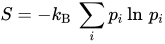
I agree with User:Moxplayer that this article needs to be more accessible. I added a less technical and more accessible opening paragraph but in general this needs more translation to the average reader not grounded in mathematics. Alex Jackl (talk) 20:14, 5 August 2021 (UTC)
Data and Information pages both cyclically refer to each-other in their definition.
On wikipedia if you look at the pages for (1) Data and (2) Information, you'll find they cyclically refer to each other in their definitions. I think eliminating "information" from the core definition of data would be preferable.
Removal of newly added History section
I removed the history section that was just added because it had NO supporting citations and was highly speculative. I can imagine a section like this but it would have to be really well sourced. Alex Jackl (talk) 15:21, 17 September 2021 (UTC)
- I HAVE AN ADVANTAGE PLAN NOW WITH,
- WELL CARE, AND I AM VERY PLEASED WITH IT. 2600:6C5E:4DF0:7690:44AF:EF0A:4BBB:D2C7 (talk) 02:29, 2 June 2023 (UTC)
External links
I wrote in talk with Vsmith, but he never answered me, normally one cites the article that forbids something or indicates a more appropriate space, but to exclude it like this for no reason is very depressing.--Skymen (talk) 21:39, 28 February 2022 (UTC)
- I watched the whole video, nearly an hour of listening to an articulate fellow stooping in close to the camera to give the impression of taking the viewer into his confidence. He started with Mesopotamian clay tablets and other ways to preserve ideas in writing, moving to the Jacquard loom, various systems of electric telegraph culminating in Morse's compact symbol choices, Maxwell's demon, Turing's work on computation, a brief nod to Shannon's information theory, and some 21st century buzzwords, including "quantum."
- I found the shimmering, semi-amorphous soundtrack hard to ignore. The videography relied heavily on slow-motion pans across static scenes, and recycled clips. The relevance of some of those repeated clips made sense; others seemed like pointless eye candy or filler. The whole message could have been delivered in less than twelve or fifteen minutes, without significant loss of content. This is more like nicely produced fluff than something adding value to an encyclopedia.
- Vsmith answered you on his talk page within eight hours two days ago. Just plain Bill (talk) 03:13, 1 March 2022 (UTC)
- The documentary is a simple but very complete informative work, made by university professors-researchers, I honestly didn't even hypothetically think that someone might not like it. On the contrary, I find this important article lacking, starting with the absence of even a minimal historical overview. What is the use, for example, of putting the image of the utopian "Pioneer plaque" instead of the historical clay tablets of Mesopotamia, there are not some interesting anthropological and technological experiences even earlier from information technology ?! No reference to a scientific theoretical basis, not to mention the contribution during the industrial revolution, or do you think that even the economic one is a concept that has become completely fluff ?!--Skymen (talk) 15:02, 1 March 2022 (UTC)
- The presentation is full of fluff. This is not a documentary, but an overview without depth. Repeatedly showing the same close-up clip of looped Jacquard punched cards serves as a thumbnail of information development during the industrial revolution, but but it explains almost nothing. Just plain Bill (talk) 15:13, 1 March 2022 (UTC)
- On the other hand, is this article beautiful and complete ?! — Preceding unsigned comment added by Skymen (talk • contribs) 16:29, 1 March 2022 (UTC)
Technologically mediated information
This section starts with the following statement, "These sections are using measurements of data rather than information, as information cannot be directly measured." This statement is false and is presented without references.
For several years (2010 to 2013), this article started with the statement the "Information, in its most restricted technical sense, is an ordered sequence of symbols." In my opinion, the current lead sentence of this section is an unsubstantiated violation of the very core of how this article described information in the technical sense that Shannon and other used the term. If we are going to present a technological definition of information, we should be willing to say, "in a technical sense, information is an ordered sequence of symbols or signals that can be interpreted."
There have been extensive discussions here and on the data page about the difference between information and data. But the difference is simple for those who work in the information technology industry. Information is the sequence of symbols. Data is preprocessed (or predefined) information whose categorical meaning is recognized by the data structure in which is is found. The actual content of the data in the data structure provides the specialization to complete the definition of the information. (A definition is comprised of a lexeme (word), a category and a specialization.
The only reason a (dumb) computer can identify the meaning of a piece of data is by the data structure that we (the intelligent ones handling the information) have agreed on as the categorical meaning of what is communicated in that context. 50.206.176.154 (talk) 20:47, 10 March 2022 (UTC)
Alternate Opinion Location in Article
I moved the "alternate opinion" on Information Theory into the Information Theory section as that seemed more appropriate. I have no issue with the content - it is cited and seems appropriate- but it is too deep to be in the opening, so I moved it. Happy to discuss. Alex Jackl (talk) 18:09, 17 May 2022 (UTC)
- This "alternate opinion" should be moved into a different section, perhaps with more historical or philosophical takes. Currently it splits two paragraphs that belong together because they both discuss technical concepts and applications of Shannon's theory. Mameister (talk) 23:32, 3 January 2025 (UTC)
I moved the general non-technical description of information back into the header. Leaping right into "signals" is not an appropriate opening for anyone except someone already deeply versed in information theory.Alex Jackl (talk) 14:24, 11 August 2022 (UTC)
- I am not sure what the latest change was for. Please explain what link was "geo-locked". I put back the simple opening and I removed and incorrect (I believe -open to debate) assertion in the opening that asserted information was derived from knowledge which is not consistent with most of the rest of the article. With a fundamental article like this I think we need to be VERY cautious in how we use words. Alex Jackl (talk) 14:33, 15 August 2022 (UTC)
Exact definition of information and application
I suggest to place the following paragraph after the introduction:
Exact definition of information and application
Information can be defined exactly by set theory:
"Information is selection from a set, the domain of information".
Sender and receiver of information must know the "domain of information" before information exchange. For example, digital information consists of building blocks, which are all sequences of numbers. Each sequence of numbers represents a selection from its domain of information. Sender and receiver of digital information (number sequences) must know the domain of information and binary format of each number sequence before information exchange.
By online definition of number sequences this would be systematically and universally usable. Before the exchanged digital number sequence, an efficient link to its online definition can be placed. Thus online defined digital information would be worldwide comparable and precisely searchable.
Reference: Orthuber, Wolfgang (16 May 2022). "We Can Define the Domain of Information Online and Thus Globally Uniformly". Information. 13(5), 256. https://doi.org/10.3390/info13050256 . Wqq (talk) 14:54, 3 August 2023 (UTC)
- I recommend removal of this section. It starts with a nonsensical autoregressive claim "Information is selection from a set, the domain of information", which, if one were to take it seriously, becomes "Information is selection from a set, the domain of selection from a set, the domain of...". The remainder isn't any more useful. The section is neither a definition, nor does it address the huge domain of applications. It's a distraction on an otherwise serious Wiki page.
- There is a technical definition of information - in the Shannon meaning - later on this page. Mameister (talk) 23:22, 3 January 2025 (UTC)
- I have now deleted the section.—St.Nerol (talk, contribs) 13:35, 16 January 2025 (UTC)
- Did you really understand that?
- Information is (always transported as) a selection from a set of possibilities (domain of information) which must be known *before* information is exchanged (simple example: language vocabulary).
- The “selection from a set” is a universal exact definition of information, which could be used for the definition of a universal, precise, reproducible, application-optimized global language by online definition of number sequences (e.g. in medicine). Online definition would have far-reaching consequences for digital information: https://doi.org/10.59400/cai1884 . So it would be important. Wqq (talk) 11:27, 25 February 2025 (UTC)
- The exact definition of information as a “reproducible selection from a set of possibilities” is actually clear and unambiguous. At the same time, this can be arbitrarily complex, depending on the structure of the set of possibilities to which I have given the name “domain of information”.
- Perhaps it is unfamiliar to understand the implications of this:
- In fact, the “Domain of Information” can be very nested if its elements are themselves selections from a Domain of Information that is necessarily predefined before.
- The decisive factor is that the sender and receiver of information always must know the domain of information used uniformly.
- Example: Language vocabulary - letters ...
- Of course, the nesting goes even further, even into physics. This is still a largely unexplored important topic and by no means trivial ( https://doi.org/10.17352/amp.000097 ).
- In the field of digital information, however, it is actually simple: all digital bits represent sequences of numbers. These always select from their domains of information. In order to understand digital information or number sequences uniformly, the sender and receiver must know the domains of the digital number sequences uniformly *beforehand*.
- This principle could be used systematically for all digital information by the (globally automatically uniform, nested) online definition of digital number sequences on the Internet. Since the existence of the Internet (decades), computer science has failed to make use of this!
- But it could be used for the definition of a universal, precise, reproducible, application-optimized global language by online definition of number sequences (e.g. in medicine). Online definition would have far-reaching consequences for digital information: https://doi.org/10.59400/cai1884 . So it would be important.
- I therefore recommend that you undo the deletion (which was made as a result of your comment). If you wish, you can of course make modifications and/or cite the new literature. Wqq (talk) 16:26, 28 February 2025 (UTC)
Information as a physical structure
Information only exists as physical structure. This fact is not recognised on this page.
To elucidate this aspect, I suggest adding the following section:
Information as matter structure that evolves
Information consists of ordered material patterns, but not all ordered material patterns constitute information. Analysing information as a patterned structure, the perspective "On the Nature of Information: An Evolutionary Perspective,"[1] defines information as a mutatable structure undergoing evolution in a fitness landscape. Unlike traditional definitions, information is not merely a pattern or data but a dynamic entity that can replicate and mutate, driving the emergence and evolution of complex systems. It exists across various layers of self-organization, including physical, biological, cultural, and civilizational domains. This definition emphasizes the dual nature of information as both a product and a driver of evolution, underlying the development of intricate structures and behaviours in the universe. Wouter at KTH (talk) 16:52, 22 July 2024 (UTC)
- Thanks for engaging again here. Let's have a centralized conversation about including this content where you first began it, at Talk:Emergence#Spontaneous vs information-templated emergence, rather than on each of the pages where the content was removed. If we need to have more specific conversations on each of these pages later, we can. Cheers, Generalrelative (talk) 16:57, 22 July 2024 (UTC)
References
- ^ van der Wijngaart, Wouter (2024). "On the nature of information -- an evolutionary perspective". arXiv:2407.09567.
{{cite arXiv}}: CS1 maint: missing class (link) A bot will complete this citation soon. Click here to jump the queue
Information = Communication?
The page describes information as the abstract concept to inform. “to inform” brings the user to communication. I do not agree with this sentiment. You see, imagine you have a friend. This friend states “hello” to you. Do you gain any “information”? No. But you do communicate. If the friend was talking to you about a new subject, that would be a different concept. I disagree that information is equal to communication, these elements are different from one another. Am I mistaken?
Newaccount33333 (talk) 17:03, 19 December 2024 (UTC)
Semi-protected edit request on 3 January 2025
 | This edit request has been answered. Set the |answered= parameter to no to reactivate your request. |
"The uncertainty of an event is measured by its probability of occurrence. Uncertainty is inversely proportional to the probability of occurrence." The second part is wrong. This matters, because it contradicts the numerical examples in the rest of the paragraph. Where does the logarithm come from suddenly in those expressions? So...
change
"Uncertainty is inversely proportional to the probability of occurrence."
to
"Uncertainty is proportional to the negative logarithm of the probability of occurrence." Mameister (talk) 23:46, 3 January 2025 (UTC)
 Done (3OpenEyes's talk page. Say hi!) | (PS: Have a good day) 16:01, 7 January 2025 (UTC)

Hi.
I was skimming the article and noticed that the section in question was missing math formatting. Upon further reading, I was confused about the precise meaning of the text; Is a set of subsets or a particular subset et c.? Looking at the history, it seems that the only user editing the section is Galois17 and the first appearance of the section was a few months before the relevant article was published in 2011.

It's worth mentioning that Galois17's only other contributions are to the last paragraph of Ideotype, which seems suspicious to me.
I'd love some input <3
— xo Ergur (talk) 12:39, 11 August 2025 (UTC)
- I removed it. — xo Ergur (talk) 14:06, 18 August 2025 (UTC)
we need a better short description
the short description provided by Ffffrr in 2021, "Facts provided or learned about something or someone" doesn't make sense to me, except maybe in the context of fact checking of mis/disinformation. Given the vast amount of debate about the definition of information in past chats, I'm not sure of a suitable alternative, so have started this topic to fish for ideas for defining Information in 40 characters or less? Duncnbiscuit (talk) 07:29, 3 December 2025 (UTC)
The discussion of Algorithmic information here is brief and somewhat confused, e.g. Algorithmic information theory is considered a "subfield" of Shannon information theory. Obviously not so given that they have completely different approaches. In general all articles on information theory have the same shortcoming. But it will be a major cleanup across many articles. Alas beyond my time budget. Yesterday, all my dreams... (talk) 10:02, 12 January 2026 (UTC)
Proposal for introduction.
Dear colleagues,
The current introduction does not explain the nature of information and its relationship to language.
I intend to replace the text of the introduction:
Information is an abstract concept that refers to something which has the power to inform. At the most fundamental level, it pertains to the interpretation (perhaps formally) of that which may be sensed, or their abstractions. Any natural process that is not completely random and any observable pattern in any medium can be said to convey some amount of information. Whereas digital signals and other data use discrete signs to convey information, other phenomena and artifacts such as analogue signals, poems, pictures, music or other sounds, and currents convey information in a more continuous form.[1] Information is not knowledge itself, but the meaning that may be derived from a representation through interpretation.[2]
With the following text:
Information is an abstract entity that is supposed to be the answer to the question of what kind of entity we acquire through cognition (of the real world), what we store when we remember something, and what we transport when we convey something. In a general sense, information is understood as the results of cognition of a certain part of the real world. Information reduces a person’s uncertainty of knowledge. The amount of information can be characterized by how its acquisition has reduced the recipient’s degree of uncertainty of knowledge [1]. Information, as an abstract entity (human creative construct), cannot be grasped through the use of tools. In order to grasp it—for the purposes of archiving (memorizing) and thus also disseminating (communicating) it, or for processing it—a “container” is required. That container is called a language in which the information is imprinted. Therefore, the above mentioned operations with information are actually operations with language constructs. Language is an abstract structure (an order among suitable abstract objects) [2], [3], and this must be materialized for application by a suitable structure of matter or energy. Thus, any structure of matter or energy found in the real world can serve as a language, provided that one is able to recognize (read) and interpret it. Examples of material or energy structures include texts on stone or paper, human speech, dendrological sections, X-ray images of human organs, signals captured by radio telescopes, radio and television broadcasts, and so on. It is assumed that the human mind is also equipped with intrapsychic languages. Language has the function of an intermediary for information, which allows it (gives it its own properties) to pass from one material or energy environment to another, for example, from the human psyche (biochemical and electrochemical interactions taking place in the human brain) to the external real world of interactions (e.g. the human voice) and vice versa. Semiotician Charles W. Morris calls such an intermediary a vehiculum [4]. Language through materialization entering the world of interactions can also be the executor of a command – information (e.g., it causes the movement of a robot arm), at least that's how we sometimes need to see it, but physics sees it as a chain of interactions.
Two types of information
There are two types of information to consider (for an explanation see Vagueness).
First, information obtained through natural human cognition, where vagueness serves as a filter of cognition [5] and the information obtained is inherently vague. Language in this case is inherently vague informal language, usually natural. In this case, the study and quantification of information falls within the remit of cognitive psychology.
Second, information obtained through artificial scientific cognition, where the filter of cognition is Newton's discrete filter and the information obtained is exact; see Vagueness. The language here is a formal language (mathematics language, formal logic, programming languages), which always has an exact interpretation, i.e. with zero (internal) vagueness in the meaning of linguistic constructs. In this case, the study and quantification of information falls within the framework of the formal theory of information, founded by C. E. Shannon. [6]. The title of Shannon's publication makes it clear that both the representation of information and the model of its sender are mathematical models.
Information and order
There is a bilateral relationship between order (organization, structure, orderliness) and information.
The first is that there is a structure that we are able to recognize and which we are able to interpret (assign meaning), and thus obtain information. In this case, the structure serves as a language, as mentioned above.
The second is the situation when, based on information (regulation, project documentation, etc.), some structure or order, some artifact, is to be created in the real world. This means that we must create such interactions in the real world that the designed artifact is created. (To explain, since the time of Newton, all sciences have seen events in the real world as the result of interactions). Such examples include all human work: Forming and machining metals according to drawings, building computers, building houses, embroidering fabric patterns according to a given regulation, producing gramophone records. Examples also include automatic control, where the best known is probably Watt's speed regulator. In this case, the created order is that the speed of the steam engine is maintained at the desired value (set by the operator), which almost does not change with the engine load or the current boiler output (steam pressure), see Feedback.
Kremen (talk) 09:50, 31 May 2026 (UTC)
- ^ C. E. Shannon, The Mathematical Theory of Communication, Bell Syst. Techn. J. 27 (1948), č. 3, pp. 379–423
- ^ Chomsky, N: Aspects of the Theory of Syntax. Cambridge, Mass.: M.I.T. Press, 1965. 5.
- ^ Chomsky, N: Current Issues in Linguistic Theory. De Gruyter Mouton; Printing 1975
- ^ Charles W. Morris: Foundations of the Theory of Signs. International Encyclopedia of Unified Science 1 (2). Chicago: University of Chicago Press. 1946
- ^ Russell B.: Vaguness. In: The Australasian Journal of Psychology and Philosophy 1, June 1923, pp. 84–92
- ^ C. E. Shannon, Mathematical theory of communication, Bell Syst. Techn. J. 27 (1948), No. 3, pp. 379–423
Content Disclaimer
Informasi ini disarikan dari Wikipedia dan disajikan kembali untuk tujuan edukasi. Konten tersedia di bawah lisensi CC BY-SA 3.0. Kami tidak bertanggung jawab atas ketidakakuratan data yang bersumber dari kontribusi publik tersebut.
- The information displayed on this website is sourced in part or in whole from Wikipedia and has been adapted for the purpose of restating it. We strive to provide accurate and relevant information, however:
- There is no guarantee of absolute accuracy. Wikipedia is an open, collaborative project that can be edited by anyone, so information is subject to change.
- It is not intended to constitute professional advice. The content displayed is for informational and educational purposes only. For important decisions (e.g., medical, legal, or financial), please consult a professional.
- Content copyright. Wikipedia is licensed under the Creative Commons Attribution-ShareAlike License (CC BY-SA). This means that content may be reused with appropriate attribution and shared under a similar license.
- Responsible use. Any risk arising from the use of information from this website is entirely the responsibility of the user.