Talk:Critical speed
It is called critical speed because if a shaft approaches its critical speed it will sometimes cause a the shaft to fail dramatically - as in becoming two piece

 | This article has not yet been rated on Wikipedia's content assessment scale. It is of interest to the following WikiProjects: | ||||||||||
| |||||||||||


Why call that critical speed?
It is called critical speed because if a shaft approaches its critical speed it will sometimes cause a the shaft to fail dramatically - as in becoming two pieces.
There seems to be two definitions of critical speed: one is due to unbalanced mass; one is due to applied loads (e.g., gravity).
- Unbalance mass (example): http://www.engineersedge.com/bearing/critical-speeds-rotating-bodies.htm
- Applied load (example): http://www.engineersedge.com/bearing/critical-speed-distributed-load.htm
I am unsure how this article means to address these two causes. (I may have made it less clear in my effort to tidy up the article.)
Roebling (talk) 20:55, 16 June 2012 (UTC)
- The two definitions apply to the same concept: the loads simply affect the critical speed, and the vibration is caused by an unbalanced mass.--Gciriani (talk) 17:11, 4 September 2012 (UTC)
Is the formula correct?
I formatted the formula differently (I forgot to login with my username at first). However, the formula doesn't seem the right one. It's the formula for the natural frequency of a pendulum as far as I can see. The formulas reported in the second link above, seem more pertinent.--Gciriani (talk) 14:55, 4 September 2012 (UTC)
I went through the paper by Krueger http://www.krugerfan.com/brochure/publications/Tbn017.pdf which seems to be verbatim the source for the article section containing the formula. I understand now the correctness of the formula, and expanded on the expanded on the explanation of the term.--Gciriani (talk) 16:56, 4 September 2012 (UTC)
- I have my doubts about the accuracy of the Krueger document. For one thing, it is asking for the modulus of elasticity, but gives the units in kg/m^2, which is incorrect. I would have thought that the maximum deflection would have been in units of metres, but if you try and cancel out the units, you're left with seconds still knocking around. Stephen! Coming... 09:43, 11 February 2015 (UTC)
- I You can express the modulus in kg/m^2, where kg would mean kg force. If you have the weight of the shaft in kg too, then the kg weight units in the denominator cancel out the kg force units in the numerator. The Krueger paper lists the modulus of elasticity for steel as 200x10^8 kg/m^2, which would be correct since in SI units, the modulus is 200x10^9 N/m^2. There are about 10 N per kg (9.81).Hermanoere (talk) 15:29, 18 June 2015 (UTC)
- I Look at the units in the sqrt(g/d). If g is in m/s^2, and d is in m, then the overall units are in 1/s, which is correct for radians/s. The other units would have to be in the 30/ pi, to convert to rev/min (RPM).Hermanoere (talk) 22:15, 17 June 2015 (UTC)
Re: accuracy. For a uniform shaft (constant diameter), you can get the max deflection here. If you plug q = A (where is the specific weight, and A is the cross-sectional area) in to the formula, you get:

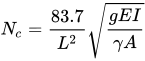
Shigley's Mechanical Engineering Design (McGraw Hill) gives an exact solution for a uniform shaft in rad/s:
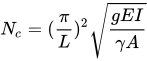
When you multiply this by 60/2 to convert to RPM, this yields:

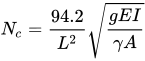
Pretty close..Hermanoere (talk) 22:15, 17 June 2015 (UTC)
Misleading information
In the Critical speed equation (Nc) section, it states:
Good practice suggests that the maximum operating speed should not exceed 75% of the critical speed.
Not necessarily true. There are a variety of mechanical systems that routinely work best above their critical speed. For example,
- Automatic washing machines during the spin cycle
- The "drum" in a helical scan video tape recorder
— QuicksilverT @ 01:01, 9 September 2012 (UTC)
It's common practice for rocket engine turbopumps to run supercritical as well. -A Random Aerospace Engineer — Preceding unsigned comment added by 199.36.17.2 (talk) 17:09, 24 June 2014 (UTC)
Content Disclaimer
Informasi ini disarikan dari Wikipedia dan disajikan kembali untuk tujuan edukasi. Konten tersedia di bawah lisensi CC BY-SA 3.0. Kami tidak bertanggung jawab atas ketidakakuratan data yang bersumber dari kontribusi publik tersebut.
- The information displayed on this website is sourced in part or in whole from Wikipedia and has been adapted for the purpose of restating it. We strive to provide accurate and relevant information, however:
- There is no guarantee of absolute accuracy. Wikipedia is an open, collaborative project that can be edited by anyone, so information is subject to change.
- It is not intended to constitute professional advice. The content displayed is for informational and educational purposes only. For important decisions (e.g., medical, legal, or financial), please consult a professional.
- Content copyright. Wikipedia is licensed under the Creative Commons Attribution-ShareAlike License (CC BY-SA). This means that content may be reused with appropriate attribution and shared under a similar license.
- Responsible use. Any risk arising from the use of information from this website is entirely the responsibility of the user.