Enstrophy
In fluid dynamics, the enstrophy E {\displaystyle {\mathcal {E}}} can be…

In fluid dynamics, the enstrophy can be interpreted as another type of potential density; or, more concretely, the quantity directly related to the kinetic energy in the flow model that corresponds to dissipation effects in the fluid. It is particularly useful in the study of turbulent flows, and is often identified in the study of thrusters as well as in combustion theory and meteorology.
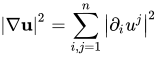
Given a domain and a once-weakly differentiable vector field which represents a fluid flow, such as a solution to the Navier-Stokes equations, its enstrophy is given by:[1]

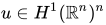

where . This quantity is the squared seminorm in the Sobolev space .


Incompressible flow
In the case that the flow is incompressible, or equivalently that , the enstrophy can be described as the integral of the square of the vorticity :[2]


or, in terms of the flow velocity:

In the context of the incompressible Navier-Stokes equations, enstrophy appears in the following useful result:[1]

The quantity in parentheses on the left is the kinetic energy in the flow, so the result says that energy declines proportional to the kinematic viscosity times the enstrophy.

See also
References
- ^ a b Navier-Stokes equations and turbulence. Ciprian Foiaş. Cambridge: Cambridge University Press. 2001. pp. 28–29. ISBN 0-511-03936-0. OCLC 56416088.
{{cite book}}: CS1 maint: others (link) - ^ Doering, C. R. and Gibbon, J. D. (1995). Applied Analysis of the Navier-Stokes Equations, p. 11, Cambridge University Press, Cambridge. ISBN 052144568-X.
Further reading
- Arakawa, A.; Lamb, V.R. (January 1981). "A Potential Enstrophy and Energy Conserving Scheme for the Shallow Water Equations". Monthly Weather Review. 109 (1): 18–36. Bibcode:1981MWRv..109...18A. doi:10.1175/1520-0493(1981)109<0018:APEAEC>2.0.CO;2. ISSN 1520-0493.
- Umurhan, O. M.; Regev, O. (December 2004). "Hydrodynamic stability of rotationally supported flows: Linear and nonlinear 2D shearing box results". Astronomy and Astrophysics. 427 (3): 855–872. arXiv:astro-ph/0404020. Bibcode:2004A&A...427..855U. doi:10.1051/0004-6361:20040573. S2CID 15418079.
- Weiss, John (March 1991). "The dynamics of enstrophy transfer in two-dimensional hydrodynamics". Physica D: Nonlinear Phenomena. 48 (2–3): 273–294. Bibcode:1991PhyD...48..273W. doi:10.1016/0167-2789(91)90088-Q.
Content Disclaimer
Informasi ini disarikan dari Wikipedia dan disajikan kembali untuk tujuan edukasi. Konten tersedia di bawah lisensi CC BY-SA 3.0. Kami tidak bertanggung jawab atas ketidakakuratan data yang bersumber dari kontribusi publik tersebut.
- The information displayed on this website is sourced in part or in whole from Wikipedia and has been adapted for the purpose of restating it. We strive to provide accurate and relevant information, however:
- There is no guarantee of absolute accuracy. Wikipedia is an open, collaborative project that can be edited by anyone, so information is subject to change.
- It is not intended to constitute professional advice. The content displayed is for informational and educational purposes only. For important decisions (e.g., medical, legal, or financial), please consult a professional.
- Content copyright. Wikipedia is licensed under the Creative Commons Attribution-ShareAlike License (CC BY-SA). This means that content may be reused with appropriate attribution and shared under a similar license.
- Responsible use. Any risk arising from the use of information from this website is entirely the responsibility of the user.