Draft:Jane Speed
This is a draft Articles for creation (AfC) submission. It is not currently pending review. While there are no deadlines, abandoned drafts may be deleted after

 | Draft article not currently submitted for review.
This is a draft Articles for creation (AfC) submission. It is not currently pending review. While there are no deadlines, abandoned drafts may be deleted after six months. To edit or make changes to this draft, simply click on the "Edit" tab at the top of the window. To be accepted, a draft should:
It is strongly discouraged to write about either yourself or your business or employer. If you do so, you must declare it. Where to get help
How to improve a draft
You can also browse Wikipedia:Featured articles and Wikipedia:Good articles to find examples of Wikipedia's best writing on topics similar to your proposed article. Improving your odds of a speedy review To improve your odds of a faster review, tag your draft with relevant WikiProject tags using the button below. This will let reviewers know a new draft has been submitted in their area of interest. For instance, if you wrote about a female astronomer, you would want to add the Biography, Astronomy, and Women scientists tags. Editor resources
Last edited by DavidESpeed (talk | contribs) 37 days ago. (Update) |
Jane Speed | |
|---|---|
| Born | Jane Helen Krisher January 4, 1920 Akron, Ohio, U.S. |
| Died | March 5, 1991 (aged 71) New York City, U.S. |
| Occupation | Mystery writer, radio scriptwriter |
| Education | Ohio Wesleyan University (1937-1939) |
| Alma mater | Northwestern University (1939–1941) |
| Genre | Murder mystery, screwball comedy, romantic comedy |
| Years active | 1941–1953, 1963–1980 |
Jane Speed (born Jane Helen Krisher; January 4, 1920 – March 5, 1991)[1] was an American mystery writer, radio dramatist and actress, best known for her crime fiction,[2][3][4] published primarily in Ellery Queen's Mystery Magazine.[5]
Early life and career
Speed was born Jane Helen Krisher in Akron, Ohio, on January 4, 1920,[1] the only child of William Chester Krisher and Helen E. Roush.[6] Her first stage assignment of note came in the fall of 1935 at Akron's First Congregational Church, where she served as prompter and assistant to the director in a production of the British anti-war play Ashes of Victory.[7] The following spring, she took part in an amateur radio program which concluded with a production of the three-act play, The Tinker.[8][9][a] After graduating from Buchtel High School in 1937, Krisher attended first Ohio Wesleyan University,[11] where she became a member of Theta Alpha Phi,[12] and then Northwestern University's School of Speech, joining Alpha Gamma Delta and graduating in 1941 with a Bachelor of Science in Speech.[13][1][14] At Buchtel, she studied drama with Mrs. T. C. Laughlin,[15][16] and at Northwestern with Alvina Krause.[17][18] Krisher's collegiate résumé includes roles in Ayn Rand's Night of January 16th,[15] Dion Boucicault's The Poor of New York.[19], Lenore Coffee's Family Portrait[18] and H. L. Mencken's The Artist,[15] as well as the female lead in Seumas O'Kelly's The Matchmakers.[19]
Radio
Following her graduation and return to Akron, two of Krisher's original radio dramas aired locally, both of which she directed.[20][21] She also wrote a holiday-themed drama, which aired Christmas Eve on WLW.[22] Krisher also continued to perform onstage, joining Akron's Little Theater group, the Weathervane Players, in September 1941.[23][24][25] Subsequently, she worked as a copywriter and continuity writer at WFMJ in Youngstown, Ohio.[1] It was there, in the fall of 1942, that Krisher met her soon-to-be husband, James Speed, a fellow WFMJ employee.[13]
In 1946, following the birth of her first child and completion of her husband's military service, Speed relocated to New York City. On June 6, her radio drama "My Dear Aunt Caroline" aired on Elaine Sterne Carrington's anthology series showcasing new writers, The Carrington Playhouse,[1][26][27] performed live at New York's Longacre Theatre under Perry Lafferty's direction and broadcast nationally on the Mutual Broadcasting System.[28] Recounting "the near tragedy brought about by the dominance by an older woman over a young girl,"[17] Speed's narrative clearly anticipates the oppressive family relationships that would characterize her most popular mystery stories roughly 20 years later.[29][30]
The next two scripts sold were "The Perfect Wife" and "A Hard Bargain" (broadcast, respectively, on Family Theater and The Whistler[b][c]), the former a gentle domestic comedy starring Spring Byington and Ralph Morgan,[38][39] the latter, a noir-ish tale of one "small doubt, fed by growing uncertainty, grow[ing] into suspicion as lethal as poison."[34] A new production of "A Hard Bargain" aired more than 2½ years later on Murder by Experts,[40] Dave Kogan's and Robert Arthur's short-lived but twice-Edgar Award-winning series.[41]
"Farewell to Birdie McKeesler," Speed's tale of a severely typing-challenged office employee whose dismissal proves considerably easier said than done,[42] was produced three times in five years, first in 1948 on Family Theater with June Haver,[43][44] then in 1950—with "McKeesler" changed to "McKeever"—on Skippy Hollywood Theatre, with Gloria Grahame,[45] and, finally, adapted for television in 1953 on Your Jeweler's Showcase, starring Marilyn Erskine.[46] The latter production was frequently re-aired over the next decade;[47] it was shown on KCOP-TV in Los Angeles as late as August 1966,[48] and, more than three years later, on ATV in Great Britain.[49] Moreover, the film was subsequently re-released by producer Stuart Reynolds and screened as a teaching tool addressing both workplace interaction and interpersonal communication in general.[50][51] The remainder of Speed's produced output during this period includes four episodes of Armstrong's Theatre of Today[52] and her adaptation of Richard Hughes' novel A High Wind in Jamaica, which aired on NBC University Theater.[53]
Hollywood interlude
On June 16, 1947, roughly five months prior to her second nationally broadcast radio drama (and the first one produced in Hollywood), Speed, as well as veteran character actors Harry Davenport and Kathryn Card, were named by The Hollywood Reporter as late additions to the cast of Warner Brothers' Mary Hagen (ultimately released as That Hagen Girl, starring Shirley Temple and Ronald Reagan).[54][55] Although whatever dialogue the film's shooting script may have assigned her character did not make it into the finished film, Speed's uncredited 14-second walk-on at the very beginning of a nightclub scene late in the film—as a cigarette girl emerging from a crowd of anonymous dancers and wending her way past seated diners towards the club's bar (tended by an uncredited Gino Corrado)—is clearly the focal point of a carefully designed traveling crane shot.[56][57][d]
Crime fiction: a new beginning
In the wake of radio drama's demise in the early 1950s, Speed's roughly 25-year transition from stage to page concluded in March 1963 with the publication of "According to Plan," her professional mystery-writing debut,[52] which thus became—by editor Frederic Dannay's reckoning—"the 247th 'first story' to be published by Ellery Queen's Mystery Magazine."[61] Almost without exception Speed's crime fiction, all of which debuted between 1963 and 1980, did so in EQMM, the sole outlier being "Poor Eva", which first appeared in Alfred Hitchcock's Mystery Magazine in 1977.[5][62] Her first two stories were included in Anthony Boucher's honor roll for detective fiction of 1963,[63][64] as were her next three, in the 1964, '65 and '66 editions, respectively.[65] Her 1969 story, "The Unhappening", was likewise honored by Boucher's successor Allen J. Hubin;[66] in addition, it appeared the following year in Ellery Queen's Grand Slam (25th anniversary annual): 25 stories from 'Ellery Queen's Mystery Magazine'.[67]
"The Freya of Fire Island", Speed's third published story, appeared in the September 1964 issue and shortly thereafter in Ellery Queen's 20th Anniversary Annual.[68] In his introduction, editor Fred Dannay—aka Ellery Queen—observed: "Her style gets firmer with each story, her insight deeper, her observation sharper."[69] Regarding her 1966 novelette "Sounds in the Night", Dannay's introduction—entitled "Sui Generis"—notes that Speed's latest work "is not of the fast, grating, or slam-bang school. It chooses its own inherent speed, growing, growing... warmly human, sympathetically understanding, probing with the gentle touch of a highly skilled surgeon."[70] Six years later, Speed spelled out in verse her personal mystery preferences, chief among them being "to read not of dolls pulled about by plots, but of humans tied up in their self-made knots."[71]
"End of the Day" (EQMM, March 1965), described by Dannay as "a superb character study [of] a nervous, harassed mother of two [and] wife of a demanding, sarcastic, belittling husband,"[29] appears to have created an immediate buzz; barely had the March issue hit the newsstands when Speed was contacted by noted mystery/suspense editor Joan Kahn in hopes of giving her employer Harper & Row the inside track on any upcoming novel.[72] Although the novel never materialized, more than two decades later, Kahn did include another popular Speed story, "Fair's Fair",[73] in Ready or Not, Here Come Fourteen Frightening Stories, the last in Kahn's series of wide-ranging short fiction anthologies. Speed's entry was singled out by both School Library Journal[74] and McAllen Monitor critic Wanda Koeller, who writes, "'Fair's Fair' is my favorite. [...] The author does an excellent job of doing what a frightening story should do — keep you on the edge of your seat. [...] It is written very plainly by Jane Speed, but offers a complex and sinister message."[30] More recently, Mystery.com's 2021 review of the February 1967 issue of EQMM awarded "Fair's Fair" 4 of 5 stars (as contrasted with another seven of the issue's 12 stories, which received 3 or fewer, and with the issue's overall score of 3.5).[75]
Kahn and Dannay were not alone in their regard for Speed's work. For the 1977 edition of Best Detective Stories of the Year, Edward D. Hoch selected her story "View From the Inside".[76] Five years later, two of her stories and three by Hoch appeared in Martin H. Greenberg's anthology Miniature Mysteries: 100 Malicious Little Mystery Stories. Reviewing that collection, the San Francisco Examiner Magazine singled out Speed, Hoch, and fellow contributors Kay Nolte Smith, Jack Ritchie, Francis M. Nevins and Helen McCloy as "some of the most respected names in the profession."[2] Reviewing the same book, Kiplinger's Changing Times selected an almost entirely different group to represent the best of the best, yet likewise included Speed:
Included are works by some of the best writers in the field, such as Edward Wellen, Michael Gilbert, Lawrence Treat and Jane Speed.[3]
In retrospect, "End of the Day" may be Speed's most enduring work; aside from numerous subsequent printings,[77][78][79] it almost singlehandedly resurrected the author's previous career in the form of radio dramatizations and readings in South Africa, Italy, and, in Germany, by RAI Bozen, Radio Bremen and Sender Freies Berlin.[80] One production, starring Elisabeth Wiedemann and Henning Schlüter, debuted on July 3, 1976.[81] In addition, a reading of Speed's "Poor Eva" was aired by SFB in 1979 and again in 1981.[82][83] In 2018, more than half a century after its publication, "End of the Day" was performed live for the benefit of Seattle Central Library patrons[84][4] (part of that library's longstanding program, "Thrilling Tales! A Story Time for Grownups"[85]).
Personal life and death
From April 1943 until her death in 1991, she was married to musician/computer programmer James Edward Speed, with whom she had three children.[86][13][87] Following the appearance of her last published story in 1980, much of Speed's time was taken up in managing the affairs of her aging father in Akron and, following his death in 1988, successfully contesting a fraudulent will which, ironically, would have left her a considerably larger sum than did the actual document drawn up by her charitably inclined father almost a decade earlier.[88]
On March 5, 1991, Speed died of natural causes, survived by her husband and children,[86] as well as her son-in-law, poet John Curl, and her granddaughter, Grammy-winning film and video producer Rachel Curl.[87]
Works
Radio
- "Blitzkrieg at McDougall's" aired September 19, 1941 on WJW-AM[20]
- "Story Conference" aired October 3, 1941 on WAKR-AM[21]
- "My Dear Aunt Caroline" aired June 6, 1946 on The Carrington Playhouse[17]
- "The Perfect Wife" aired November 13, 1947 on Family Theater, hosted by Lizabeth Scott, featuring Spring Byington, Ralph Morgan,[39] Florence Ravenel, Cynthia Corley, and Tyler McVey; directed by David Young, music by Max Terr[89]
- "A Hard Bargain" aired April 7, 1948 on The Whistler,[1] on CBS;[90][34] directed by William N. Robson, music by Lud Gluskin[36]
- "Farewell to Birdie McKeesler" aired October 14, 1948 on Family Theater, hosted by George Murphy, starring June Haver, Alan Reed, Charles Maxwell, Leo Cleary, Herb Butterfield, and Jo Graham; directed by David Young, music by Max Terr[44][91]
- "Dinner by Candlelight" aired April 2, 1949 on Armstrong's Theatre of Today[1]
- "Second Best" aired March 4, 1950 on Armstrong's Theatre of Today,[1] starring Teri Keane and Bill Quinn[92]
- "Good Old Annie" aired May 6, 1950 on Armstrong's Theatre of Today,[1] starring Grace Matthews[93]
- "A High Wind in Jamaica" aired August 20, 1950 on NBC University Theater,[1] narrated by Ramsay Hill, starring Anne Whitfield, John Ramsay-Hill, Dawn Bender, Henry Blair, Jeanine Ann Roose, Alma Lawton, John Dodsworth, Herbert Rawlinson, Stanley Farrar, Ben Wright, Norma Varden, Charles Davis and Felix Nelson; directed by Andrew C. Love[94][95]
- "Farewell to Birdie McKeever" aired August 31, 1950 on Hollywood Theatre, starring Gloria Grahame, Herbert Rawlinson, Herb Butterfield, Dan O'Herlihy, Fred Howard and Madelon Mitchel; music by Del Castillo; produced and directed by Les Mitchel.[45]
- "A Hard Bargain" aired October 23, 1950 on Murder by Experts, produced and directed by Robert A. Arthur & David Kogan,[1] hosted by Brett Halliday[96]
- "A Wonderful Guy" aired January 20, 1951 on Armstrong's Theatre of Today,[1] starring Vinton Hayworth and Joan Alexander[97]
Television
- "Farewell to Birdie McKeever" aired December 22, 1953 on Your Jeweler's Showcase (starring Marilyn Erskine, Paul Harvey, Lloyd Corrigan, Richard Gaines, Robert Shayne, Gerry Pattison, and Joy Lansing; directed by Jean Yarbrough)[46]
Short stories
Except where otherwise indicated, information is derived from Galactic Central.[5]
- "According to Plan" in Ellery Queen's Mystery Magazine (March 1963)
- "The Listening Game" in EQMM (December 1963)
- "The Freya of Fire Island" in EQMM (September 1964), reprinted in Ellery Queen's 20th Anniversary Annual (New York, Random House, 1965), edited by Ellery Queen[68]
- "End of the Day" in EQMM (March 1965), reprinted in With Malice Towards All (New York, G.P. Putnam's Sons, 1968), edited by Robert Fish[77]
- "As the Wheel Turns" in EQMM (April 1966), reprinted in Miniature Mysteries: 100 Malicious Little Mystery Stories (New York, Taplinger, 1981, 1992), edited by Martin Greenberg,[76] reprinted in Hayakawa's Mystery Magazine (November 1982)[98]
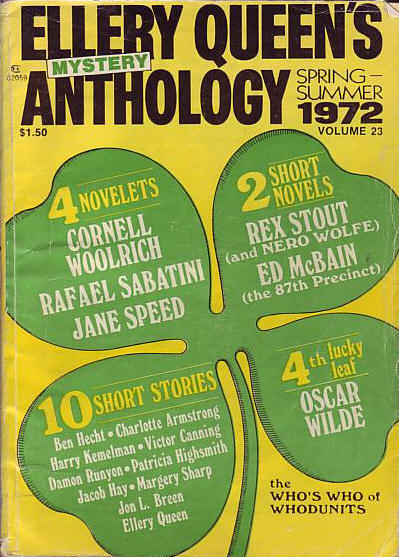
- "Sounds in the Night" in EQMM (September 1966), reprinted in Ellery Queen's Mystery Anthology (Spring-Summer 1972, Volume 23), edited by Ellery Queen[76]
- "Fair's Fair" in EQMM (February 1967), reprinted in Hayakawa's Mystery Magazine (June 1967),[98] in Alfred Hitchcock Presents: Stories to Stay Awake By (New York, Random House,1971),[76] Alfred Hitchcock Presents: More Stories to Stay Awake By (New York, Dell Publishing Company, 1973),[76] A Slender Thread: An anthology of short stories (Melbourne, Thomas Nelson, 1987), edited by Brian Keyte and Richard Baines, Ready or Not, Here Come Fourteen Frightening Stories! A collection of fourteen unsettling tales by a variety of authors (New York, Greenwillow Books, 1987), edited by Joan Kahn[30]
- "The Unhappening" in EQMM (March 1969), reprinted in Hayakawa's Mystery Magazine (December 1969),[98] Ellery Queen's Grand Slam: 25th anniversary annual; 25 stories from 'Ellery Queen's Mystery Magazine' (New York; World Pub. Co.; 1970), edited by Ellery Queen,[99] and in Alt for Damerne in 1977[100]
- "The Events Between" in EQMM (June 1972)
- "Who-Dun-It" in EQMM (June 1972) (verse)
- "Just Another Friday" in EQMM (May 1974)
- "Recipe for Revenge" in EQMM (October 1974), reprinted in Miniature Mysteries: 100 Malicious Little Mystery Stories (New York, Taplinger, 1981, 1992), edited by Martin Greenberg[76]
- "A Shock of Recognition" in EQMM (April 1976), reprinted in Kvinner og Klær in 1978[101]
- "View from the Inside" in EQMM (August 1976), reprinted in Best Detective Stories of the Year, 1977: 31st annual collection (New York, E.P. Dutton, 1977), edited by Edward D. Hoch,[76] and in The Australian Women's Weekly (November 1, 1978)[102]
- "Poor Eva" in Alfred Hitchcock's Mystery Magazine (August 1977), pp. 24–32[103]
- "Further Instructions 9 P.M." in EQMM (August 1979)
- "A Lady of Refinement" in EQMM (December 1980)

Notes
- ^ This was almost certainly the then already widely performed three-act, religious play penned by the Ohio-born and educated Fred Eastman, longtime Professor of religious drama and literature at Chicago Theological Seminary.[10]
- ^ Although the initial November 1947 "Hard Bargain" purchase had been made by CBS for use on Suspense,[31] Mrs. Speed had the misfortune of making that sale at precisely the moment the network's long-running series was in newly un-sponsored crisis mode, facing what seemed imminent cancellation.[32] The CBS solution to this dilemma unfortunately entailed what would ultimately prove a relatively short-lived expansion of the program's running time to sixty minutes (implemented January 1948, abandoned just over six months later);[33] hence, the network's "HB" Plan B, shifting Speed's script to its long-running, otherwise comparable, but still half-hour-sized crime series, The Whistler.[34][35]
- ^ The Whistler's production of Speed's "A Hard Bargain" aired on its 'east of the Rockies'—i.e. Household Finance Corp.—edition only,[36] while the rest of the country heard "What Makes a Murderer," a new production of the show's like-named 8/13/45 episode[37]
- ^ The party responsible for Speed's presence here is most likely the film's dialogue director, Herschel Daugherty, who, as of June 23, 1941, had been a longtime faculty member at the Pasadena Playhouse.[58] It was approximately one week later that Jane Krisher—who, as evidenced by her Northwestern résumé, was at that time at least as much focused on acting as on writing or directing[15][59]—embarked with three fellow Northwestern graduates on a three-part California road trip, the first stop being Pasadena.[60]
References
- ^ a b c d e f g h i j k l Ellett, Ryan (May-June 2023) "Jane Speed: Another Overlooked Writer from Radio’s Golden Age". The Old Radio Times. pp. 5–7.
- ^ a b Lachtman, Howard (August 21, 1983). "Lachtman on Mysteries". The San Francisco Examiner Magazine. p. 5. "'Miniature Mysteries' is a collection of abbreviated crime fictions which showcases the seldom-collected short short genre. It features both unknown authors and some of the most respected names in the profession (Edward D. Hoch, Kay Nolte Smith, Jack Ritchie, Jane Speed, Francis M. Nevins, Helen McCloy).'
- ^ a b "The Bookshelf: Fiction". Kiplinger's Changing Times. August 1983. p. 74. "Miniature Mysteries, selected by Isaac Asimov, Martin Harry Greenberg & Joseph D. Olander [...] Included are works by some of the best writers in the field, such as Edward Wellen, Michael Gilbert, Lawrence Treat and Jane Speed."
- ^ a b Constant, Paul (August 13, 2018). "Your Week in Readings: The best literary events from August 13th - August 19th". The Seattle Review of Books. "Monday, August 13: Thrilling Tales After Dark. The Seattle Public Library’s story time event for grownups continues with a special reading of the short story 'End of the Day,' by Jane Speed. The quote supplied by the library from this story is as follows: 'I swear, I’d lose my head if it wasn’t connected to my shoulders! Now where on earth did I put my husband?'"
- ^ a b c "The Crime, Mystery, & Gangster Fiction Magazine Index: Speed, Jane (fl. 1960s-1980s) (chron.)". Galactic Central.
- ^ Washburn, Elizabeth Fesseden (1986). Snively-Snavely: The Swiss Ancestors and American Descendants of Johann Jacob Schnebele (1659-1743) and Other Snivelys and Snavelys of Southeastern Pennsylvania. Madison, WS: Gateway Press. p. 380. "Roush, Helen — b. Apr. 16, 1894; m. Dec. 29, 1916, William Krisher. Dau.: Jane Krisher (m. James Speed)" See also:
- "Death Notices". Akron Beacon Journal. November 11, 1955. p. 65. Retrieved May 7, 2023. See also:
- "Marriage License Applications Filed". The Oil City Derrick. October 14, 1959. p. 14.
- ^ "Miss Krisher Directs Play". The Akron Beacon Journal. October 31, 1935. p. 12. See also:
- "'Ashes of Victory'; Performance. by Rawtenstall Unitarian Players; Excellent Christmas Production". The Ramsbottom Observer. 29 December 1933. p. 2.
- ^ Geyer, Marion (April 16, 1936). “Women of Church Assist Committee in Charge of Demonstration; Various Groups, Classes to Present Activities in Connection With Character Building Program for Young People”. The Akron Beacon Journal. p. 46.
- ^ Geyer, Marion (April 17, 1936). “Annual All-Church Night Is Scheduled; Young People of West Congregational Open Program With Supper”. The Akron Beacon Journal. p. 8.
- ^ "Obituary Notices". Progress-Bulletin. April 6, 1963. p. 10. See also:
- "Free Lecture: Fred Eastman, L. D.". The Marion Star. February 5, 1935. p. 4.
- "Endeavor Group Will Present 'Tinker' Sunday". The Taylorville Daily Breeze. February 28, 1933. p. 21.
- "'The Tinker', Fred Eastman's Great Christmas Play". Lincoln Journal Star. December 27, 1936. p. 23
- ^ "Enter College". Akron Beacon Journal. September 9, 1937. p. 14.
- ^ "In the Colleges: Pupils Wed, With Honors, at Miami; Denison University; Ohio Wesleyan". The Akron Beacon Journal. March 5, 1939. p. 20.
- ^ a b c "Studio Staff Members Wed". The Akron Beacon Journal. April 11, 1943. p. 23.
- ^ Northwestern University (1941). Eighty-Third Annual Commencement. p. 27.
- ^ a b c d "News of Akronites in College and High School: Cast in Two University Productions; Jane Krisher Has Roles in Northwestern Plays; Others Honored; Jane Krisher, Popular Dramatist". The Akron Beacon Journal. May 5, 1940. p. 54.
- ^ "Akron Monnett Club Gives Party Honoring High School, Wesleyan College Students". The Akron Beacon Journal. April 6, 1934. p. 18.
- ^ a b c Offineer, Bee (June 6, 1946). "Two Summer Shows Debut Tonight; Reminders'". The Akron Beacon Journal. p. 16.
- ^ a b "N.U. Amateurs Offer Play Thru Saturday". Chicago Sunday Tribune. July 21, 1940. p. 101.
- ^ a b "In the Colleges". The Akron Beacon Journal. November 5, 1939. p. 21.
- ^ a b Doran, Dorothy (September 19, 1941). "Around the Dial: Top Radio Shows of Other Seasons Stay in Spotlight; Paragraphs: Jane Krisher, young scripter". The Akron Beacon Journal. p. 36.
- ^ a b Doran, Dorothy (October 2, 1941). "Around the Dial: 'Mortimer Meek' Will Come Back in Weekly Show; Tonight's Toppers; Dot's Dashes; Local Cast". The Akron Beacon Journal. p. 32.
- ^ Doran, Dorothy (December 23, 1941). "Around the Dial: St. Paul's Service Will Be Broadcast On Christmas Eve". The Akron Beacon Journal. "Jane Krisher has written a Christmas eve script to be presented by the WJW Players tomorrow at 6:30 p. m."
- ^ "Here's Who's Who in Weathervane Group". The Akron Beacon Journal. September 24, 1941. p. 13. "Here's a Who's Who in the Weathervane theater, currently staging the play, 'Here Today.' Left, above, Fred McKinley, who his first lead in this vehicle, and center, Jane Krisher, who was active in the theater at Northwestern university, beginning first year with the Weathervane."
- ^ "Old 'Tear Jerker' Being Revived: Jane – Dunlevy – Kay". The Akron Beacon Journal. October 23, 1941. p. 39. "The stern father who is ordering his daughter out into the cold, cold night is James Dunlevy. The grief-stricken daughter is Jane Krisher while her sister, Kay Stevens, tries to intercede for her."
- ^ Gloss, Edward E. (October 25, 1941). "Virtue Again is Rewarded in Third Act". The Akron Beacon Journal. p. 11. "What happens to Jane Krisher, the Little Nell of this piece, shouldn't happen to the worst girl alive, and probably wouldn't. She is deceived, misunderstood, cast aside and cast off and darned near dies of starvation and overwork before the villain is given his just deserts [...] Krisher, Vernon and Miss Halldin 'double in brass' by leading community singing and also offering solos from the stage."
- ^ "Today's Radio Highlights". The Gazette and Daily. June 6, 1946. p. 18.
- ^ Palmer, Zuma (June 7, 1946). "Frank Morgan's New Role Good". Hollywood Citizen-News. p. 16.
- ^ Carrington, Elaine (January 8, 1947). ""Queen of Soapers Asks: Does Radio Want New Writers?". Variety. p. 110. ProQuest 1285902690.
I am inordinately proud of many of our productions and of the roster of new writers who have been launched on their careers as a result of Playhouse productions under the direction of Perry Lafferty. There is Kenneth Greeberg, who wrote 'The Sparrow;' Winifred Wolfe, who wrote 'Portrait of a Girl'; Howard Rodman, who wrote 'Ride a Cock Horse'; Carolyn Darling, who wrote 'Enter Youth'; Jane Speed, who wrote 'My Dear Aunt Caroline'; and from a radio station in Hartford, Ralph Klein with his unusual and clever mystery stories.
See also:;- "MBS to Try Scripts by Unknowns; New Dramatic 'Playhouse' Will Be Produced by Soap Serial Writer, Mrs. Carrington". Broadcasting, Telecasting. February 4, 1946. p. 9. ProQuest 1014888227.
The show, to be called The Carrington Playhouse, will be broadcast Thursdays from 8 to 8:30 p.m., beginning Feb. 21. Mrs. Carrington will select the scripts and produce the shows. Perry Lafferty will be the director.
- "Inside Stuff––Radio". Variety. February 27, 1946. p. 44. ProQuest 1285871269.
"Carrington Playhouse," preeming over MBS last Thursday (21) brought to the Longacre theatre, N. Y., Mutual studio, something of a legit first-night atmosphere, what with prominent guests, et al.
- "MBS to Try Scripts by Unknowns; New Dramatic 'Playhouse' Will Be Produced by Soap Serial Writer, Mrs. Carrington". Broadcasting, Telecasting. February 4, 1946. p. 9. ProQuest 1014888227.
- ^ a b Dannay, Frederic, ed. (March 1965). Ellery Queen Mystery Magazine. p. 84. "'End of the Day' [...] Jane Speed keeps improving with each new story [...] And now her fourth story: about a nervous, harassed mother of two small children, the wife of a demanding, sarcastic, belittling husband—a woman who desperately tries to cope with the tensions and pressures of everyday family problems ... a superb character study."
- ^ a b c Koeller, Wanda (May 15, 1988). "Scare Me Just a Little". The McAllen Monitor. p. 57. "'Fair's Fair' was my favorite. It is written very plainly by Jane Speed, but offers a complex and sinister message. [...] The Bellmans do not get along. As a way to pass time during his constant absence, Mrs. Bellman takes up feeding and tending the neighborhood cats. He hates having the cats around his house. One night, as she steps outside, Amy sees him kick one of the cats so hard it dies. [...] Mrs. Bellman's revenge is how the story got its name."
- ^ Offiner, Bee (November 3, 1947). "Around the Dial: Air Town Meeting from Germany; All-Star Cast Subs for Bob Hope On NBC; Bee's Bits". The Akron Beacon Journal. p. 10. "A former Akronite was the author of the 'Family Theater' script, aired on Saturday over WHKK. Jane Speed, the former Jane Krisher, wrote 'The Perfect Wife,' performed by Spring Byington and Ralph Morgan. Mrs. Speed has had another script accepted, this time by 'Suspense.' It is titled 'The Hard Bargain' and has not been scheduled for broadcast yet."
- ^ "Last Vino Rites". Variety. October 22, 1947. p. 29. ProQuest 1285909139.
The suspense is about over for 'Suspense,' Roma Wine's psychological chiller on CBS. Show finally fades on Nov. 20. Schenley and its wine subsids favor a divorce. [...] The makes two Biow whodunits on the cancellation block.
- ^ Grams Jr., Martin L. (2000). Radio Drama: A Comprehensice Chronicle of American Network Programs, 1932 – 1962. Jefferson, NC: McFarland & Company. p. 456. ISBN 978-0-7864-3871-6. "Roma Wines became the first sponsor of the series, beginning in December of 1943. On November 20, 1947, the series went sustatining again, and on January 3, 1948, Suspense went to an hour-long format. On July 8, 1948, the series returned to the thirty-minute format, and under a new sponsorship, Auto-Lite."
- ^ a b c "KGLO – CBS". Globe-Gazette. April 7, 1948. p. 2. "The Whistler (9 p.m.) A small doubt, fed by continuing uncertainty, grows into suspicion as lethal as poison in the mind of a criminal who is unmasked in 'Hard Bargain."
- ^ Ellett, op. cit., p. 6
- ^ a b "Radio Roundup". Hollywood Citizen News. March 8, 1948. p. 22.
- ^ "Episode Search: What_Makes_a_Murderer". OTRR.org.
- ^ Palmer, Zuma (November 13, 1947). "Many Fingers in Comedy Mixing Bowl". Hollywood Citizen-News. p. 32. "Lizabeth Scott will be the hostess, Spring Byington and Ralph Morgan the stars for The Perfect Wife,' KHJ at 7. Jane Speed of New 'York wrote this 'Family Theater' script."
- ^ a b "Ralph Morgan Will Appear on 'Family Theater'". The Messenger (Belleville, Illinois). November 7, 1947. p. 5.
- ^ "Succumbs". Janesville Daily Gazette. October 23, 1950. p. 12.
- ^ Dunning, John (1998). On the Air: The Encyclopedia of Old-Time Radio. New York: Oxford University Press. p. 470. ISBN 978-0-19-507678-3. See also:
- "Murder by Experts Given the 'Edgar'". The Virginia-Pilot. May 14, 1950. pt. 4, pg. 2.
- "Writers Hail Mystery Shows". Detroit Free Press. May 23, 1951. p. 10.
- ^ Reed, Alan; Ohmart, Ben (2009). Yabba Dabba Doo!: The Alan Reed Story. Albany, GA: BearManor Media. p. 178. ISBN 1-59393-313-4.
- ^ Von Pelt, Rita (October 14, 1948). "Today in Radio: Screen Stars to Air Views; Murphy is Host". The Atlanta Constitution. p. 22.
- ^ a b Palmer, Zuma (October 14, 1948). "Radio-Television". Hollywood Citizen-News, p. 28.
- ^ a b Hammerston, Claude (August 31, 1950). "Radio Highlights: Rollicking Comedy". The Ottawa Citizen. p. 23. See also:
- Kirby, Walter (August 27, 1950). "Better Radio Programs for the Week". Herald and Review. p. 42.
- "Today's Radio Highlights". Wisconsin State Journal. August 31, 1950. p. 12.
- "Highlights of Today's Programs: Radio Today". The Evening Star (Washington, D.C.). August 31, 1950. p. D-13.
- "On the Radio". The New York Times. August 31, 1950. "10:30-11 - Hollywood Theatre: "Farewell to Birdie McKeever,' with Gloria Grahame - WCBS."
- ^ a b "Tuesday, December 22 (Cont'd)". The Ross Reports on Television. December 21-27, 1953. p. 8.
- ^ "Search results for 'Farewell to Birdie McKeever' from 1955 to 1964" at Newspapers.com.
- ^ "Television Log". Long Beach Independent. August 4, 1966. p. D-8.
- ^ "Television and Radio". The Guardian Journal. September 9, 1969. p. 10.
- ^ National Institute of Health (1960). Mental Health Motion Pictures: A Selective Guide, 1960, Volume 15. Washington: United States Government Printing Office. pp. 30–31. See also:
- "Films for Management: 16mm Sound Motion Pictures Available for Rental and Purchase". Business Screen Magazine. No. 7, Vol. 21. 1960. p. 55.
- This, Leslie E. (1961). Training Film Index: Films on Audio-visual Aids, Communication, Community Action and Citizen Responsibility, Human Behavior and Human Relations, Leadership, Sales Training, Supervision, Training Methodology. Washington, D.C.: Leadership Resources. p. 20.
- National Science Foundation (1977). Continuing Education in Science and Engineering. Washington, D.C.; U.S. Government Printing Office. p. 149.
- Conroy, Barbara (1983). Learning Packaged to Go: A Directory and Guide to Staff Development and Training Packages. Phoenix, AZ: Onyx Press. p. 112. ISBN 0897740653.
- ^ "Secretaries Will Meet Tuesday". The Baltimore Sun. September 9, 1960. p. 24. See also:
- "Golden Triangle NSA Sends Delegate to Trinity Seminar". The Daily News-Texan. November 30, 1961. p. 5.
- "Where's the Action? Educational". Deseret News. October 21, 1966. p. 10.
- ^ a b Ellett, op. cit., p. 6
- ^ "Audio and Video: Eisenhower Will Talk on Korea". The Akron Beacon Journal. September 4, 1950. p. 28.
- ^ "Up-to-the-Minute Casting News". The Hollywood Reporter. June 16, 1947. p. 9. ProQuest 2322717854.
Soledad Jiminez, Anne O'Neal, Nina Compana, 'Adventures of Black Bart,' U-I; Harry Davenport, Kathryn Card, Jane Speed, 'Mary Hagen,' Warners
- ^ Jane Speed filmography. American Film Institute.
- ^ snakeblskn (September 30, 2016). "1947 swing dance/lindy hop clip". YouTube.
- ^ That Hagen Girl (1947; from 1:06:22 to 1:06:38) Internet Archive.
- ^ "Pasadena Playhouse Association: Playhouse Staff; Associate Directors". Playbill. July 23, 1941. p. 7.
- ^ Doran, Dorothy (December 20, 1941). "Around the Dial". The Akron Beacon Journal. p. 8.
- ^ Henrietta Jr. (June 25, 1941). "The Tattle-Tale.....". The Akron Beacon Journal. p. 12.
- ^ Dannay, Frederic, ed. (March 1963). Ellery Queen's Mystery Magazine. p. 82.
- ^ Speed, Jane (August 1977) "Poor Eva". Alfred Hitchcock's Mystery Magazine. pp. 24–32.
- ^ Dannay, Frederic, editor: Ellery Queen Mystery Magazine. September 1964.
- ^ Boucher, Anthony (1964). Best Detective Fiction of the Year, 19th Annual Collection. New York; E.P. Dutton. & Company. p. 284.
- ^ Boucher, Anthony (1965). Best Detective Fiction of the Year, 19th Annual Collection. New York; E.P. Dutton. & Company. p. 271. See also:
- Boucher, Anthony (1966). Best Detective Fiction of the Year, 19th Annual Collection. New York; E.P. Dutton. & Company. p. 287.
- Boucher, Anthony (1967). Best Detective Fiction of the Year, 19th Annual Collection. New York; E.P. Dutton. & Company. p. 284.
- ^ Hubin, Allen J. (1970). Best Detective Fiction of the Year, 19th Annual Collection. New York; E.P. Dutton. & Company. p. 284.
- ^ Queen, Ellery (1970). Ellery Queen's Grand Slam (25th Anniversary Annual): 25 Stories from Ellery Queen's Mystery Magazine. New York: World Publishing. pp. 71–84. OCLC 39640801.
- ^ a b Ellery Queen's 20th anniversary annual; 20 stories from Ellery Queen's mystery magazine.. Catalog.loc.gov.
- ^ Dannay, Frederic, ed. (1965). Ellery Queen's 20th anniversary annual; 20 stories from 'Ellery Queen's Mystery Magazine'. New York: Random House. p. 247. OCLC 54612.
- ^ Dannay, Frederic, ed. (September 1966). Ellery Queen's Mystery Magazine. p. 99.
- ^ Speed, Jane (June 1972). "Who-Dun-It". Ellery Queen's Mystery Magazine. p. 98.
- ^ "Private correspondence, Joan Kahn, February 5, 1965." Mediafire.
- ^ Letter seeking French rights to "Fair's Fair". See also:
- ^ Yaakov, Juliet (1990). Junior High School Library Catalog ISBN 0-8242-0799-8. pp. 433–434
- ^ Lewis, Steve (December 10, 2021). "Diary Review: ELLERY QUEEN’S MYSTERY MAGAZINE – February 1967.". MysteryFile.com
- ^ a b c d e f g Contento, William G.; Greenberg, Martin H. (1991). Index to Crime and Mystery Anthologies. Boston, MA: G.K. Hall & Company. pp. 562, 611, 616, 625, 660, 673, 679, 686. ISBN 0-8161-8629-4.
- ^ a b "With malice toward all : an anthology of mystery stories, by the Mystery Writers of America ; edited and with a foreword by Robert L. Fish". DallasLibrary.org.
- ^ Request for German one-time reprint rights for "End of the Day". See also:
- ^ Payment for Finnish rights for "Fair's Fair".
- ^ Ellett, op. cit., pp. 6–7
- ^ "Jane Speed – Ende Des Tages". ARD®Hörspieldatenbank.
- ^ "Poor Eva" produced and broadcast by SFB on Feb 2, 1979
- ^ "Poor Eva" rebroadcast by SFB in 1981
- ^ Ellett, op. cit., p. 7
- ^ W. David (June 8, 2018). "Shelf Talk Blog: Don’t be afraid of the dark: Thrilling Tales just for you!". The Seattle Public Library. See also:
- Einbinder, Nicole (March 3, 2016). "Seattle library offers suspenseful story time just for grown-ups". Seattle Times.
- ^ a b Ellett, op. cit., p. 7
- ^ a b "James Edward Speed". Legacy.com. September 28, 2009. See also:
- "Artist: Rachel Curl. Grammy.com.
- "Meet Your Makers: Rachel Curl". Little Black Book. March 25, 2021.
- ^ McBane, Richard (May 2, 1989). "Akron Heir Gives Up Largest Part of Fortune; Akron Man's Heir to Share Fortune. The Akron Beacon Journal. pp. 1, 5.
- ^ Old Time Radio Researchers (March 7, 2023). "Family Theater - The Perfect Wife". YouTube.
- ^ "Radio and Television". The New York Herald Tribune. April 7, 1948. p. 35. ProQuest 1327269502.
- ^ Old Time Radio Researchers (Mar 18, 2023 ). "Family Theater - Farewell to Birdie McKeesler". YouTube.
- ^ "Programs on the Air: Afternoon". The New York Times. March 4, 1950. p. 28. ProQuest 111495408.
12:00-WNBC–News, Charles F. McCarthy; WOR–Man on the Farm; WJZ–Home Gardener–Phil Alampi; WCBS–Theatre of Today: Second Best, With Teri Keane, Bill Quinn
- ^ "On the Radio: Afternoon". The New York Times. May 6, 1950. p. 30. ProQuest 111374099.
12:00-WNBC–News, Charles F. McCarthy; WOR–Man on the Farm; WJZ–Home Gardener–Phil Alampi; WCBS–Theatre of Today: Good Old Annie, with Grace Matthews
- ^ "Sunday's Radio Features". New York Daily News. August 20, 1950. p. 31C.
- ^ Dennis Morrison (Mar 31, 2023). "A HIGH WIND IN JAMAICA - NBC UNIVERSITY RADIO THEATER!!!!!". YouTube.
- ^ "Radio and Television: Radio Program Notes". New York Herald Tribune. October 23, 1950. p. 27. ProQuest 1327426254.
Crime Fighters: 'Headquarters Homicide,' WOR, 8:30
Murder by Experts: 'A Hard Bargain,' WOR, 9
Jussi Bjoerling, tenor, sings with Don Voorhees' orchestra, WNBC, 9 - ^ "On the Radio: Afternoon". The New York Times. May 6, 1950. p. 15. ProQuest 112031238.
12:00-WNBC–News Reports; WOR–Man on the Farm; WJZ–101 Ranch Boys–Western Variety; WCBS–Theatre of Today: A Wonderful Guy, with Vinton Hayworth and Joan Alexander
- ^ a b c "Jane Speed, U.S.A., Author's List". Ameqlist.com.
- ^ "FORGOTTEN BOOKS #544: ELLERY QUEEN’S GRAND SLAM: 25TH ANNUAL MYSTERY ANTHOLOGY Edited by Ellery Queen". GeorgeKelley.org. Retrieved May 8, 2023.
- ^ "Alt for Damerne payment for serial use of 'The Unhappening'; April 1977". Mediafire.
- ^ "Kvinner og Klær payment for use of 'A Shock of Recognition'". Mediafire.
- ^ Speed, Jane (November 1, 1978). "View from the Inside". The Australian Women's Weekly. pp. 147–159
- ^ "Contents". Alfred Hitchcock Mystery Magazine. August 1977. p. 3.

Further reading
Articles
- "Students: Miss Springer, Miss Allison, Miss Wade, Miss Krisher". The Akron Beacon Journal. April 5, 1939. p. 12
- Offiner, Bee (December 8, 1946). "Around the Dial: Students Reject 'Superman'; Opinions Disagree with Association; Bee's Bits". The Akron Beacon Journal. p. 10—B
- Speed, Jane (November 1, 1978). "View from the Inside". The Australian Women's Weekly. pp. 147–159
Books
- The Library of Congress Copyright Office (1942). Catalog of Copyright Entries: Part 1, Group 3, Dramatic Compositions and Motion Pictures; New Series, Volume 14 for the Year 1941, Nos. 1 – 12
External links
- Jane Speed at IMDb
- Jane Speed at ISFDB
- Jane Speed at OTRR.org
- Jane Speed at Galactic Central
- Jane Speed Radio Scripts at pCloud.com
- Jane Speed - Stories at Bibliography of German Science Fiction Stories and Books
Audio
- Family Theater – "The Perfect Wife" at YouTube
- Family Theater – "Farewell to Birdie McKeesler" at YouTube
- NBC University Theater – "A High Wind in Jamaica" at YouTube
- Skippy Hollywood Theatre – "Farewell to Birdie McKeever" at YouTube
Video
- "1947 swing dance/lindy hop clip (from That Hagen Girl)" at YouTube.
- Your Jeweler's Showcase – "Farewell to Birdie McKeever" at YouTube.
Category:1920 births
Category:1991 deaths
Category:20th-century actresses
Category:20th-century American women writers
Category:American mystery writers
Category:American radio writers
Category:American women short story writers
Category:Northwestern University alumni
Category:Ohio Wesleyan University alumni
Category:People from Akron, Ohio
Category:Writers from New York City
Category:Writers from Ohio
Content Disclaimer
Informasi ini disarikan dari Wikipedia dan disajikan kembali untuk tujuan edukasi. Konten tersedia di bawah lisensi CC BY-SA 3.0. Kami tidak bertanggung jawab atas ketidakakuratan data yang bersumber dari kontribusi publik tersebut.
- The information displayed on this website is sourced in part or in whole from Wikipedia and has been adapted for the purpose of restating it. We strive to provide accurate and relevant information, however:
- There is no guarantee of absolute accuracy. Wikipedia is an open, collaborative project that can be edited by anyone, so information is subject to change.
- It is not intended to constitute professional advice. The content displayed is for informational and educational purposes only. For important decisions (e.g., medical, legal, or financial), please consult a professional.
- Content copyright. Wikipedia is licensed under the Creative Commons Attribution-ShareAlike License (CC BY-SA). This means that content may be reused with appropriate attribution and shared under a similar license.
- Responsible use. Any risk arising from the use of information from this website is entirely the responsibility of the user.