Digroup
In the mathematical area of algebra, a digroup is a generalization of a group that has two one-sided product operations, ⊢

In the mathematical area of algebra, a digroup is a generalization of a group that has two one-sided product operations, and , instead of the single operation in a group. Digroups were introduced independently by Liu (2004), Felipe (2006), and Kinyon (2007), inspired by a question about Leibniz algebras.

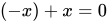
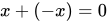
To explain digroups, consider a group. In a group there is one operation, such as addition in the set of integers; there is a single "unit" element, like 0 in the integers, and there are inverses, like in the integers, for which both the following equations hold: and . A digroup replaces the one operation by two operations that interact in a complicated way, as stated below. A digroup may also have more than one "unit", and an element may have different inverses for each "unit". This makes a digroup vastly more complicated than a group. Despite that complexity, there are reasons to consider digroups, for which see the references.


Definition
A digroup is a set D with two binary operations, and , that satisfy the following laws (e.g., Ongay 2010):
- Associativity:
- and are associative,



- Bar units: There is at least one bar unit, an , such that for every


- The set of bar units is called the halo of D.

- Inverse: For each bar unit e, each has a unique e-inverse, , such that



Generalized digroup
In a generalized digroup or g-digroup, a generalization due to Salazar-Díaz, Velásquez, and Wills-Toro (2016), each element has a left inverse and a right inverse instead of one two-sided inverse.
One reason for this generalization is that it permits analogs of the isomorphism theorems of group theory that cannot be formulated within digroups.
References
- Raúl Felipe (2006), Digroups and their linear representations, East-West Journal of Mathematics Vol. 8, No. 1, 27–48.
- Michael K. Kinyon (2007), Leibniz algebras, Lie racks, and digroups, Journal of Lie Theory, Vol. 17, No. 4, 99–114.
- Keqin Liu (2004), Transformation digroups, unpublished manuscript, arXiv:GR/0409256.
- Fausto Ongay (2010), On the notion of digroup, Comunicación del CIMAT, No. I-10-04/17-05-2010.
- O.P. Salazar-Díaz, R. Velásquez, and L. A. Wills-Toro (2016), Generalized digroups, Communications in Algebra, Vol. 44, 2760–2785.
Content Disclaimer
Informasi ini disarikan dari Wikipedia dan disajikan kembali untuk tujuan edukasi. Konten tersedia di bawah lisensi CC BY-SA 3.0. Kami tidak bertanggung jawab atas ketidakakuratan data yang bersumber dari kontribusi publik tersebut.
- The information displayed on this website is sourced in part or in whole from Wikipedia and has been adapted for the purpose of restating it. We strive to provide accurate and relevant information, however:
- There is no guarantee of absolute accuracy. Wikipedia is an open, collaborative project that can be edited by anyone, so information is subject to change.
- It is not intended to constitute professional advice. The content displayed is for informational and educational purposes only. For important decisions (e.g., medical, legal, or financial), please consult a professional.
- Content copyright. Wikipedia is licensed under the Creative Commons Attribution-ShareAlike License (CC BY-SA). This means that content may be reused with appropriate attribution and shared under a similar license.
- Responsible use. Any risk arising from the use of information from this website is entirely the responsibility of the user.