Diffeomorphometry
Diffeomorphometry is the metric study of imagery, shape and form in the discipline of computational anatomy (CA) in medical imaging. The study of images in comp…

Diffeomorphometry is the metric study of imagery, shape and form in the discipline of computational anatomy (CA) in medical imaging. The study of images in computational anatomy rely on high-dimensional diffeomorphism groups which generate orbits of the form , in which images can be dense scalar magnetic resonance or computed axial tomography images. For deformable shapes these are the collection of manifolds , points, curves and surfaces. The diffeomorphisms move the images and shapes through the orbit according to which are defined as the group actions of computational anatomy.



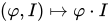
The orbit of shapes and forms is made into a metric space by inducing a metric on the group of diffeomorphisms. The study of metrics on groups of diffeomorphisms and the study of metrics between manifolds and surfaces has been an area of significant investigation.[1][2][3][4][5][6][7][8][9] In Computational anatomy, the diffeomorphometry metric measures how close and far two shapes or images are from each other. Informally, the metric is constructed by defining a flow of diffeomorphisms which connect the group elements from one to another, so for then . The metric between two coordinate systems or diffeomorphisms is then the shortest length or geodesic flow connecting them. The metric on the space associated to the geodesics is given by. The metrics on the orbits are inherited from the metric induced on the diffeomorphism group.
![{\displaystyle {\dot {\phi }}_{t},t\in [0,1],\phi _{t}\in \operatorname {Diff} _{V}}](https://wikimedia.org/api/rest_v1/media/math/render/svg/61eed7ca80d893276a2c25f3b788171112951e0b)




The group is thusly made into a smooth Riemannian manifold with Riemannian metric associated to the tangent spaces at all . The Riemannian metric satisfies at every point of the manifold there is an inner product inducing the norm on the tangent space that varies smoothly across .


Oftentimes, the familiar Euclidean metric is not directly applicable because the patterns of shapes and images don't form a vector space. In the Riemannian orbit model of Computational anatomy, diffeomorphisms acting on the forms don't act linearly. There are many ways to define metrics, and for the sets associated to shapes the Hausdorff metric is another. The method used to induce the Riemannian metric is to induce the metric on the orbit of shapes by defining it in terms of the metric length between diffeomorphic coordinate system transformations of the flows. Measuring the lengths of the geodesic flow between coordinates systems in the orbit of shapes is called diffeomorphometry.

The diffeomorphisms group generated as Lagrangian and Eulerian flows
The diffeomorphisms in computational anatomy are generated to satisfy the Lagrangian and Eulerian specification of the flow fields, , generated via the ordinary differential equation
![{\displaystyle \varphi _{t},t\in [0,1]}](https://wikimedia.org/api/rest_v1/media/math/render/svg/f3a24a9823ffccf9b3fa5b105656d6401d244341)
| Lagrangian flow |
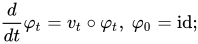
with the Eulerian vector fields in for . The inverse for the flow is given by and the Jacobian matrix for flows in given as


![{\displaystyle v_{t}={\dot {\varphi }}_{t}\circ \varphi _{t}^{-1},t\in [0,1]}](https://wikimedia.org/api/rest_v1/media/math/render/svg/262b7d3594d68bf744c6ee66cdb5934eb9b68e9b)



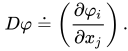
To ensure smooth flows of diffeomorphisms with inverse, the vector fields must be at least 1-time continuously differentiable in space[10][11] which are modelled as elements of the Hilbert space using the Sobolev embedding theorems so that each element has 3-square-integrable derivatives thusly implies embeds smoothly in 1-time continuously differentiable functions.[10][11] The diffeomorphism group are flows with vector fields absolutely integrable in Sobolev norm:


| Diffeomorphism Group |

The Riemannian orbit model
Shapes in Computational Anatomy (CA) are studied via the use of diffeomorphic mapping for establishing correspondences between anatomical coordinate systems. In this setting, 3-dimensional medical images are modelled as diffeomorphic transformations of some exemplar, termed the template , resulting in the observed images to be elements of the random orbit model of CA. For images these are defined as , with for charts representing sub-manifolds denoted as .



The Riemannian metric
The orbit of shapes and forms in Computational Anatomy are generated by the group action , . These are made into a Riemannian orbits by introducing a metric associated to each point and associated tangent space. For this a metric is defined on the group which induces the metric on the orbit. Take as the metric for Computational anatomy at each element of the tangent space in the group of diffeomorphisms



with the vector fields modelled to be in a Hilbert space with the norm in the Hilbert space . We model as a reproducing kernel Hilbert space (RKHS) defined by a 1-1, differential operator , where is the dual-space. In general, is a generalized function or distribution, the linear form associated to the inner-product and norm for generalized functions are interpreted by integration by parts according to for ,





When , a vector density,


The differential operator is selected so that the Green's kernel associated to the inverse is sufficiently smooth so that the vector fields support 1-continuous derivative. The Sobolev embedding theorem arguments were made in demonstrating that 1-continuous derivative is required for smooth flows. The Green's operator generated from the Green's function(scalar case) associated to the differential operator smooths.
For proper choice of then is an RKHS with the operator . The Green's kernels associated to the differential operator smooths since for controlling enough derivatives in the square-integral sense the kernel is continuously differentiable in both variables implying




The diffeomorphometry of the space of shapes and forms
The right-invariant metric on diffeomorphisms
The metric on the group of diffeomorphisms is defined by the distance as defined on pairs of elements in the group of diffeomorphisms according to
| metric-diffeomorphisms |

This distance provides a right-invariant metric of diffeomorphometry,[12][13][14] invariant to reparameterization of space since for all ,

The metric on shapes and forms
The distance on images,[15] ,

| metric-shapes-forms |

The distance on shapes and forms,[16] ,

| metric-shapes-forms |

The metric on geodesic flows of landmarks, surfaces, and volumes within the orbit
For calculating the metric, the geodesics are a dynamical system, the flow of coordinates and the control the vector field related via The Hamiltonian view [17] [18] [19] [20][21] reparameterizes the momentum distribution in terms of the Hamiltonian momentum, a Lagrange multiplier constraining the Lagrangian velocity .accordingly:




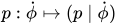


The Pontryagin maximum principle[17] gives the Hamiltonian The optimizing vector field with dynamics . Along the geodesic the Hamiltonian is constant:[22] . The metric distance between coordinate systems connected via the geodesic determined by the induced distance between identity and group element:





Landmark or pointset geodesics
For landmarks, , the Hamiltonian momentum


with Hamiltonian dynamics taking the form

with

The metric between landmarks

The dynamics associated to these geodesics is shown in the accompanying figure.
Surface geodesics
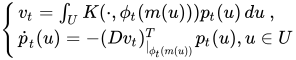
For surfaces, the Hamiltonian momentum is defined across the surface has Hamiltonian

and dynamics
- The metric between surface coordinates

Volume geodesics
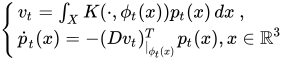
For volumes the Hamiltonian

with dynamics
- The metric between volumes

Software for diffeomorphic mapping
Software suites containing a variety of diffeomorphic mapping algorithms include the following:
- Deformetrica[23]
- ANTS[24]
- DARTEL[25] Voxel-based morphometry(VBM)
- DEMONS[26]
- LDDMM[27]
- StationaryLDDMM[28]
Cloud software
- MRICloud[29]
References
- ^ Miller, M. I.; Younes, L. (2001-01-01). "Group Actions, Homeomorphisms, and Matching: A General Framework". International Journal of Computer Vision. 41 (1–2): 61–84. doi:10.1023/A:1011161132514. ISSN 0920-5691. S2CID 15423783.
- ^ Younes, L. (1998-04-01). "Computable Elastic Distances Between Shapes". SIAM Journal on Applied Mathematics. 58 (2): 565–586. CiteSeerX 10.1.1.45.503. doi:10.1137/S0036139995287685.
{{cite journal}}: Cite uses deprecated parameter|citeseerx=(help) - ^ Mio, Washington; Srivastava, Anuj; Joshi, Shantanu (2006-09-25). "On Shape of Plane Elastic Curves". International Journal of Computer Vision. 73 (3): 307–324. CiteSeerX 10.1.1.138.2219. doi:10.1007/s11263-006-9968-0. S2CID 15202271.
{{cite journal}}: Cite uses deprecated parameter|citeseerx=(help) - ^ Michor, Peter W.; Mumford, David; Shah, Jayant; Younes, Laurent (2008). "A Metric on Shape Space with Explicit Geodesics". Rend. Lincei Mat. Appl. (). 9 (2008): 25–57. arXiv:0706.4299. Bibcode:2007arXiv0706.4299M.
- ^ Michor, Peter W.; Mumford, David (2007). "An overview of the Riemannian metrics on spaces of curves using the Hamiltonian approach". Applied and Computational Harmonic Analysis. 23 (1): 74–113. arXiv:math/0605009. doi:10.1016/j.acha.2006.07.004. S2CID 732281.
- ^ Kurtek, Sebastian; Klassen, Eric; Gore, John C.; Ding, Zhaohua; Srivastava, Anuj (2012-09-01). "Elastic geodesic paths in shape space of parameterized surfaces". IEEE Transactions on Pattern Analysis and Machine Intelligence. 34 (9): 1717–1730. Bibcode:2012ITPAM..34.1717K. doi:10.1109/TPAMI.2011.233. PMID 22144521. S2CID 7178535.
- ^ Srivastava, Anuj; Klassen, Eric; Joshi, Shantanu H.; Jermyn, Ian H. (2011). "Shape Analysis of Elastic Curves in Euclidean Spaces". IEEE Transactions on Pattern Analysis and Machine Intelligence. 33 (7): 1415–1428. Bibcode:2011ITPAM..33.1415S. doi:10.1109/TPAMI.2010.184. ISSN 1939-3539. PMID 20921581. S2CID 12578618.
- ^ Jermyn, Ian H.; Kurtek, Sebastian; Klassen, Eric; Srivastava, Anuj (2012), "Elastic Shape Matching of Parameterized Surfaces Using Square Root Normal Fields", in Fitzgibbon, Andrew; Lazebnik, Svetlana; Perona, Pietro; Sato, Yoichi (eds.), Computer Vision – ECCV 2012, vol. 7576, Berlin, Heidelberg: Springer Berlin Heidelberg, pp. 804–817, doi:10.1007/978-3-642-33715-4_58, ISBN 978-3-642-33714-7
- ^ Jermyn, Ian H.; Kurtek, Sebastian; Laga, Hamid; Srivastava, Anuj (2017-09-15). "Elastic Shape Analysis of Three-Dimensional Objects". Synthesis Lectures on Computer Vision. 7 (3): 1–185. doi:10.2200/s00785ed1v01y201707cov012. ISSN 2153-1056. S2CID 52096321.
- ^ a b P. Dupuis, U. Grenander, M.I. Miller, Existence of Solutions on Flows of Diffeomorphisms, Quarterly of Applied Math, 1997.
- ^ a b A. Trouvé. Action de groupe de dimension infinie et reconnaissance de formes. C R Acad Sci Paris Sér I Math, 321(8):1031– 1034, 1995.
- ^ Miller, M. I.; Younes, L. (2001-01-01). "Group Actions, Homeomorphisms, And Matching: A General Framework". International Journal of Computer Vision. 41 (1–2): 61–84. CiteSeerX 10.1.1.37.4816. doi:10.1023/A:1011161132514. S2CID 15423783.
{{cite journal}}: Cite uses deprecated parameter|citeseerx=(help) - ^ Miller, M. I; Younes, L; Trouvé, A (2014). "Diffeomorphometry and geodesic positioning systems for human anatomy". Technology. 2 (1): 36. doi:10.1142/S2339547814500010. PMC 4041578. PMID 24904924.
- ^ Miller, Michael I.; Trouvé, Alain; Younes, Laurent (2015-01-01). "Hamiltonian Systems and Optimal Control in Computational Anatomy: 100 Years Since D'Arcy Thompson". Annual Review of Biomedical Engineering. 17 (1): 447–509. doi:10.1146/annurev-bioeng-071114-040601. PMID 26643025.
- ^ Miller, M. I.; Younes, L. (2001-01-01). "Group Actions, Homeomorphisms, And Matching: A General Framework". International Journal of Computer Vision. 41 (1–2): 61–84. CiteSeerX 10.1.1.37.4816. doi:10.1023/A:1011161132514. S2CID 15423783.
{{cite journal}}: Cite uses deprecated parameter|citeseerx=(help) - ^ Miller, Michael I.; Younes, Laurent; Trouvé, Alain (March 2014). "Diffeomorphometry and geodesic positioning systems for human anatomy". Technology. 2 (1): 36. doi:10.1142/S2339547814500010. ISSN 2339-5478. PMC 4041578. PMID 24904924.
- ^ a b Miller, Michael I.; Trouvé, Alain; Younes, Laurent (2015-01-01). "Hamiltonian Systems and Optimal Control in Computational Anatomy: 100 Years Since D'arcy Thompson". Annual Review of Biomedical Engineering. 17 (1): 447–509. doi:10.1146/annurev-bioeng-071114-040601. PMID 26643025.
- ^ Glaunès J, Trouvé A, Younes L. 2006. Modeling planar shape variation via Hamiltonian flows of curves. In Statistics and Analysis of Shapes, ed. H Krim, A Yezzi Jr, pp. 335–61. Model. Simul. Sci. Eng. Technol. Boston: Birkhauser
- ^ Arguillère S, Trélat E, Trouvé A, Younes L. 2014. Shape deformation analysis from the optimal control viewpoint. arXiv:1401.0661 [math.OC]
- ^ Miller, MI; Younes, L; Trouvé, A (2014). "Diffeomorphometry and geodesic positioning systems for human anatomy". Technology (Singap World Sci). 2 (1): 36. doi:10.1142/S2339547814500010. PMC 4041578. PMID 24904924.
- ^ Michor, Peter W.; Mumford, David (2007-07-01). "An overview of the Riemannian metrics on spaces of curves using the Hamiltonian approach". Applied and Computational Harmonic Analysis. Special Issue on Mathematical Imaging. 23 (1): 74–113. arXiv:math/0605009. doi:10.1016/j.acha.2006.07.004. S2CID 732281.
- ^ Miller, Michael I.; Trouvé, Alain; Younes, Laurent (2015-01-01). "Hamiltonian Systems and Optimal Control in Computational Anatomy: 100 Years Since D'Arcy Thompson". Annual Review of Biomedical Engineering. 17 (1): 447–509. doi:10.1146/annurev-bioeng-071114-040601. PMID 26643025.
- ^ Software - Stanley Durrleman (Report).
- ^ Avants, Brian B.; Tustison, Nicholas J.; Song, Gang; Cook, Philip A.; Klein, Arno; Gee, James C. (2011-02-01). "A Reproducible Evaluation of ANTs Similarity Metric Performance in Brain Image Registration". NeuroImage. 54 (3): 2033–2044. doi:10.1016/j.neuroimage.2010.09.025. ISSN 1053-8119. PMC 3065962. PMID 20851191.
- ^ Ashburner, John (2007-10-15). "A fast diffeomorphic image registration algorithm". NeuroImage. 38 (1): 95–113. doi:10.1016/j.neuroimage.2007.07.007. PMID 17761438. S2CID 545830.
- ^ "Software - Tom Vercauteren". sites.google.com. Retrieved 2015-12-11.
- ^ Beg, M. Faisal; Miller, Michael I.; Trouvé, Alain; Younes, Laurent (2005-02-01). "Computing Large Deformation Metric Mappings via Geodesic Flows of Diffeomorphisms". International Journal of Computer Vision. 61 (2): 139–157. doi:10.1023/B:VISI.0000043755.93987.aa. ISSN 0920-5691. S2CID 17772076.
- ^ "Comparing algorithms for diffeomorphic registration: Stationary LDDMM and Diffeomorphic Demons (PDF Download Available)". ResearchGate. Retrieved 2017-12-02.
- ^ "MRICloud". The Johns Hopkins University. Retrieved 1 January 2015.
Content Disclaimer
Informasi ini disarikan dari Wikipedia dan disajikan kembali untuk tujuan edukasi. Konten tersedia di bawah lisensi CC BY-SA 3.0. Kami tidak bertanggung jawab atas ketidakakuratan data yang bersumber dari kontribusi publik tersebut.
- The information displayed on this website is sourced in part or in whole from Wikipedia and has been adapted for the purpose of restating it. We strive to provide accurate and relevant information, however:
- There is no guarantee of absolute accuracy. Wikipedia is an open, collaborative project that can be edited by anyone, so information is subject to change.
- It is not intended to constitute professional advice. The content displayed is for informational and educational purposes only. For important decisions (e.g., medical, legal, or financial), please consult a professional.
- Content copyright. Wikipedia is licensed under the Creative Commons Attribution-ShareAlike License (CC BY-SA). This means that content may be reused with appropriate attribution and shared under a similar license.
- Responsible use. Any risk arising from the use of information from this website is entirely the responsibility of the user.