Gigantopithecus
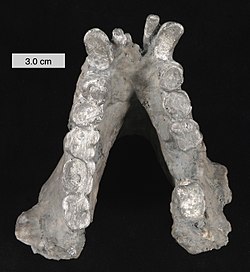
| Gigantopithecus Temporal range: Pleistoseno
| |
|---|---|

| |
| Isang paglalarawan ng Gigantopithecus na nasa Museo ng Tao, sa San Diego, California. | |
| Pag-uuring siyentipiko | |
| Kaharian: | |
| Pilo: | |
| Klase: | |
| Orden: | |
| Pamilya: | |
| Subpamilya: | |
| Henero: | †Gigantopithecus von Koenigswald, 1935
|
| Mga uri | |
|
†Gigantopithecus blacki | |
Ang Gigantopithecus[1] ay isang nangamatay na o hindi na umiiral na sari ng bakulaw o ugaw na namuhay mula mga isang milyong taon hanggang sa kamakailang mga tatlong daan libong taon na ang nakalipas,[2] sa ngayong pangkasalukuyang Tsina, Indiya, at Biyetnam, na naglalagay sa Gigantopithecus sa kaparehong kapanahunan at pook na heograpiko kasama ng ilang mga hominidyong mga uri.[3] Iminumungkahi ng talaan ng bakas o rekord ng posil na ang uring Gigantopithecus blacki ang pinakamalaking mga bakulaw na nabuhay, na tumatayo hanggang 3 metro (9.8 tal) at may timbang na hanggang 540 kilogramo (1,190 lb).[2][4][5]
Mga sanggunian
- ↑ Harvey, Anthony; Barry Cork; Maurice Allward; Teresa Ballús; Roser Oromi (1978). "Gigantopithecus". Qué Sabes del Universo 1 (orihinal na pamagat: New World of Knowledge: Our Earth and the Universe). Ediciones Nauta, S.A. (nilimbag sa Espanya) / William Collins Sons and Company Limited, ISBN 84-278-0441-5, ISBN 84-278-0453-9., pahina 91.
- ↑ 2.0 2.1 Christmas, Jane (2005-11-07). "Giant Ape lived alongside humans". McMaster University. Inarkibo mula sa orihinal noong 2012-02-06. Nakuha noong 2007-12-06.
- ↑ Ciochon, R.; atbp. (1996). "Dated Co-Occurrence of Homo erectus and Gigantopithecus from Tham Khuyen Cave, Vietnam" (PDF). Proceedings of the National Academy of Sciences of the United States of America. 93 (7): 3016–3020. doi:10.1073/pnas.93.7.3016. PMID 8610161. Inarkibo mula sa orihinal (PDF) noong 2008-07-31. Nakuha noong 2007-12-06.
{{cite journal}}: Explicit use of et al. in:|author2=() - ↑ Ciochon, Russell L. "The Ape that Was - Asian fossils reveal humanity's giant cousin". University of Iowa. Inarkibo mula sa orihinal noong 2015-05-25. Nakuha noong 2007-12-06.
- ↑ Pettifor, Eric (2000) [1995]. "From the Teeth of the Dragon: Gigantopithecus Blacki". Selected Readings in Physical Anthropology. Kendall/Hunt Publishing Company. pp. 143–149. ISBN 0787271551. Inarkibo mula sa orihinal noong 2017-08-04. Nakuha noong 2008-01-30.
Content Disclaimer
Informasi ini disarikan dari Wikipedia dan disajikan kembali untuk tujuan edukasi. Konten tersedia di bawah lisensi CC BY-SA 3.0. Kami tidak bertanggung jawab atas ketidakakuratan data yang bersumber dari kontribusi publik tersebut.
- The information displayed on this website is sourced in part or in whole from Wikipedia and has been adapted for the purpose of restating it. We strive to provide accurate and relevant information, however:
- There is no guarantee of absolute accuracy. Wikipedia is an open, collaborative project that can be edited by anyone, so information is subject to change.
- It is not intended to constitute professional advice. The content displayed is for informational and educational purposes only. For important decisions (e.g., medical, legal, or financial), please consult a professional.
- Content copyright. Wikipedia is licensed under the Creative Commons Attribution-ShareAlike License (CC BY-SA). This means that content may be reused with appropriate attribution and shared under a similar license.
- Responsible use. Any risk arising from the use of information from this website is entirely the responsibility of the user.