Bos
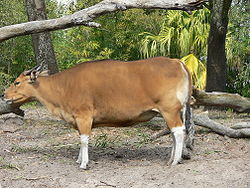
| Bos | |
|---|---|

| |
| Banteng (Bos javanicus ) | |
Pag-uuring siyentipiko 
| |
| Kaharian: | Animalia |
| Pilo: | Chordata |
| Klase: | Mammalia |
| Orden: | Artiodactyla |
| Pamilya: | Bovidae |
| Subpamilya: | Bovinae |
| Tribo: | Bovini |
| Henero: | Bos Linnaeus, 1758 |
| Species | |
|
B. acutifrons † | |
Ang Bos ay isang henus ng ligaw at paamuing baka.
Ang Bos ay kadalasang nahahati sa apat na subgenera: Bos, Bibos, Novibos, at Poephagus, ngunit kasama ang huling tatlong dibisyong ito sa loob ng henus na Bos, nang hindi kasama ang Bison, ay pinaniniwalaan na parapileptiko ng maraming manggagawa sa pag-uuri ng henus mula noong 1980s. Ang henus bilang tradisyonal na tinukoy ay may limang umiiral na mga espesye,[1] ngunit ito ay tumataas sa walo kapag ang mga domestikadong mga uri ay binibilang bilang hiwalay na mga espesye, at sampu kapag ang malapit na nauugnay na Bison ay kasama rin.[2][3][4] Karamihan ngunit hindi lahat ng modernong lahi ng mga alagang baka (kabilang ang taurine na baka at zebu) ay pinaniniwalaang nagmula sa mga namatay na auroch.[5][6] Ang iba tulad ng bakang Bali at gayal ay inaakalang nagmula sa mga espesye ng Timog at Timog-silangang Asya.
Mga sanggunian
- ↑ Grubb, Peter (2005). "Bos". Mula sa Wilson, Don E.; Reeder, DeeAnn M. (mga pat.). Mammal Species of the World. A Taxonomic and Geographic Reference (ika-3rd (online edition) (na) labas). Baltimore: Johns Hopkins University Press. ISBN 9780801882210.
- ↑ Groves, C. P., 1981. Systematic relationships in the Bovini (Artiodactyla, Bovidae). Zeitschrift für Zoologische Systematik und Evolutionsforschung, 4:264-278., quoted in Don E. Wilson & DeeAnn M. Reeder (editors). 2005. Mammal Species of the World. A Taxonomic and Geographic Reference (3rd ed), Johns Hopkins University Press: "Bison". (online edition )
- ↑ Groves, C. P. & Grubb, P. 2011. Ungulate taxonomy. The Johns Hopkins University Press, Baltimore, Maryland.
- ↑ Wang, K., Lenstra, J. A., Liu, L., Hu, Q., Ma, T., Qiu, Q., & Liu, J. (2018). Incomplete lineage sorting rather than hybridization explains the inconsistent phylogeny of the wisent. Communications biology, 1(1), 1-9.
- ↑ van Vuure, Cis (March 2003). De Oeros – Het spoor terug (Ulat) (sa wikang Olandes). publisher=Stichting Kritisch Bosbeheer, Sectie Natuurbeheer van Wageningen Universiteit, Afdeling Natuur van het Ministerie van de Vlaamse Gemeenschap, & Wetenschapswinkel. pp. 1–340. ISBN 906754678X. rapport 186. Nakuha noong 4 January 2020.
- ↑ Briggs, H.M. and Briggs, D.M. (1980). Modern Breeds of Livestock. Macmillan Publishing
 Ang lathalaing ito na tungkol sa Mamalya ay isang usbong. Makatutulong ka sa Wikipedia sa pagpapalawig nito.
Content Disclaimer
Informasi ini disarikan dari Wikipedia dan disajikan kembali untuk tujuan edukasi. Konten tersedia di bawah lisensi CC BY-SA 3.0. Kami tidak bertanggung jawab atas ketidakakuratan data yang bersumber dari kontribusi publik tersebut.
- The information displayed on this website is sourced in part or in whole from Wikipedia and has been adapted for the purpose of restating it. We strive to provide accurate and relevant information, however:
- There is no guarantee of absolute accuracy. Wikipedia is an open, collaborative project that can be edited by anyone, so information is subject to change.
- It is not intended to constitute professional advice. The content displayed is for informational and educational purposes only. For important decisions (e.g., medical, legal, or financial), please consult a professional.
- Content copyright. Wikipedia is licensed under the Creative Commons Attribution-ShareAlike License (CC BY-SA). This means that content may be reused with appropriate attribution and shared under a similar license.
- Responsible use. Any risk arising from the use of information from this website is entirely the responsibility of the user.