Wonsan
Wonsan is a port city and naval base in Kangwon Province, North Korea along the coast of the Sea of Japan. Wonsan is also the provincial capital of the province
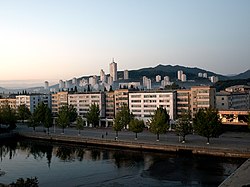

Wonsan is a port city and naval base in Kangwon Province, North Korea along the coast of the Sea of Japan. Wonsan is also the provincial capital of the province.[1]
Geography
Wonsan's area is 269 square kilometres. It is located in Kangwon Province, on the westernmost part of the Sea of Japan. Mount Kŭmgang is near Wonsan.
Administrative divisions
Wonsan is the provincial capital of Kangwon Province.
The City of Wonsan (Wonsan-si) is divided into 45 tong (neighborhoods) and 14 ri (villages):
- Changchon-dong
- Changdŏk-dong
- Changsan-dong
- Chŏkchŏn-dong
- Chŏnjin-dong
- Chungchŏng-dong
- Haean-dong
- Haebang 1-dong
- Haebang 2-dong
- Kaesŏn-dong
- Kalma-dong
- Kwangsŏk-dong
- Kwanphung-dong
- Myŏngsasimri-dong
- Myŏngsŏk-dong
- Naewŏnsan-dong
- Namsan-dong
- Panghasan-dong
- Pogmak-dong
- Poha-dong
- Pongchun-dong
- Pongsu-dong
- Phyŏnghwa-dong
- Ryŏdo-dong
- Ryongha-dong
- Ryul-dong
- Sambong-dong
- Sang-dong
- Segil-dong
- Sinhŭng-dong
- Sinphung-dong
- Sinsŏng-dong
- Sŏgu-dong
- Sŏkhyŏn-dong
- Songchŏn-dong
- Songhŭng-dong
- Sŭngri-dong
- Tŏksŏng-dong
- Tongmyŏngsan-dong
- Thap-dong
- Wau-dong
- Wŏnnam 1-dong
- Wŏnnam 2-dong
- Wŏnsŏk-dong
- Yangji-dong
- Changrim-ri
- Chuksal-li
- Chungp'yŏng-ri
- Chilbong-ri
- Chunsan-ri
- Hyŏndong-ri
- Namchŏn-ri
- Raksu-ri
- Ryongchŏn-ri
- Samthae-ri
- Sangja-ri
- Sinsŏng-ri
- Susang-ri
- Yŏngsam-ri
Transportation
Road and rail
The district of Wonsan is served by several stations on the Kangwon Line of the Korean State Railway.[2]
A trolleybus system with two lines is currently in operation in Wonsan.[3] The system opened on September 8, 1988, from Wonsan station to Changchon-dong.[3] In 2020, there were three new trolleybus lines under construction in the city, which is aimed to prevent air pollution[3]
Urban transit (Tram)
Wonsan Tram was a tourist tram system that was opened in 2025. It consists of one line.[4]
Air

Wonsan is served by Kalma Airport (IATA: WOS, ICAO: ZKWS). Kalma Airport is a dual-use civilian and military use airport. Air Koryo connects Wonsan to Pyongyang Sunan International Airport. A new international terminal was built in 2015.[5]
Sea

Wonsan was the terminus of the Mangyongbong-92 ferry that operated between Wonsan and Niigata. In 2006, This service was canceled when Japan banned North Korean ships in Japanese waters.[6]
Tourism
.jpg)
Wonsan is a popular tourism destination for both Koreans and international visitors. Attractions include Songdowon beach, Masikryong Ski Resort, Songdowon International Children's Union Camp, Wonsan Special Tourist Zone, Sokwangsa Temple, Lake Sijung, Sinphyong-Kumgang Scenic Site, Ullim Falls, and Wonsan Kalma Coastal Tourist Area.[7]
Sister cities
- Sakaiminato, Tottori,
 Japan (1992–2006)[8]
 - Puebla,
 Mexico[9]
 - Vladivostok,
 Russia[10]


References
- ↑ North, 38 (2011-01-19). "City Spotlight: Wonsan". 38 North. Retrieved 2026-02-18.
{{cite web}}:|first=has numeric name (help) - ↑ "Wonsan Train Station | North Korea Travel Guide - Koryo Tours". koryogroup.com. 2019-12-18. Retrieved 2026-02-18.
- ↑ 3.0 3.1 3.2 "Public transport goes environment friendly in Wonsan". The Pyongyang Times. Archived from the original on 2021-07-08. Retrieved 2020-11-17. Alt URL
- ↑ "North Korea opens beach resort tramway". www.mainspring.co.uk. Retrieved 2026-02-18.
- ↑ Grisafi, John (30 July 2015). "Wonsan Airport nears completion, with potential for impact on tourism and economy". NK News. Archived from the original on 16 June 2019. Retrieved 15 January 2017.
- ↑ https://www.washingtontimes.com, The Washington Times (16 October 2006). "Ferry ban turns tide on Korean smuggling". The Washington Times. Retrieved 2026-02-18.
{{cite web}}: External link in|last= - ↑ "North Korea has opened a new tourist zone. The only thing missing — foreign tourists". ABC News. 2025-06-26. Retrieved 2026-02-18.
- ↑ Vyas, Utpal (2010). Soft Power in Japan-China Relations: State, Sub-state and Non-state Relations. Oxon: Routledge. p. 107. ISBN 978-1-136-85896-3.
- ↑ "Secretaría de Relaciones Exteriores - Gobierno - gob.mx" (PDF). www.sre.gob.mx. Archived from the original (PDF) on 2012-06-27. Retrieved 2014-07-14.
- ↑ "Kim Jong Il Holds Third Summit Talks with Putin during Tour of Far Eastern Region of Russia". The People's Korea. Archived from the original on 17 August 2016.
Content Disclaimer
Informasi ini disarikan dari Wikipedia dan disajikan kembali untuk tujuan edukasi. Konten tersedia di bawah lisensi CC BY-SA 3.0. Kami tidak bertanggung jawab atas ketidakakuratan data yang bersumber dari kontribusi publik tersebut.
- The information displayed on this website is sourced in part or in whole from Wikipedia and has been adapted for the purpose of restating it. We strive to provide accurate and relevant information, however:
- There is no guarantee of absolute accuracy. Wikipedia is an open, collaborative project that can be edited by anyone, so information is subject to change.
- It is not intended to constitute professional advice. The content displayed is for informational and educational purposes only. For important decisions (e.g., medical, legal, or financial), please consult a professional.
- Content copyright. Wikipedia is licensed under the Creative Commons Attribution-ShareAlike License (CC BY-SA). This means that content may be reused with appropriate attribution and shared under a similar license.
- Responsible use. Any risk arising from the use of information from this website is entirely the responsibility of the user.