Tumbleweed
Several plant species that grow in arid, steppe-like environments use the wind to propagate. The structure that is pushed by the wind is usually called tumblewe

Several plant species that grow in arid, steppe-like environments use the wind to propagate. The structure that is pushed by the wind is usually called tumbleweed. This structure will detach from its root or stem and will roll on the ground. In most such species, the tumbleweed consists of the whole plant apart from the root system. Sometimes, only a hollow fruit or inflorescence detaches.[1] Tumbleweed species occur most commonly in steppe and arid ecosystems, where frequent wind and the open environment permit rolling easly.[2]
Most tissues of the tumbleweed structure are dead. This needs to be the case, because the structure needs to degrade and fall apart so that its seeds or spores can escape during the tumbling. Sometimes they germinate after the tumbleweed has come to rest in a wet location. In this case, many species of tumbleweed open mechanically, releasing their seeds as they swell when they absorb water.[3]
The tumbleweed diaspore disperses seeds. This stategy is not limited to the seed plants; some species of spore-bearing cryptogams—such as Selaginella—form tumbleweeds, and some fungi that resemble puffballs dry out, break free of their attachments and are similarly tumbled by the wind, dispersing spores as they go.[4][5]

Examples
-
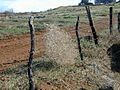 A Kali tragus tumbleweed caught against a fence
 -
 Amaranthus albus
 -
 Brunsvigia bosmaniae in flower in the veld, showing the globular umbels of tumbleweed Amaryllidaceae
 -
 Mass of Salsola tumbleweeds caught behind a fence
 -
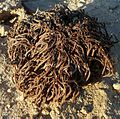 Anastatica, a North African desert tumbleweed
 -
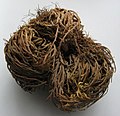 Selaginella lepidophylla, a North American desert tumbleweed
 -
 A tumbleweed in Chelan, Washington

.jpg)


References
- ↑ William Francis Ganong (1921). A Textbook of Botany for Colleges. MacMillan Co. p. 359.
- ↑ Dirk V. Baker (2007). Dispersal of an Invasive Tumbleweed. pp. 90–. ISBN 978-0-549-44310-0.[permanent dead link]
- ↑ W. F. Ganong (1896). "An outline of phytobiology". Bulletin of the Natural History Society of New Brunswick. 13: 3–26, page 1 errata. page 16
- ↑ Orson K. Miller, Jr.; Hope H. Miller (1988). Gasteromycetes: Morphological and Developmental Features with Keys to the Orders, Families, and Genera. Mad River PressInc. ISBN 978-0-916422-74-5.
- ↑ Bulletin. Ohio State University. 1928.
Other websites
- Video showing a massive displacement of tumbleweed in the Mojave desert.
- Howard, Brian Clark (2015-12-17). "Watch a Plague of Tumbleweeds Blow Across the West". National Geographic.
Content Disclaimer
Informasi ini disarikan dari Wikipedia dan disajikan kembali untuk tujuan edukasi. Konten tersedia di bawah lisensi CC BY-SA 3.0. Kami tidak bertanggung jawab atas ketidakakuratan data yang bersumber dari kontribusi publik tersebut.
- The information displayed on this website is sourced in part or in whole from Wikipedia and has been adapted for the purpose of restating it. We strive to provide accurate and relevant information, however:
- There is no guarantee of absolute accuracy. Wikipedia is an open, collaborative project that can be edited by anyone, so information is subject to change.
- It is not intended to constitute professional advice. The content displayed is for informational and educational purposes only. For important decisions (e.g., medical, legal, or financial), please consult a professional.
- Content copyright. Wikipedia is licensed under the Creative Commons Attribution-ShareAlike License (CC BY-SA). This means that content may be reused with appropriate attribution and shared under a similar license.
- Responsible use. Any risk arising from the use of information from this website is entirely the responsibility of the user.