Toxoplasma
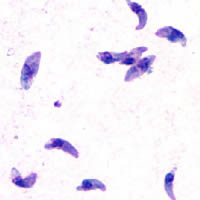
| Toxoplasma gondii | |
|---|---|

| |
| T. gondii tachyzoites | |
| Scientific classification | |
| Kingdom: | |
| Phylum: | |
| Class: | |
| Subclass: | |
| Order: | |
| Family: | |
| Genus: | Toxoplasma
|
| Binomial name | |
| Toxoplasma gondii | |
Toxoplasma gondii is a protozoan parasite that can infect almost all warm-blooded animals, including humans.[1][2]
In humans, it is one of the most common parasites.[3] Blood test show that up to a third of the world population has been or is infected with T. gondii. Infection rates differ greatly from country to country.[4]
Although mild, flu-like symptoms occasionally occur during the first few weeks, infection with T. gondii generally produces no symptoms in healthy human adults.[5] But in infants, HIV/AIDS patients, and others with weakened immunity, infection can cause serious and occasionally fatal illness (toxoplasmosis).[2][5]p77
Infection in humans and other warm-blooded animals can occur
- by eating raw or undercooked meat containing T. gondii tissue cysts.[6][7]
- by drinking water or eating anything contaminated with oocysts.[8] in the faeces of an infected animal.[7]
- from a blood transfusion or organ transplant
- or by transmission from mother to foetus across the placenta.[7]
The parasite can only sexually reproduce in the intestines of members of the cat family (felids).[9] Felids are therefore the definitive hosts of T. gondii, with all other hosts defined as 'intermediate hosts'.
References
- ↑ Weiss, Louis M. & Kami Kim, eds. 2011. Toxoplasma gondii: the model Apicomplexan: perspectives and methods. Academic Press/Elsevier, London, p49.
- ↑ 2.0 2.1 Dubey J.P. 2010. Toxoplasmosis of animals and humans. 2nd ed, CRC Press. ISBN 978-1-4200-9237-0
- ↑ "CDC – About Parasites". Retrieved 12 March 2013.
- ↑ Pappas, Georgios; Roussos, Nikos; Falagas, Matthew E. (2009). "Toxoplasmosis snapshots: global status of Toxoplasma gondii seroprevalence and implications for pregnancy and congenital toxoplasmosis". International Journal for Parasitology. 39 (12): 1385–94. doi:10.1016/j.ijpara.2009.04.003. PMID 19433092.
- ↑ 5.0 5.1 "CDC Parasites – Toxoplasmosis (Toxoplasma infection) – Disease". Retrieved 12 March 2013.
- ↑ Tissue cyst = group of cells with a hard shell around them
- ↑ 7.0 7.1 7.2 Tenter, Astrid M.; Heckeroth, Anja R.; Weiss, Louis M. (2000). "Toxoplasma gondii: from animals to humans". International Journal for Parasitology. 30 (12–13): 1217–58. doi:10.1016/S0020-7519(00)00124-7. PMC 3109627. PMID 11113252.
- ↑ Oocyst: a hardy, thick-walled spore able to survive for long periods outside a host. The zygote develops within the spore, which acts to protect it during transfer to new hosts. This method is found in some Apicomplexa.
- ↑ Dubey, JP (2009). "History of the discovery of the life cycle of Toxoplasma gondii". International Journal for Parasitology. 39 (8): 877–882. doi:10.1016/j.ijpara.2009.01.005. PMID 19630138.
Content Disclaimer
Informasi ini disarikan dari Wikipedia dan disajikan kembali untuk tujuan edukasi. Konten tersedia di bawah lisensi CC BY-SA 3.0. Kami tidak bertanggung jawab atas ketidakakuratan data yang bersumber dari kontribusi publik tersebut.
- The information displayed on this website is sourced in part or in whole from Wikipedia and has been adapted for the purpose of restating it. We strive to provide accurate and relevant information, however:
- There is no guarantee of absolute accuracy. Wikipedia is an open, collaborative project that can be edited by anyone, so information is subject to change.
- It is not intended to constitute professional advice. The content displayed is for informational and educational purposes only. For important decisions (e.g., medical, legal, or financial), please consult a professional.
- Content copyright. Wikipedia is licensed under the Creative Commons Attribution-ShareAlike License (CC BY-SA). This means that content may be reused with appropriate attribution and shared under a similar license.
- Responsible use. Any risk arising from the use of information from this website is entirely the responsibility of the user.