Tetration
Tetration is the hyperoperation which comes after exponentiation.[1] x

Tetration is the hyperoperation which comes after exponentiation.[1] means y exponentiated by itself, (x-1) times.[2][3][4] List of first 4 natural number hyperoperations, the inverse operations of tetration are the super root and the super logarithm.
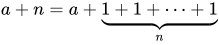
- Addition
-
- n copies of 1 added to a.
-
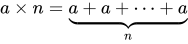
- Multiplication
-
- n copies of a combined by addition.
-
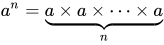
- Exponentiation
-
- n copies of a combined by multiplication.
-
- Tetration

- n copies of a combined by exponentiation, right-to-left.
The above example is read as "the nth tetration of a".
Examples


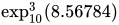
1 1 (11) 1 (11) 1 (11) (11) (Absolute infinity and Infinity) 2 4 (22) 16 (24) 65,536 (216) 3 27 (33) 7,625,597,484,987 (327) 1.258015 × 103,638,334,640,024 4 256 (44) 1.34078 ×10154 (4256) (8.1 × 10153 digits) 5 3,125 (55) 1.91101 × 102,184 (53,125) (1.3 × 102,184 digits) 6 46,656 (66) 2.65912 × 1036,305 (646,656) (2.1 × 1036,305 digits) 7 823,543 (77) 3.75982 × 10695,974 (7823,543) (3.2 × 10695,974 digits) 8 16,777,216 (88) 6.01452 × 1015,151,335 (5.4 × 1015,151,335 digits) 9 387,420,489 (99) 4.28125 × 10369,693,099 (4.1 × 10369,693,099 digits) 10 10,000,000,000 (1010) 1010,000,000,000 (1010,000,000,000 digits) ∞ ∞∞ (∞∞∞)


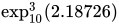

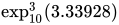

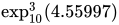

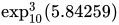

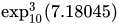



References
- ↑ "Google Answers: addition, multiplication, exponentiation, then ???". Retrieved 2011-11-02.
- ↑ Daniel Geisler. "tetration.org". Tetration. Archived from the original on 2021-05-06. Retrieved 2011-11-02.
- ↑ "Power Tower - from Wolfram MathWorld". Mathworld.wolfram.com. Retrieved 2011-11-02.
- ↑ "The Fourth Operation". Retrieved 2019-09-11.

Content Disclaimer
Informasi ini disarikan dari Wikipedia dan disajikan kembali untuk tujuan edukasi. Konten tersedia di bawah lisensi CC BY-SA 3.0. Kami tidak bertanggung jawab atas ketidakakuratan data yang bersumber dari kontribusi publik tersebut.
- The information displayed on this website is sourced in part or in whole from Wikipedia and has been adapted for the purpose of restating it. We strive to provide accurate and relevant information, however:
- There is no guarantee of absolute accuracy. Wikipedia is an open, collaborative project that can be edited by anyone, so information is subject to change.
- It is not intended to constitute professional advice. The content displayed is for informational and educational purposes only. For important decisions (e.g., medical, legal, or financial), please consult a professional.
- Content copyright. Wikipedia is licensed under the Creative Commons Attribution-ShareAlike License (CC BY-SA). This means that content may be reused with appropriate attribution and shared under a similar license.
- Responsible use. Any risk arising from the use of information from this website is entirely the responsibility of the user.