Takehazuchi
Takehazuchi-no-Mikoto (建葉槌命) Takehazuchi-no-Mikoto (武羽槌命) Toyohazuchi-no-Mikoto (止与波豆知命)
| Takehazuchi | |
|---|---|
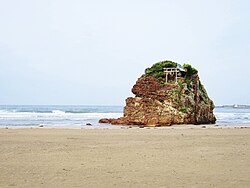
 Inasa Beach (Inasa-no-hama) in Izumo, Shimane Prefecture, where the heavenly messengers met Ōkuninushi. | |
| Other names | Ama-no-Hazuchi-no-Kami (天羽槌雄神) Takehazuchi-no-Mikoto (建葉槌命) |
| Major cult centre | |
| Personal information | |
| Spouse | Shitateru-hime? |
| Parents |
|
Takehazuchi-no-Mikoto (武羽槌命) is a Japanese kami of weaving.[1][2]
Names and identity
Takehazuchi is also called Shizuri (倭文). Legends do not agree on their gender.
- Some versions say Takehazuchi and Shitateruhime-no-mikoto are the same deity.
- Other versions say Shitateru-hime is the wife of Takehazuchi.
Many sources say they are a fifth-generation descendant of Takamimusubi. Some say it goes through the god Sukunabikona.[3]
Some analysis argues that Takehazuchi is a name used to refer to either Ame no Wakahiko or his wife shitateruhime-no-mikoto and this explains the ambiguity in gender.
Myths
In the tale of the rock cave of heaven, Takehazuchi hung bright streamers on the sacred Masakaki tree to help lure Amaterasu out.[4]
During the Tenson kōrin (descent of the heavenly grandson) a star god, Amatsu-Mikaboshi, refused to submit. The Nihon Shoki has two passages about his defeat:
- One says Takehazuchi beat the star god.[5][1]
- The other says Takemikazuchi or Futsunushi beat the star god.[6]
All versions agree that Amatsu-Mikaboshi’s fall cleared the way for the heavenly descent.[2]
Because the name begins with take (“brave”), some writers see Takehazuchi as a war deity. Others say the goddess “wove” the unruly stars into order, calming them.[3]
Connection with weaving and the Shitori clan
The Shitori clan (倭文氏), who were ancient weavers, believed Takehazuchi was their ancestor.[7] Their home shrine is Shitori Shrine, where Takehazuchi and Shitateru-hime are both worshipped as weaving deities.[2]
Shrine legend says Shitateru-hime sailed from izumo, lived on the mountain behind the shrine, and after death was buried in a kofun within the shrine grounds.[7]
Shrines
Takehazuchi is mainly honoured at: Shitori Shrine, Shizu Shrine, and Katsuraki Shitori ni Imasu Ame no Ha Ikazuchi no Mikoto Shrine.
In popular culture
In the movie Your Name a goddess who drives the plot is named Shizuri Takehazuchi no Mikoto (倭文神 建葉槌命)
Related pages
References
- ↑ 1.0 1.1 Aston (1896). "
 Book II". Nihongi: Chronicles of Japan from the Earliest Times to A.D. 697. Wikisource. pp. 69–70.
- ↑ 2.0 2.1 2.2 Mizue, Mori. "Shizuri". Encyclopedia of Shinto (in Japanese).
- ↑ 3.0 3.1 "天羽槌雄神・建葉槌命" (in Japanese). Retrieved 2024-05-23.
- ↑ "神々の庭:天羽槌雄神". Retrieved 2024-05-23.
- ↑ 宇治谷 1988 『日本書紀』上 p.64, 58
- ↑ 寺島良安 (1985). 和漢三才図会. Vol. 10. p. 71.
- ↑ 7.0 7.1 Yoshiki, Emi (2007). Zenkoku “Ichinomiya” tettei gaido (in Japanese). PHP Institute. ISBN 978-4569669304.

Bibliography
- Aston, William George (1896). Nihongi: Chronicles of Japan from the Earliest Times to A.D. 697. Vol. 1. Japan Society of London.
- 宇治谷, 孟 (Tsutomu Ujitani) (1988). 日本書紀. Vol. 上. 講談社.
- Chamberlain, Basil Hall (1919) [1882]. A Translation of the “Ko-ji-ki,” or a Record of Ancient Matters.
Content Disclaimer
Informasi ini disarikan dari Wikipedia dan disajikan kembali untuk tujuan edukasi. Konten tersedia di bawah lisensi CC BY-SA 3.0. Kami tidak bertanggung jawab atas ketidakakuratan data yang bersumber dari kontribusi publik tersebut.
- The information displayed on this website is sourced in part or in whole from Wikipedia and has been adapted for the purpose of restating it. We strive to provide accurate and relevant information, however:
- There is no guarantee of absolute accuracy. Wikipedia is an open, collaborative project that can be edited by anyone, so information is subject to change.
- It is not intended to constitute professional advice. The content displayed is for informational and educational purposes only. For important decisions (e.g., medical, legal, or financial), please consult a professional.
- Content copyright. Wikipedia is licensed under the Creative Commons Attribution-ShareAlike License (CC BY-SA). This means that content may be reused with appropriate attribution and shared under a similar license.
- Responsible use. Any risk arising from the use of information from this website is entirely the responsibility of the user.