Synthetic division
Synthetic division is a way to divide polynomials. It takes up less space than polynomial long division. It is mostly used to divide a polynomial by a binomial

Synthetic division is a way to divide polynomials. It takes up less space than polynomial long division. It is mostly used to divide a polynomial by a binomial that looks like this:
but it can be divided by any polynomial with one variable.
Synthetic division can be used to make calculations without writing variables. It also uses a small number of calculations, and takes less room on paper than long division. The subtractions in long division are changed to additions by changing the signs at the very beginning, which keeps sign errors from happening.
Synthetic division for linear denominators is also called division in Ruffini's rule.
Process
The first example is synthetic division with a denominator that only has one variable.

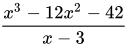
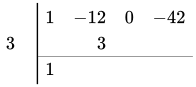
The coefficients of the polynomial to divide are put at the top (the zero is for the unseen ).

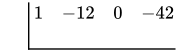
Make the coefficients of the denominator their opposite.

Put every coefficient of the divisor except the first one on the left.
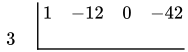
Put the first number after the bar, 1, at the bottom.
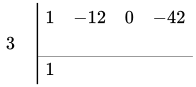
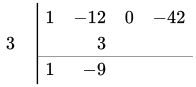
Multiply the dropped number by the number before the bar, and put it under the next coefficient, 12.
Add the numbers in the second column (which equals -9 in this example).
Do the last two steps again to get this:
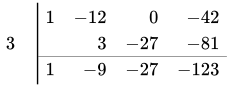
Count the terms to the left of the bar. Since there is only one, the remainder has degree zero, which means it is a constant that is more than zero. Put an up and down line next to the last number, -123.

The terms are written with a rising degree from right to left. It begins with degree zero for both the remainder and the result.

The last part of the division is:

Content Disclaimer
Informasi ini disarikan dari Wikipedia dan disajikan kembali untuk tujuan edukasi. Konten tersedia di bawah lisensi CC BY-SA 3.0. Kami tidak bertanggung jawab atas ketidakakuratan data yang bersumber dari kontribusi publik tersebut.
- The information displayed on this website is sourced in part or in whole from Wikipedia and has been adapted for the purpose of restating it. We strive to provide accurate and relevant information, however:
- There is no guarantee of absolute accuracy. Wikipedia is an open, collaborative project that can be edited by anyone, so information is subject to change.
- It is not intended to constitute professional advice. The content displayed is for informational and educational purposes only. For important decisions (e.g., medical, legal, or financial), please consult a professional.
- Content copyright. Wikipedia is licensed under the Creative Commons Attribution-ShareAlike License (CC BY-SA). This means that content may be reused with appropriate attribution and shared under a similar license.
- Responsible use. Any risk arising from the use of information from this website is entirely the responsibility of the user.