Suzhousaurus
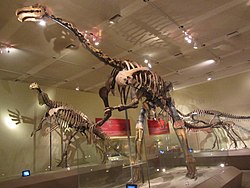
| Suzhousaurus Temporal range: Early Cretaceous,
~ | |
|---|---|

| |
| Mounted skeleton displayed in National Museum of Natural Science with elements from both specimens | |
Scientific classification 
| |
| Kingdom: | Animalia |
| Phylum: | Chordata |
| Clade: | Dinosauria |
| Clade: | Saurischia |
| Clade: | Theropoda |
| Clade: | †Therizinosauria |
| Superfamily: | †Therizinosauroidea |
| Genus: | †Suzhousaurus Li et al. 2007 |
| Type species | |
| †Suzhousaurus megatherioides Li et al. 2007
| |
Suzhousaurus is a genus of large therizinosauroid dinosaur from the Early Cretaceous of China. It was an unusually large dinosaur for its time, reaching lengths of 6 meters (20 ft) and weighing nearly 3.1 tons (3,100 kg). It was a herbivore and known from two specimens discovered in the Xiagou Formation and Zhonggou Formation in China.[1][2]
History/Discovery
The genus Suzhousaurus was named after the old name of Jiuquan, the city where it was found. The first specimens were discovered during field works in 1999 and 2004 in the Xiagou Formation and Zhonggou Formation, which are part of the Xinminbao Group in China. It’s considered a significant find due to its large size and because it helps to understand more about therizinosauroid dinosaurs.[3] The name Suzhousaurus is derived from “Suzhou,” which is the old name for the Jiuquan area where the dinosaur fossils were found. The suffix “-saurus” is commonly used in dinosaur names and means “lizard” in Greek, so Suzhousaurus translates to "Suzhou lizard".
Unique features
Suzhousaurus had several unique features that differentiated it from other therizinosaur taxa:
- A round top border of the preacetabular projection of the ilium.
- A foramen (hole) on the obturator area with a total width greater than its height.
- A relatively short pubis with a deep and wide obturator notch.
- The ischiadic shaft was deflected towards the rear.
Additionally, it was an unusually large Early Cretaceous therizinosauroid, reaching lengths of 6 meters (20 ft) and weighing nearly 3.1 tons (3,100 kg). Its upper arm was very distinct from other therizinosaurids, which contributed to its classification as a therizinosauroid.[4] These features reflect its adaptations as a herbivore with a specialized diet.
Habitat and environment
Suzhousaurus lived during the Early Cretaceous period in what is now China. It inhabited areas known as the Xiagou Formation and Zhonggou Formation, which are part of the Xinminbao Group. These formations suggest a habitat that was likely rich in vegetation, supporting its herbivorous diet. The exact nature of its environment, such as climate and specific flora, is not detailed in the search results. However, it’s reasonable to infer that Suzhousaurus lived in an ecosystem that could sustain large herbivorous dinosaurs.
Feeding habits
Suzhousaurus was a herbivore, as indicated by its classification as a therizinosauroid. Therizinosaurs are known for their long necks and small heads with beak-like mouths, which suggest they fed on vegetation. Their large claws may have been used for defense or to help in feeding, possibly pulling down branches to reach leaves or other plant material.[5] [6]
References
- ↑ "Suzhousaurus". Dinopedia. Retrieved 2024-06-19.
- ↑ "Suzhousaurus". dinosaurpictures.org. Retrieved 2024-06-19.
- ↑ "Suzhousaurus and its strange relatives". Science. 2007-10-11. Retrieved 2024-06-19.
- ↑ "Suzhousaurus and its strange relatives". Science. 2007-10-11. Retrieved 2024-06-19.
- ↑ "Suzhousaurus and its strange relatives". Science. 2007-10-11. Retrieved 2024-06-19.
- ↑ October 11, laelaps on; 2007. "Suzhousaurus and its strange relatives | ScienceBlogs". scienceblogs.com. Retrieved 2024-06-19.
{{cite web}}:|last2=has numeric name (help)CS1 maint: numeric names: authors list (link)
Content Disclaimer
Informasi ini disarikan dari Wikipedia dan disajikan kembali untuk tujuan edukasi. Konten tersedia di bawah lisensi CC BY-SA 3.0. Kami tidak bertanggung jawab atas ketidakakuratan data yang bersumber dari kontribusi publik tersebut.
- The information displayed on this website is sourced in part or in whole from Wikipedia and has been adapted for the purpose of restating it. We strive to provide accurate and relevant information, however:
- There is no guarantee of absolute accuracy. Wikipedia is an open, collaborative project that can be edited by anyone, so information is subject to change.
- It is not intended to constitute professional advice. The content displayed is for informational and educational purposes only. For important decisions (e.g., medical, legal, or financial), please consult a professional.
- Content copyright. Wikipedia is licensed under the Creative Commons Attribution-ShareAlike License (CC BY-SA). This means that content may be reused with appropriate attribution and shared under a similar license.
- Responsible use. Any risk arising from the use of information from this website is entirely the responsibility of the user.