Snakefly
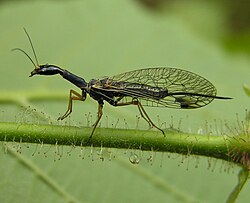
| Snakefly Temporal range: Lower Jurassic – Recent
| |
|---|---|

| |
| Female Dichrostigma flavipes | |
| Scientific classification | |
| Kingdom: | |
| Phylum: | |
| Class: | |
| Infraclass: | |
| Order: | Raphidioptera Handlirsch, 1908
|
| Synonyms | |
| |
The snakeflies (Raphidioptera) are a small order of Endopterygote insects. They are closely related to the Megaloptera and Neuroptera.[1]
There are about 210 living species. They are easily recognized by their small head and long 'neck', which is actually the elongated prothorax.
The snakefly, about 15 mm (0.6 inch) long, has two pairs of similar, net-veined wings, long antennae, and chewing mouthparts. The female lays eggs with a long ovipositor.
Life cycle
The life cycle includes egg, larva, pupa, and adult. The active and carnivorous larvae live beneath loose tree bark. The snakefly is found on every continent except Australia and may be beneficial to humans because it destroys the larvae and pupae of other insects.[2]
References
- ↑ Jepson, J.E.; Jarzembowski, E.A. (2008). "Two new species of snakefly (Insecta:Raphidioptera) from the Lower Cretaceous of England and Spain with a review of other fossil raphidiopterans from the Jurassic/Cretaceous transition" (PDF). Alavesia. 2: 193–201. Archived from the original (PDF) on 2011-07-18. Retrieved 2011-06-10.
- ↑ Aspöck, H. 2002. The biology of Raphidioptera: a review of present knowledge. Acta Zoologica Academiae Scientiarum Hungaricae. 48 (Supplement 2): 35–50. PDF fulltext
Content Disclaimer
Informasi ini disarikan dari Wikipedia dan disajikan kembali untuk tujuan edukasi. Konten tersedia di bawah lisensi CC BY-SA 3.0. Kami tidak bertanggung jawab atas ketidakakuratan data yang bersumber dari kontribusi publik tersebut.
- The information displayed on this website is sourced in part or in whole from Wikipedia and has been adapted for the purpose of restating it. We strive to provide accurate and relevant information, however:
- There is no guarantee of absolute accuracy. Wikipedia is an open, collaborative project that can be edited by anyone, so information is subject to change.
- It is not intended to constitute professional advice. The content displayed is for informational and educational purposes only. For important decisions (e.g., medical, legal, or financial), please consult a professional.
- Content copyright. Wikipedia is licensed under the Creative Commons Attribution-ShareAlike License (CC BY-SA). This means that content may be reused with appropriate attribution and shared under a similar license.
- Responsible use. Any risk arising from the use of information from this website is entirely the responsibility of the user.