Rivet
A rivet is a type of bolt which fastens plates of metal together. Riveting was a main method of building metal ships, bridges and many other complex metal objec
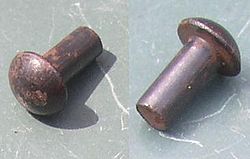


A rivet is a type of bolt which fastens plates of metal together. Riveting was a main method of building metal ships, bridges and many other complex metal objects. It was developed in the early industrial revolution from earlier ideas. It is no longer the main method of metal fastening, but examples can be seen all over the world.
The key idea is that the slug of metal is red-hot when hammered into place. This results in the slug of metal having a dumbell shape which holds the two metal sheets together. An automatic jackhammer is used to force the metal into position, so giving a bulb on the inside face away from the pounding. The process (for example, of ship building) was very noisy. As the metal cooled, the two end of the rivet were pulled together, making a tight joint.[1]
To be a riveter was skilled work. The men worked in teams of four: two to heat the rivet and pass it to the two fasteners. It was therefore an expensive process even when it was shortened by mechanising the heating process as in the example shown.
Rivets could be tested simply by tapping. A rivet tightly set in its hole gives a clear ring, while a loose rivet produces a different sound.
Riveting developed in many ways, and there are many different kinds of rivets.[2][3] Today riveting has been largely replaced by welding, or by high-strength bolts. However, riveting is still used where light weight and high strength are critical, such as in aircraft.
Examples
References
- ↑ Segui, William T. 2007. Steel design. 4th ed, Toronto: Thomson. ISBN 978-0-495-24471-4
- ↑ Improvements in and relating to rivets and riveting – United Kingdom Patent GB286471
- ↑ Emhart News June 2011 GB
Content Disclaimer
Informasi ini disarikan dari Wikipedia dan disajikan kembali untuk tujuan edukasi. Konten tersedia di bawah lisensi CC BY-SA 3.0. Kami tidak bertanggung jawab atas ketidakakuratan data yang bersumber dari kontribusi publik tersebut.
- The information displayed on this website is sourced in part or in whole from Wikipedia and has been adapted for the purpose of restating it. We strive to provide accurate and relevant information, however:
- There is no guarantee of absolute accuracy. Wikipedia is an open, collaborative project that can be edited by anyone, so information is subject to change.
- It is not intended to constitute professional advice. The content displayed is for informational and educational purposes only. For important decisions (e.g., medical, legal, or financial), please consult a professional.
- Content copyright. Wikipedia is licensed under the Creative Commons Attribution-ShareAlike License (CC BY-SA). This means that content may be reused with appropriate attribution and shared under a similar license.
- Responsible use. Any risk arising from the use of information from this website is entirely the responsibility of the user.