Radiodonta
| Radiodonta Temporal range:
| |
|---|---|

| |
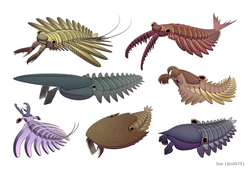
| Some radiodonts (Amplectobelua symbrachiata, Anomalocaris canadensis, Aegirocassis benmoulai, Peytoia nathorsti, Lyrarapax unguispinus, Cambroraster falcatus, and Hurdia victoria) | |
| Scientific classification | |
| Kingdom: | |
| Phylum: | |
| Class: | |
| Order: | †Radiodonta
|
Radiodonta is an extinct order of ancient arthropods that was successful during the Cambrian period. They can be called radiodonts[1] and radiodontans[2] along with other names.
Radiodonts are identified by distinct appendages on their faces, which are diverse and can do a lot of things. They were some of the earliest top predators, such as Anomalocaris, but some others, such as Aegirocassis were filter feeders, eating by filtering food out of the water around them.[3]
References
- ↑ Hou, Xian-Guang (November 2018). "New radiodonts with gnathobase-like structures from the Cambrian Chengjiang biota and implications for the systematics of Radiodonta". Papers in Palaeontology. 4 (4): 605–621. Bibcode:2018PPal....4..605C. doi:10.1002/spp2.1219. ISSN 2056-2802.
- ↑ Cong, Peiyun; Daley, Allison C.; Edgecombe, Gregory D.; Hou, Xianguang (2017-08-30). "The functional head of the Cambrian radiodontan (stem-group Euarthropoda) Amplectobelua symbrachiata". BMC Evolutionary Biology. 17 (1): 208. Bibcode:2017BMCEE..17..208C. doi:10.1186/s12862-017-1049-1. ISSN 1471-2148. PMC 5577670. PMID 28854872.
- ↑ Van Roy, Peter; Daley, Allison C.; Briggs, Derek E. G. (June 2015). "Anomalocaridid trunk limb homology revealed by a giant filter-feeder with paired flaps". Nature. 522 (7554): 77–80. Bibcode:2015Natur.522...77V. doi:10.1038/nature14256. ISSN 1476-4687. PMID 25762145.

Content Disclaimer
Informasi ini disarikan dari Wikipedia dan disajikan kembali untuk tujuan edukasi. Konten tersedia di bawah lisensi CC BY-SA 3.0. Kami tidak bertanggung jawab atas ketidakakuratan data yang bersumber dari kontribusi publik tersebut.
- The information displayed on this website is sourced in part or in whole from Wikipedia and has been adapted for the purpose of restating it. We strive to provide accurate and relevant information, however:
- There is no guarantee of absolute accuracy. Wikipedia is an open, collaborative project that can be edited by anyone, so information is subject to change.
- It is not intended to constitute professional advice. The content displayed is for informational and educational purposes only. For important decisions (e.g., medical, legal, or financial), please consult a professional.
- Content copyright. Wikipedia is licensed under the Creative Commons Attribution-ShareAlike License (CC BY-SA). This means that content may be reused with appropriate attribution and shared under a similar license.
- Responsible use. Any risk arising from the use of information from this website is entirely the responsibility of the user.