Maxillopoda
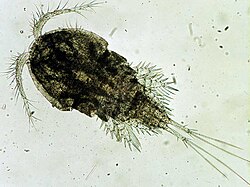
| Maxillopoda Temporal range: Cambrian to Recent
| |
|---|---|

| |
| Cyclops (Copepoda: Cyclopoida) | |
| Scientific classification | |
| Kingdom: | |
| (unranked): | |
| Phylum: | |
| Subphylum: | |
| Class: | Maxillopoda |
| Sub-classes | |
| |
Maxillopoda was a diverse class of crustaceans which includes the barnacles, copepods and a number of related animals. It is now an obsolete taxon, this means the class is no longer used. Dna testing has shown that many members in this group are not closely related to each other.
It does not appear to be a monophyletic group, and no single character unites all the members.[2]
Description
With the exception of some barnacles, maxillopodans are mostly small,[3] including the smallest known arthropod, Stygotantulus stocki.[2] They often have short bodies, with the abdomen reduced in size, and generally lacking any appendages [3] This may have arisen through paedomorphosis.[3]
Apart from barnacles, which use their legs for filter feeding, most maxillopodans feed with their maxillae. Their bodyplan has 5 head segments, 6 thoracic segments and 4 abdominal segments, followed by a telson (tailpiece).[4]
Fossil record
The fossil record of the group extends back into the Cambrian, with fossils of barnacles and tongue worms known from that period.[5][6]
Classification
Six subclasses are generally recognised, although many works have included the ostracods among the Maxillopoda.[2] Of the six groups, only Mystacocarida are entirely free-living; all the members of the Tantulocarida, Pentastomida and Branchiura are parasitic, and many of the Copepoda and Thecostraca are parasites.
References

- ↑ "Maxillopoda". Integrated Taxonomic Information System. Retrieved October 7, 2010.
- ↑ 2.0 2.1 2.2 Joel W. Martin & George E. Davis (2001). An updated classification of the Recent Crustacea (PDF). Natural History Museum of Los Angeles County. p. 132. Archived from the original (PDF) on 2013-05-12. Retrieved 2011-09-12.
- ↑ 3.0 3.1 3.2 "Introduction to Maxillopoda". University of California, Berkeley. Retrieved December 31, 2009.
- ↑ Phil Myers (2001). ""Maxillopoda"". Animal Diversity Web. Retrieved December 31, 2009.
- ↑ B.A. Foster & J.S. Buckeridge (1987). "Barnacle palaeontology". In A.J. Southward (ed.). Crustacean Issues 5: Barnacle biology. CRC Press. pp. 41–63. ISBN 90-6191-628-3.
- ↑ Dieter Waloszek, John E. Repetski & Andreas Maas (2005). "A new Late Cambrian pentastomid and a review of the relationships of this parasitic group". Transactions of the Royal Society of Edinburgh: Earth Sciences. 96 (2): 163–176. doi:10.1017/S0263593300001280. S2CID 84859920.
Content Disclaimer
Informasi ini disarikan dari Wikipedia dan disajikan kembali untuk tujuan edukasi. Konten tersedia di bawah lisensi CC BY-SA 3.0. Kami tidak bertanggung jawab atas ketidakakuratan data yang bersumber dari kontribusi publik tersebut.
- The information displayed on this website is sourced in part or in whole from Wikipedia and has been adapted for the purpose of restating it. We strive to provide accurate and relevant information, however:
- There is no guarantee of absolute accuracy. Wikipedia is an open, collaborative project that can be edited by anyone, so information is subject to change.
- It is not intended to constitute professional advice. The content displayed is for informational and educational purposes only. For important decisions (e.g., medical, legal, or financial), please consult a professional.
- Content copyright. Wikipedia is licensed under the Creative Commons Attribution-ShareAlike License (CC BY-SA). This means that content may be reused with appropriate attribution and shared under a similar license.
- Responsible use. Any risk arising from the use of information from this website is entirely the responsibility of the user.