Hylonomus
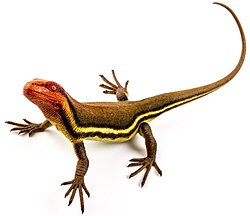
| Hylonomus Temporal range: Pennsylvanian,
| |
|---|---|

| |
| Model | |
Scientific classification 
| |
| Kingdom: | Animalia |
| Phylum: | Chordata |
| Class: | Reptilia |
| Clade: | Romeriida |
| Genus: | †Hylonomus Dawson, 1860 |
| Type species | |
| †Hylonomus lyelli Dawson, 1860
| |
Hylonomus is an extinct stem tetrapod which lived 312 million years ago (mya) during the Pennsylvanian.[1] The lack of skull openings behind the eyes makes it difficult to decide whether or not it is a sauropsid. Westlothiana is older, but may have been an amphibian, and Casineria is rather fragmentary.
Hylonomus was 20 centimetres (8 in) long (including the tail) and probably would have looked rather similar to modern lizards. It had small sharp teeth and likely ate small invertebrates such as millipedes or early insects.[2]
Fossils of Hylonomus have been found in the remains of fossilized club moss stumps in Joggins Fossil Cliffs, Nova Scotia, Canada. The theory is that, after harsh weather, the club mosses would crash down. The stumps eventually hollow out. Small animals such as Hylonomus, seeking shelter, might enter and become trapped, starving to death. Fossils of the basal pelycosaur Archaeothyris and the basal diapsid Petrolacosaurus are also found in the same region of Nova Scotia, higher up, dated about 6 million years later.[1]
Some fossilized footprints, from about 315 mya, have been found in New Brunswick. They are attributed to Hylonomus.[3]
References
- ↑ 1.0 1.1 Van Tuinen, Marcel; Hadly, Elizabeth A. (2004). "Error in estimation of rate and time inferred from the early Amniote fossil record and avian molecular clocks" (PDF). Journal of Molecular Evolution. 59 (2): 267–276. Bibcode:2004JMolE..59..267V. doi:10.1007/s00239-004-2624-9. PMID 15486700. S2CID 25065918. Retrieved 2009-09-02.
- ↑ Palmer D., ed. (1999). The Marshall Illustrated encyclopedia of dinosaurs and prehistoric animals. London: Marshall Editions. p. 62. ISBN 1-84028-152-9.
- ↑ Falcon-Lang H.J., Benton M.J. & Stimson M. 2007. Ecology of early reptiles inferred from Lower Pennsylvanian trackways. Journal of the Geological Society, London, 164, 6, 1113-1118. article[permanent dead link]
Content Disclaimer
Informasi ini disarikan dari Wikipedia dan disajikan kembali untuk tujuan edukasi. Konten tersedia di bawah lisensi CC BY-SA 3.0. Kami tidak bertanggung jawab atas ketidakakuratan data yang bersumber dari kontribusi publik tersebut.
- The information displayed on this website is sourced in part or in whole from Wikipedia and has been adapted for the purpose of restating it. We strive to provide accurate and relevant information, however:
- There is no guarantee of absolute accuracy. Wikipedia is an open, collaborative project that can be edited by anyone, so information is subject to change.
- It is not intended to constitute professional advice. The content displayed is for informational and educational purposes only. For important decisions (e.g., medical, legal, or financial), please consult a professional.
- Content copyright. Wikipedia is licensed under the Creative Commons Attribution-ShareAlike License (CC BY-SA). This means that content may be reused with appropriate attribution and shared under a similar license.
- Responsible use. Any risk arising from the use of information from this website is entirely the responsibility of the user.