Gorgonopsid
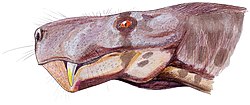
| Gorgonopsia Temporal range: Middle to Late Permian
| |
|---|---|

| |
| Gorgonops | |
| Scientific classification | |
| Kingdom: | |
| Phylum: | |
| Class: | |
| Order: | |
| Suborder: | †Gorgonopsia Seeley, 1895
|
| Family: | †Gorgonopsidae Lydekker, 1890
|
| Subfamilies | |
|
Gorgonopsinae | |
The Gorgonopsids [1] were Therapsids, a group of tetrapods which eventually gave rise to the cynodonts, with the cynodonts ultimately giving rise to mammals. Gorgonopsids probably had rhino like skin and still laid eggs.
Gorgonopsids were a successful group which lived during the Permian period, about 260 million years ago. They were members of the Class Synapsida and possibly related to the pelycosaurs. They became extinct in the Permian–Triassic extinction event.
They were the major predators of their day, having large, powerful, square-shaped jaws with huge, sabre-like canines and interlaced, socket-like teeth. Many fossils have been found in South Africa.
The most famous of all, Inostrancevia, was the size of Smilodon with a 45-cm long skull, and 12-cm long sabre-like teeth. The teeth were not as long as saber toothed cats but had a more robust skull. This predator could easily take down a Scutosaurus, or small animals such as Dvinosaurus.
The Gorgonopsidae are divided into three sub-families:
- Rubidginae, which had large, broad skulls,
- Gorgonopsinae, which included most of the gorgonopsid genera.
- Inostranceviinae
Notes

Content Disclaimer
Informasi ini disarikan dari Wikipedia dan disajikan kembali untuk tujuan edukasi. Konten tersedia di bawah lisensi CC BY-SA 3.0. Kami tidak bertanggung jawab atas ketidakakuratan data yang bersumber dari kontribusi publik tersebut.
- The information displayed on this website is sourced in part or in whole from Wikipedia and has been adapted for the purpose of restating it. We strive to provide accurate and relevant information, however:
- There is no guarantee of absolute accuracy. Wikipedia is an open, collaborative project that can be edited by anyone, so information is subject to change.
- It is not intended to constitute professional advice. The content displayed is for informational and educational purposes only. For important decisions (e.g., medical, legal, or financial), please consult a professional.
- Content copyright. Wikipedia is licensed under the Creative Commons Attribution-ShareAlike License (CC BY-SA). This means that content may be reused with appropriate attribution and shared under a similar license.
- Responsible use. Any risk arising from the use of information from this website is entirely the responsibility of the user.