Colour theory
Colour theory or color theory is a guide for colour mixing and the visual effects of colour combinations.
Colour theory or color theory is a guide for colour mixing and the visual effects of colour combinations.
There are also definitions (or categories) of colours based on the colour wheel: primary colour, secondary and tertiary colours.[1] Colour theory principles first appeared in the writings of Leone Battista Alberti (c. 1435) and the notebooks of Leonardo da Vinci (c. 1490).

The foundations of pre-20th-century colour theory were built around "pure" or ideal colours, as sensory experiences rather than the physical world. This has led to a number of inaccuracies in the colour theory principles.
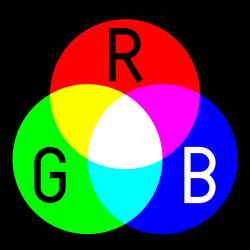
There is a difference between the behaviour of light mixtures, called additive color mixing, and the behavior of paint, ink, dye, or pigment mixtures, called subtractive color mixing. The absorption of light by material substances follows different rules from the perception of light by the eye.
A second problem is the failure to describe the important effects of strong light. The appearance of colours reflected from a surface (such as paints or inks) is not the same as mixed colours of light. "Colours" such as browns or ochres cannot appear in mixtures of light. A strong lightness contrast between a mid-valued yellow paint and a surrounding bright white makes the yellow appear to be green or brown, while a strong brightness contrast between a rainbow and the surrounding sky makes the yellow in a rainbow appear to be a fainter yellow, or white.
Another problem is the tendency to describe colour too simply, for example as a contrast between "yellow" and "blue". Most colour effects are due to contrasts on the attributes that define all colours:
- Value, (light vs. dark, or white vs. black),
- Chroma, [saturation, strength, intensity] (intense vs. dull), and
- Hue (e.g. the name of the colour family: red, yellow, green, cyan, blue and magenta).
Thus, the visual impact of "yellow" vs. "blue" hues in visual design depends on the relative lightness and saturation of the hues.
Many colour theorists have said that three "pure" primary colours can mix all possible colours. They think any failure of paints or inks to match this ideal performance is due to the impurity or imperfection of the colourants. But any three real "primary" colours of light, paint or ink can mix only a limited range of colours, which is always smaller than the full range of colours we can see.[2][3]

Related pages
References
- ↑ Dekel, Gil (2016). "RGB and CMYK Colour systems". Retrieved 2016-06-24.
- ↑ Humans can perceive over 2.8 million different hues. Pointer M.R. & Attridge G.G. 1998. The number of discernible colors. Color Research and Application, 23 (1), pp. 52–54.
- ↑ Hard, A. & Sivik, L. (2001). "A theory of colors in combination – A descriptive model related to the NCS color-order system". Color Research and Application, 26 (1), pp. 4–28.
Content Disclaimer
Informasi ini disarikan dari Wikipedia dan disajikan kembali untuk tujuan edukasi. Konten tersedia di bawah lisensi CC BY-SA 3.0. Kami tidak bertanggung jawab atas ketidakakuratan data yang bersumber dari kontribusi publik tersebut.
- The information displayed on this website is sourced in part or in whole from Wikipedia and has been adapted for the purpose of restating it. We strive to provide accurate and relevant information, however:
- There is no guarantee of absolute accuracy. Wikipedia is an open, collaborative project that can be edited by anyone, so information is subject to change.
- It is not intended to constitute professional advice. The content displayed is for informational and educational purposes only. For important decisions (e.g., medical, legal, or financial), please consult a professional.
- Content copyright. Wikipedia is licensed under the Creative Commons Attribution-ShareAlike License (CC BY-SA). This means that content may be reused with appropriate attribution and shared under a similar license.
- Responsible use. Any risk arising from the use of information from this website is entirely the responsibility of the user.