Choanozoa
Choanozoa
| Choanozoa | |
|---|---|

| |
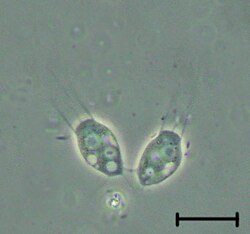
| Codonosiga, a choanoflagellate | |

| |
| Florida panther, an animal | |
Scientific classification 
| |
| Domain: | Eukaryota |
| Clade: | Podiata |
| Clade: | Amorphea |
| Clade: | Obazoa |
| Clade: | Opisthokonta |
| Clade: | Holozoa |
| Clade: | Filozoa |
| Clade: | Choanozoa Brunet and King, 2017 |
| Subdivisions | |
| Synonyms | |
| |
Choanozoa is a clade of eukaryotes. They are in the opisthokont clade. It has the choanoflagellates (Choanoflagellatea) and the animals (Animalia). It has the choanoflagellates and animals. This has important meanings for the origin of the animals.[2] The clade was found in 2015 by Graham Budd and Sören Jensen. They used the word Apoikozoa.[3] The 2018 classification by the International Society of Protistologists says to use the word Choanozoa.[4]
Evolution meanings
The last common ancestor of the Choanozoa cannot be found. However, the last common ancestor probably lived during the Ediacaran period.[3] In this cladogram, the amount of time it took to diverge into a new clade is shown.[5][6][7] The Holomycota tree is from the study by Tedersoo et al.[8]
| Opisthokonta | |
| 1300 mya |
.jpg)


.jpg)
References
- ↑ Laura Wegener Parfrey; Daniel J G Lahr; Andrew H Knoll; Laura A Katz (16 August 2011). "Estimating the timing of early eukaryotic diversification with multigene molecular clocks" (PDF). Proceedings of the National Academy of Sciences of the United States of America. 108 (33): 13624–9. Bibcode:2011PNAS..10813624P. doi:10.1073/PNAS.1110633108. ISSN 0027-8424. PMC 3158185. PMID 21810989. Wikidata Q24614721.
- ↑ King, N.; Westbrook, M. J.; Young, S. L.; Kuo, A.; Abedin, M.; Chapman, J.; Fairclough, S.; Hellsten, U.; Isogai, Y.; Letunic, I. (February 14, 2008). "The genome of the choanoflagellate Monosiga brevicollis and the origin of metazoans". Nature. 451 (7180): 783–788. Bibcode:2008Natur.451..783K. doi:10.1038/nature06617. PMC 2562698. PMID 18273011.
- ↑ 3.0 3.1 Budd, G. E.; Jensen, S. (2015). "The origin of the animals and a 'Savannah' hypothesis for early bilaterian evolution". Biological Reviews. 92 (1): 446–473. doi:10.1111/brv.12239. PMID 26588818.
- ↑ Adl, Sina M.; Bass, David; Lane, Christopher E.; Lukeš, Julius; Schoch, Conrad L.; Smirnov, Alexey; Agatha, Sabine; Berney, Cedric; Brown, Matthew W. (2018-09-26). "Revisions to the Classification, Nomenclature, and Diversity of Eukaryotes". Journal of Eukaryotic Microbiology. 66 (1): 4–119. doi:10.1111/jeu.12691. PMC 6492006. PMID 30257078.
- ↑ Peterson, Kevin J.; Cotton, James A.; Gehling, James G.; Pisani, Davide (2008-04-27). "The Ediacaran emergence of bilaterians: congruence between the genetic and the geological fossil records". Philosophical Transactions of the Royal Society of London B: Biological Sciences. 363 (1496): 1435–1443. doi:10.1098/rstb.2007.2233. PMC 2614224. PMID 18192191.
- ↑ Parfrey, Laura Wegener; Lahr, Daniel J. G.; Knoll, Andrew H.; Katz, Laura A. (2011-08-16). "Estimating the timing of early eukaryotic diversification with multigene molecular clocks". Proceedings of the National Academy of Sciences. 108 (33): 13624–13629. Bibcode:2011PNAS..10813624P. doi:10.1073/pnas.1110633108. PMC 3158185. PMID 21810989.
- ↑ Hehenberger, Elisabeth; Tikhonenkov, Denis V.; Kolisko, Martin; Campo, Javier del; Esaulov, Anton S.; Mylnikov, Alexander P.; Keeling, Patrick J. (2017). "Novel Predators Reshape Holozoan Phylogeny and Reveal the Presence of a Two-Component Signaling System in the Ancestor of Animals". Current Biology. 27 (13): 2043–2050.e6. Bibcode:2017CBio...27E2043H. doi:10.1016/j.cub.2017.06.006. PMID 28648822.
- ↑ Tedersoo, Leho; Sánchez-Ramírez, Santiago; Kõljalg, Urmas; Bahram, Mohammad; Döring, Markus; Schigel, Dmitry; May, Tom; Ryberg, Martin; Abarenkov, Kessy (2018). "High-level classification of the Fungi and a tool for evolutionary ecological analyses". Fungal Diversity. 90 (1): 135–159. doi:10.1007/s13225-018-0401-0. hdl:10138/238983. ISSN 1560-2745.
Content Disclaimer
Informasi ini disarikan dari Wikipedia dan disajikan kembali untuk tujuan edukasi. Konten tersedia di bawah lisensi CC BY-SA 3.0. Kami tidak bertanggung jawab atas ketidakakuratan data yang bersumber dari kontribusi publik tersebut.
- The information displayed on this website is sourced in part or in whole from Wikipedia and has been adapted for the purpose of restating it. We strive to provide accurate and relevant information, however:
- There is no guarantee of absolute accuracy. Wikipedia is an open, collaborative project that can be edited by anyone, so information is subject to change.
- It is not intended to constitute professional advice. The content displayed is for informational and educational purposes only. For important decisions (e.g., medical, legal, or financial), please consult a professional.
- Content copyright. Wikipedia is licensed under the Creative Commons Attribution-ShareAlike License (CC BY-SA). This means that content may be reused with appropriate attribution and shared under a similar license.
- Responsible use. Any risk arising from the use of information from this website is entirely the responsibility of the user.