Brazilwood

| Brazilwood | |
|---|---|

| |
| Scientific classification | |
| Kingdom: | |
| Division: | |
| Class: | |
| Order: | |
| Family: | |
| Subfamily: | |
| Genus: | Caesalpinia
|
| Binomial name | |
| Caesalpinia echinata | |

| |
| natural range | |
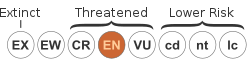
Brazilwood or Pau-Brasil, sometimes known as Pernambuco wood (Caesalpina echinata) is a Brazilian tree. It has a dense, orange-red wood (which takes a high shine), and it is the most frequently used wood for making bows for string instruments from the violin family. The wood also gives a red dye called brazilin.
There are several trees in this family which have very similar properties, including the development of red dye. The term "brazilwood" is sometimes used for these other species as well. The tree was exploited for their dye in the 18th century, and is now lost over much of its original range.[1]
When Pedro Álvares Cabral explored Brazil, he named it after the brazilwood that he found there.

References

Content Disclaimer
Informasi ini disarikan dari Wikipedia dan disajikan kembali untuk tujuan edukasi. Konten tersedia di bawah lisensi CC BY-SA 3.0. Kami tidak bertanggung jawab atas ketidakakuratan data yang bersumber dari kontribusi publik tersebut.
- The information displayed on this website is sourced in part or in whole from Wikipedia and has been adapted for the purpose of restating it. We strive to provide accurate and relevant information, however:
- There is no guarantee of absolute accuracy. Wikipedia is an open, collaborative project that can be edited by anyone, so information is subject to change.
- It is not intended to constitute professional advice. The content displayed is for informational and educational purposes only. For important decisions (e.g., medical, legal, or financial), please consult a professional.
- Content copyright. Wikipedia is licensed under the Creative Commons Attribution-ShareAlike License (CC BY-SA). This means that content may be reused with appropriate attribution and shared under a similar license.
- Responsible use. Any risk arising from the use of information from this website is entirely the responsibility of the user.