Brachiosaur
| Brachiosaurs Temporal range: Upper Jurassic – Lower Cretaceous
| |
|---|---|

| |
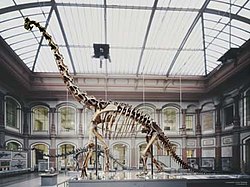
| Mounted skeleton of Giraffatitan in Berlin. | |
| Scientific classification | |
| Kingdom: | |
| Phylum: | |
| Class: | |
| Order: | |
| Suborder: | |
| Infraorder: | |
| Family: | Brachiosauridae
|
| Genera | |
Brachiosaurs are a family of sauropod dinosaurs, the Brachiosauridae.[1] They were herbivorous quadrupeds with longer forelegs than hind legs. As a result, there is also some dispute about which animals belong within this family.
The largest mounted skeleton in the world is a brachiosaur, the Giraffatitan brancai (formerly Brachiosaurus brancai) at the Museum für Naturkunde in Berlin, Germany.
Brachiosaurs first evolved in the Middle Jurassic,[2] and died out at the end of the Lower Cretaceous, surviving for about 60 million years. The earliest known brachiosaur may be Lapparentosaurus from the Middle Jurassic of Africa. The giant Sauroposeidon from North America was one of the last brachiosaurs, living just before the end of the Early Cretaceous period.
The name "brachiosaur" means "arm lizard", which may sound like a strange name for a four-legged animal. The family Brachiosauridae was given this name because the dinosaurs in it tended to have longer "arms" (front legs) than back legs.
In popular culture
Brachiosaurs have been featured in many works of culture, particularly the type genus, Brachiosaurus. Brachiosaurus was featured in the 1993 film Jurassic Park, as well as the 2000 Disney film Dinosaur. The brachiosaur Astrodon is the state dinosaur of Maryland. It was featured in paleontologist Robert T. Bakker's novel Raptor Red, where it was portrayed as a defenseless victim of Utahraptor.
References

Content Disclaimer
Informasi ini disarikan dari Wikipedia dan disajikan kembali untuk tujuan edukasi. Konten tersedia di bawah lisensi CC BY-SA 3.0. Kami tidak bertanggung jawab atas ketidakakuratan data yang bersumber dari kontribusi publik tersebut.
- The information displayed on this website is sourced in part or in whole from Wikipedia and has been adapted for the purpose of restating it. We strive to provide accurate and relevant information, however:
- There is no guarantee of absolute accuracy. Wikipedia is an open, collaborative project that can be edited by anyone, so information is subject to change.
- It is not intended to constitute professional advice. The content displayed is for informational and educational purposes only. For important decisions (e.g., medical, legal, or financial), please consult a professional.
- Content copyright. Wikipedia is licensed under the Creative Commons Attribution-ShareAlike License (CC BY-SA). This means that content may be reused with appropriate attribution and shared under a similar license.
- Responsible use. Any risk arising from the use of information from this website is entirely the responsibility of the user.