Bloomery
A bloomery is a type of furnace that was once widely used for smelting oxides. Bloomeries were the first smelters that could smelt iron.
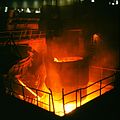
A bloomery is a type of furnace that was once widely used for smelting oxides. Bloomeries were the first smelters that could smelt iron.
The result of using a bloomery is a mass of iron and slag called a bloom. This is called sponge iron, because it is porous like a sponge. Sponge iron is usually refined into wrought iron.
Bloomeries are no longer used in smelting because blast furnaces are better.
History
Humans first began to use iron around 1200 BC.
People were using bloomeries in Sub-Saharan Africa before 500 BC.
China appeared not to use bloomeries, seemingly skipping to blast furnaces. Some bloomeries have been found in China, but these were likely brought from other locations, and not built in China.
European bloomeries started very small, smelting about 1kg of iron with each use, but got larger over time. By the 14th century, bloomeries smelted about 14kg per use on average.
Process
A bloomery consists of a chimney with heat-resistant walls made of earth, clay, or stone. Near the bottom, pipes made of clay or metal enter through the side walls. These pipes allow air to enter.
To use a bloomery, charcoal is inserted into the chimney, then heated. Then roughly the same volume of iron is inserted. A common byproduct of this process is fayalite, which is created when iron mixes with slag.
| Iron production (Ironworks) |
|  | |||||||
|---|---|---|---|---|---|---|---|---|---|
| Steelmaking (Steel mill) |
| ||||||||
| Heat treatment methods |
| ||||||||
| Production by country | |||||||||
Content Disclaimer
Informasi ini disarikan dari Wikipedia dan disajikan kembali untuk tujuan edukasi. Konten tersedia di bawah lisensi CC BY-SA 3.0. Kami tidak bertanggung jawab atas ketidakakuratan data yang bersumber dari kontribusi publik tersebut.
- The information displayed on this website is sourced in part or in whole from Wikipedia and has been adapted for the purpose of restating it. We strive to provide accurate and relevant information, however:
- There is no guarantee of absolute accuracy. Wikipedia is an open, collaborative project that can be edited by anyone, so information is subject to change.
- It is not intended to constitute professional advice. The content displayed is for informational and educational purposes only. For important decisions (e.g., medical, legal, or financial), please consult a professional.
- Content copyright. Wikipedia is licensed under the Creative Commons Attribution-ShareAlike License (CC BY-SA). This means that content may be reused with appropriate attribution and shared under a similar license.
- Responsible use. Any risk arising from the use of information from this website is entirely the responsibility of the user.