Anabaena
Anabena is a genus of plankton species. They fall under a type of bacteria called cyanobacteria.[1] They have the ability to perform photosynthesis, as
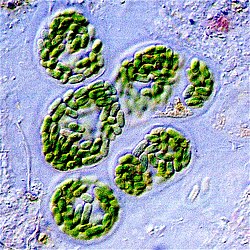

Anabena is a genus of plankton species. They fall under a type of bacteria called cyanobacteria.[1] They have the ability to perform photosynthesis, as well as the ability to convert nitrogen in the air to ammonia, in water. They form mutually beneficial relationships, called symbiotic relationships with some plants. Anabaena can make neurotoxins. It protects the plants from being eaten by wildlife. However, some species of Anabena have been used as a natural fertilizer in rice fields.
Genome
A study in 1999 has found the complete genome of Anabena (all of the DNA material). It is 7.2 million base pairs long. Anabena species have been used in research which focused on nitrogen fixation, DNA repair and primitive vision pigments.[2]
References
- ↑ The cyanobacteria : molecular biology, genomics, and evolution. Antonia Herrero, Enrique Flores. Norfolk, UK: Caister Academic Press. 2008. ISBN 978-1-904455-15-8. OCLC 153576078.
{{cite book}}: CS1 maint: others (link) - ↑ Schapiro, Igor; Ruhman, Sanford (2014-05-01). "Ultrafast photochemistry of Anabaena Sensory Rhodopsin: Experiment and theory". Biochimica et Biophysica Acta (BBA) - Bioenergetics. Retinal Proteins. 1837 (5): 589–597. doi:10.1016/j.bbabio.2013.09.014. ISSN 0005-2728. PMID 24099700.
Other websites
 Media related to Anabaena at Wikimedia Commons
 Data related to Anabaena at Wikispecies
- Sequenced Anabaena Genomes


Content Disclaimer
Informasi ini disarikan dari Wikipedia dan disajikan kembali untuk tujuan edukasi. Konten tersedia di bawah lisensi CC BY-SA 3.0. Kami tidak bertanggung jawab atas ketidakakuratan data yang bersumber dari kontribusi publik tersebut.
- The information displayed on this website is sourced in part or in whole from Wikipedia and has been adapted for the purpose of restating it. We strive to provide accurate and relevant information, however:
- There is no guarantee of absolute accuracy. Wikipedia is an open, collaborative project that can be edited by anyone, so information is subject to change.
- It is not intended to constitute professional advice. The content displayed is for informational and educational purposes only. For important decisions (e.g., medical, legal, or financial), please consult a professional.
- Content copyright. Wikipedia is licensed under the Creative Commons Attribution-ShareAlike License (CC BY-SA). This means that content may be reused with appropriate attribution and shared under a similar license.
- Responsible use. Any risk arising from the use of information from this website is entirely the responsibility of the user.