Amphiuma
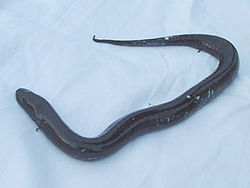
| Amphiuma | |
|---|---|

| |
| Two-toed Amphiuma | |
| Scientific classification | |
| Kingdom: | |
| Phylum: | |
| Class: | |
| Subclass: | |
| Order: | |
| Suborder: | |
| Family: | Amphiumidae Gray, 1825 [1]
|
| Genus: | Amphiuma Garden, 1821
|
| Species | |
Amphiuma is a genus of aquatic salamanders. They are the only genus still living in the family Amphiumidae. They are sometimes called "conger eels" or "congo snakes", which is not correct. Amphiumas have one of the largest amounts of DNA in the living world, around 25 times more than a human.[2]
Description
Amphiumas have a long body. They are generally grey-black in color. They do have legs but they are very small. Amphiumas can be up to 116 cm (46 in) long, their legs are only up to about 2 cm (0.79 in). It is because of this that they are often mistaken for eels or snakes. They also do not have eyelids or a tongue.[3]
Female amphiumas lay their eggs in wet mud. They then stay coiled around them for about five months, until they hatch. The larvae have external gills. After about four months these external gills disappear and the lungs begin to work.
Distribution
Amphiumas live in the southeastern part of the United States.
In the past they have lived in more areas. Fossils from the Pleistocene time show that they once lived in Europe.
Behavior
During the day amphiumas hide in plants. At night they become active and go hunting. Their prey include frogs, snakes, fish, crustaceans, insects and even other amphiumas. Hunting and eating habits are similar to that of the Axolotl. They suck food into their stomachs with vacuum force. They can become aggressive.
Species
There are three amphiuma species. They are different because of the number of toes:
- Three-toed Amphiuma (Amphiuma tridactylum)
- Two-toed Amphiuma (Amphiuma means)
- One-toed Amphiuma (Amphiuma pholeter)
References
- ↑ J. Alan Holman (2006). Fossil Salamanders of North America. Life of the past. Indiana University Press. p. 107. ISBN 978-0-253-34732-9.
- ↑ "Junk DNA and the Onion Test" 1 June 2008.
- ↑ Lanza, B., Vanni, S., & Nistri A. (1998). Cogger, H.G. & Zweifel, R.G. (ed.). Encyclopedia of Reptiles and Amphibians. San Diego: Academic Press. pp. 72. ISBN 0-12-178560-2.
{{cite book}}: CS1 maint: multiple names: authors list (link)
Other websites
Content Disclaimer
Informasi ini disarikan dari Wikipedia dan disajikan kembali untuk tujuan edukasi. Konten tersedia di bawah lisensi CC BY-SA 3.0. Kami tidak bertanggung jawab atas ketidakakuratan data yang bersumber dari kontribusi publik tersebut.
- The information displayed on this website is sourced in part or in whole from Wikipedia and has been adapted for the purpose of restating it. We strive to provide accurate and relevant information, however:
- There is no guarantee of absolute accuracy. Wikipedia is an open, collaborative project that can be edited by anyone, so information is subject to change.
- It is not intended to constitute professional advice. The content displayed is for informational and educational purposes only. For important decisions (e.g., medical, legal, or financial), please consult a professional.
- Content copyright. Wikipedia is licensed under the Creative Commons Attribution-ShareAlike License (CC BY-SA). This means that content may be reused with appropriate attribution and shared under a similar license.
- Responsible use. Any risk arising from the use of information from this website is entirely the responsibility of the user.