Agdistis
In Anatolian, Greek and Roman mythology, Agdistis was a hermaphroditic being, and symbolized the wild and uncontrolled powers of nature. She is the personificat
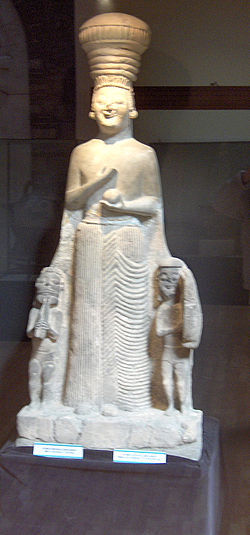

In Anatolian, Greek and Roman mythology, Agdistis was a hermaphroditic being, and symbolized the wild and uncontrolled powers of nature. She is the personification of a mountain of the same name in Phrygia.
Mythology
She was born after Zeus accidentally impregnated the earth goddess Gaia. The gods feared Agdistis because she held all the powers of creation within her body. Dionysus tricked her into castrating herself, and from then on she was known as the goddess Cybele. The blood from her severed gentials fertilized the earth, and from that spot an almond tree grew. One day the nymph Nana picked an almond from the tree, and held it against her chest, the almond vanished and she became pregnant with Attis.
Cult
Some ancient writers say Agdistis is the same as Cybele, and worshiped under that name. In many ancient inscriptions, Agdistis is clearly separate from Cybele, but in many others she is listed as an epithet of Cybele. Although primarily an Anatolian goddess, the cult of Agdistis covered a lot of territory. By 250 BC it had spread to Egypt, and later to Attica, Rhamnus around 80 BC (where there was a sanctuary of Agdistis), and later in Lesbos and Panticapeum.

Content Disclaimer
Informasi ini disarikan dari Wikipedia dan disajikan kembali untuk tujuan edukasi. Konten tersedia di bawah lisensi CC BY-SA 3.0. Kami tidak bertanggung jawab atas ketidakakuratan data yang bersumber dari kontribusi publik tersebut.
- The information displayed on this website is sourced in part or in whole from Wikipedia and has been adapted for the purpose of restating it. We strive to provide accurate and relevant information, however:
- There is no guarantee of absolute accuracy. Wikipedia is an open, collaborative project that can be edited by anyone, so information is subject to change.
- It is not intended to constitute professional advice. The content displayed is for informational and educational purposes only. For important decisions (e.g., medical, legal, or financial), please consult a professional.
- Content copyright. Wikipedia is licensed under the Creative Commons Attribution-ShareAlike License (CC BY-SA). This means that content may be reused with appropriate attribution and shared under a similar license.
- Responsible use. Any risk arising from the use of information from this website is entirely the responsibility of the user.