Quickselect
In informatica, quickselect è un algoritmo randomizzato ricorsivo che trova il k-esimo elemento di un array disordinato di grandezza n eseguendo O(n2) confront


| Quickselect | |
|---|---|
 | |
| Classe | Algoritmo di selezione |
| Struttura dati | Array |
| Caso peggiore temporalmente | |
| Caso ottimo temporalmente | |
| Caso medio temporalmente | |
| Ottimale | Sì |


In informatica, quickselect è un algoritmo randomizzato ricorsivo che trova il k-esimo elemento di un array disordinato di grandezza n eseguendo O(n2) confronti nel caso peggiore e O(n) nel caso atteso. Si basa sull'algoritmo Quicksort e sfrutta la metodologia prune and search.
L'algoritmo quicksort ha diverse relazioni di ricorrenza, dovute al tipo di problema di minore entità che si viene a creare ogni volta che l'algoritmo viene eseguito. Se ogni chiamata ricorsiva dimezza il problema, si ha:
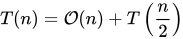
che ha soluzione O(n) in base al teorema master.
Se invece si è nel caso peggiore, si ottiene: che ha soluzione O(n2) in base al teorema master.

Implementazione in pseudocodice
algoritmo Quickselect(array A, intero K) -> elemento_array

      seleziona un elemento_array x in A
      partiziona A rispetto ad x calcolando:

      A1 = { y appartenente ad A : y < x }
      A2 = { y appartenente ad A : y = x }
      A3 = { y appartenente ad A : y > x }

      se ( k < |A1| ) allora ritorna Quickselect(A1,k)

      altrimenti se ( k > |A1| + |A2| ) allora restituisci Quickselect(A3, k - |A1| - |A2|)

      altrimenti restituisci x

Content Disclaimer
Informasi ini disarikan dari Wikipedia dan disajikan kembali untuk tujuan edukasi. Konten tersedia di bawah lisensi CC BY-SA 3.0. Kami tidak bertanggung jawab atas ketidakakuratan data yang bersumber dari kontribusi publik tersebut.
- The information displayed on this website is sourced in part or in whole from Wikipedia and has been adapted for the purpose of restating it. We strive to provide accurate and relevant information, however:
- There is no guarantee of absolute accuracy. Wikipedia is an open, collaborative project that can be edited by anyone, so information is subject to change.
- It is not intended to constitute professional advice. The content displayed is for informational and educational purposes only. For important decisions (e.g., medical, legal, or financial), please consult a professional.
- Content copyright. Wikipedia is licensed under the Creative Commons Attribution-ShareAlike License (CC BY-SA). This means that content may be reused with appropriate attribution and shared under a similar license.
- Responsible use. Any risk arising from the use of information from this website is entirely the responsibility of the user.