Zone theorem
In geometry, the zone theorem is a result that establishes the complexity of the zone of a line in an arrangement of lines.


In geometry, the zone theorem is a result that establishes the complexity of the zone of a line in an arrangement of lines.
Definition
A line arrangement, denoted as , is a subdivision of the plane, induced by a set of lines , into cells (-dimensional faces), edges (-dimensional faces) and vertices (-dimensional faces). Given a set of lines , the line arrangement , and a line (not belonging to ), the zone of is the set of faces intersected by . The complexity of a zone is the total number of edges in its boundary, expressed as a function of . The zone theorem states that said complexity is .


History
This result was published for the first time in 1985;[1] Chazelle et al. gave the upper bound of for the complexity of the zone of a line in an arrangement. In 1991,[2] this bound was improved to , and it was also shown that this is the best possible upper bound up to a small additive factor. Then, in 2011,[3] Rom Pinchasi proved that the complexity of the zone of a line in an arrangement is at most , and this is a tight bound.


Some paradigms used in the different proofs of the theorem are induction,[1] sweep technique,[2][4] tree construction,[5] and Davenport-Schinzel sequences.[6][7]
Generalizations
Although the most popular version is for arrangements of lines in the plane, there exist some generalizations of the zone theorem. For instance, in dimension , considering arrangements of hyperplanes, the complexity of the zone of a hyperplane is the number of facets ( - dimensional faces) bounding the set of cells (-dimensional faces) intersected by . Analogously, the -dimensional zone theorem states that the complexity of the zone of a hyperplane is .[7] There are considerably fewer proofs for the theorem for dimension . For the -dimensional case, there are proofs based on sweep techniques and for higher dimensions is used Euler's relation:[8]


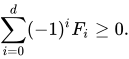
Another generalization is considering arrangements of pseudolines (and pseudohyperplanes in dimension ) instead of lines (and hyperplanes). Some proofs for the theorem work well in this case since they do not use the straightness of the lines substantially through their arguments.[7]
Motivation
The primary motivation to study the zone complexity in arrangements arises from looking for efficient algorithms to construct arrangements. A classical algorithm is the incremental construction, which can be roughly described as adding the lines one after the other and storing all faces generated by each in an appropriate data structure (the usual structure for arrangements is the doubly connected edge list (DCEL)). Here, the consequence of the zone theorem is that the entire construction of any arrangement of lines can be done in time , since the insertion of each line takes time .

Notes
References
- Agarwal, P. K.; Sharir, M. (2000), "Arrangements and their applications" (PDF), in Sack, J.-R.; Urrutia, J. (eds.), Handbook of Computational Geometry, Elsevier, pp. 49–119.
- Agarwal, P. K.; Sharir, M. (2002), "Pseudo-line arrangements: duality, algorithms, and applications", Proc. 13th ACM-SIAM Symposium on Discrete Algorithms (SODA '02), San Francisco: Society for Industrial and Applied Mathematics, pp. 800–809.
- Aharoni, Y.; Halperin, D.; Hanniel, I.; Har-Peled, S.; Linhart, C. (1999), "On-line zone construction in arrangements of lines in the plane", in Vitter, Jeffrey S.; Zaroliagis, Christos D. (eds.), Algorithm Engineering: 3rd International Workshop, WAE'99, London, UK, July 19–21, 1999, Proceedings, Lecture Notes in Computer Science, vol. 1668, Springer-Verlag, pp. 139–153, CiteSeerX 10.1.1.35.7681, doi:10.1007/3-540-48318-7_13, ISBN 978-3-540-66427-7
{{citation}}: Cite uses deprecated parameter|citeseerx=(help). - Bern, M. W.; Eppstein, D.; Plassman, P. E.; Yao, F. F. (1991), "Horizon theorems for lines and polygons" (PDF), in Goodman, J. E.; Pollack, R.; Steiger, W. (eds.), Discrete and Computational Geometry: Papers from the DIMACS Special Year, DIMACS Ser. Discrete Math. and Theoretical Computer Science, vol. 6, Amer. Math. Soc., pp. 45–66, MR 1143288.
- Chazelle, B.; Guibas, L. J.; Lee, D. T. (1985), "The power of geometric duality", BIT Numerical Mathematics, 25 (1): 76–90, doi:10.1007/BF01934990, S2CID 122411548.
- Edelsbrunner, H. (1987), Algorithms in Combinatorial Geometry, EATCS Monographs in Theoretical Computer Science, Springer-Verlag, ISBN 978-3-540-13722-1.
- Edelsbrunner, H.; O'Rourke, J.; Seidel, R. (1986), "Constructing arrangements of lines and hyperplanes with applications", SIAM Journal on Computing, 15 (2): 341–363, doi:10.1137/0215024.
- Edelsbrunner, H.; Guibas, L. J. (1989), "Topologically sweeping an arrangement", Journal of Computer and System Sciences, 38 (1): 165–194, doi:10.1016/0022-0000(89)90038-X.
- Edelsbrunner, H.; Guibas, L. J.; Pach, J.; Pollack, R.; Seidel, R.; Sharir, M. (1992), "Arrangements of curves in the plane—topology, combinatorics, and algorithms", Theoretical Computer Science, 92 (2): 319–336, doi:10.1016/0304-3975(92)90319-B.
- Edelsbrunner, H.; Seidel, R.; Sharir, M. (1991), "On the zone theorem for hyperplane arrangements", New Results and New Trends in Computer Science, 555, Graz, Austria: Springer Science & Business Media: 108, doi:10.1007/BFb0038185
- Grünbaum, B. (1972), Arrangements and Spreads, Regional Conference Series in Mathematics, vol. 10, Providence, R.I.: American Mathematical Society.
- Pinchasi, R. (2011), The zone theorem revisited (PDF) (unpublished manuscript)
- Saxena, S. (2021), "Zone theorem for arrangements in dimension three", Information Processing Letters, 172 106161, arXiv:2006.01428, doi:10.1016/j.ipl.2021.106161, S2CID 219179345
Content Disclaimer
Informasi ini disarikan dari Wikipedia dan disajikan kembali untuk tujuan edukasi. Konten tersedia di bawah lisensi CC BY-SA 3.0. Kami tidak bertanggung jawab atas ketidakakuratan data yang bersumber dari kontribusi publik tersebut.
- The information displayed on this website is sourced in part or in whole from Wikipedia and has been adapted for the purpose of restating it. We strive to provide accurate and relevant information, however:
- There is no guarantee of absolute accuracy. Wikipedia is an open, collaborative project that can be edited by anyone, so information is subject to change.
- It is not intended to constitute professional advice. The content displayed is for informational and educational purposes only. For important decisions (e.g., medical, legal, or financial), please consult a professional.
- Content copyright. Wikipedia is licensed under the Creative Commons Attribution-ShareAlike License (CC BY-SA). This means that content may be reused with appropriate attribution and shared under a similar license.
- Responsible use. Any risk arising from the use of information from this website is entirely the responsibility of the user.