Yasen-class submarine
 Yasen-class SSN profile | |
 K-560 Severodvinsk | |
| Class overview | |
|---|---|
| Name | Yasen class |
| Builders | Sevmash |
| Operators |  Russian Navy Russian Navy |
| Preceded by | |
| Succeeded by | Laika class |
| Cost | RUB47 billion for Kazan (2011)[1] |
| Built | 1993–present |
| In commission | 2013–present |
| Planned | 12[2] |
| Building | 4 |
| Completed | 6 |
| Active | 5 |
| General characteristics | |
| Type | Nuclear-powered attack submarine |
| Displacement |
|
| Length | Yasen: 139.2 m (457 ft)[4][5][6] Yasen-M: 130 m (430 ft) |
| Beam | 13 m (43 ft)[4][5][6] |
| Propulsion | OK-650KPM[7] pressurized water reactor 200 MWt turbines of 43,000 shp |
| Speed |
|
| Range | Unlimited |
| Endurance | Only limited by food and maintenance requirements |
| Test depth |
|
| Complement | Yasen: 85[8] Yasen-M: 64[9] |
| Sensors & processing systems | Rim Hat ESM/ECM Snoop Pair Surface Search Radar |
| Armament | |
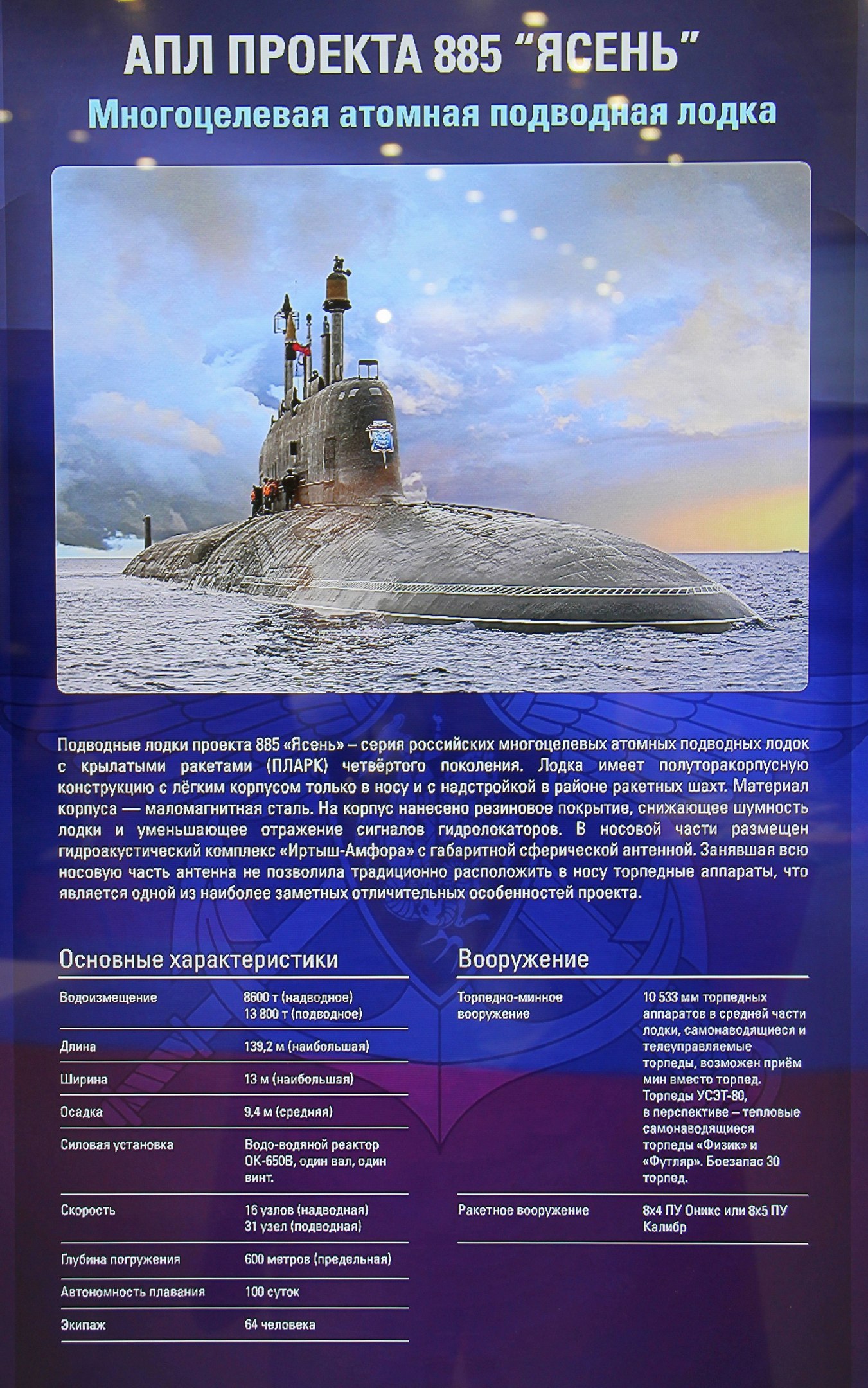
The Yasen class, Russian designations Project 885 Yasen and Project 885M Yasen-M (Russian: Ясень, lit. 'ash tree', NATO reporting name: Severodvinsk), also referred to as the Graney class, are a series of nuclear-powered attack submarines (SSN) designed by the Malakhit Marine Engineering Bureau and built by Sevmash for the Russian Navy.[15][16] Design work commenced in earnest in the 1980s with the first submarine built in the 1990s–early 2010s with commissioning in 2013. The first two boats to an upgraded (and slightly shorter overall) Yasen-M design were commissioned in 2021.[17][18] Based on the Akula class and Alfa class designs, the Yasen class is projected to replace the Russian Navy's current Soviet-era nuclear attack submarines as well as Oscar II class cruise missile submarines.[19] The multipurpose Yasen class concept uses the platform both for the hunter-killer role as well as to target enemies with the VLS-launched cruise missile, similar to the cruise missile submarine.[20][19][21] All submarines of this class but Severodvinsk are of the upgraded Yasen-M class variant.
History
The Yasen-class submarines were designed by Malakhit, which was formed through the late 1950s merger of the SKB-143 and TsKB-16 design bureaus.[citation needed] Work on the initial design was scheduled to start in 1977 and be completed in 1985.[22] Malakhit is one of the three Soviet/Russian submarine design centers, along with Rubin Design Bureau and Lazurit Central Design Bureau.

Construction on the first submarine started on 21 December 1993, with its launch slated for 1995 and its commissioning for 1998.[23] However, the project was delayed due to financial problems and it appeared during 1996 that work on the submarine had stopped completely. Some reports suggested that as of 1999 the submarine was less than 10 percent complete.[citation needed] In 2003 the project received additional funding and the work of finishing the submarine restarted.
In 2004 it was reported that the work on the submarine was moving forward, but, due to the priority given to the new Borei-class SSBNs, the lead unit of the class (Severodvinsk) would not be ready before 2010. In July 2006 the deputy chairman of the Military-Industrial Commission, Vladislav Putilin, stated that two Yasen-class submarines were to join the Russian Navy before 2015.[24]
On 24 July 2009, work commenced on a second submarine, named Kazan. On 26 July, the Russian navy command announced that starting in 2011, one multipurpose submarine would be laid down every year, although not necessarily of this class.[citation needed]
An August 2009 report from the U.S. Office of Naval Intelligence estimated the Yasen-class submarines to be the quietest, or least detectable, of seagoing Russian and Chinese nuclear submarines, but said they were still not as quiet as first-line U.S. Navy submarines (i.e. Seawolf and Virginia classes).[25][26]
In April 2010, it was reported that the 7 May launch of the first boat had been postponed due to "technical reasons".[27] Then, the launch of the first submarine and the beginning of sea trials were scheduled for September 2011.[citation needed]
.jpeg)
On 26 July 2013 the third submarine, named Novosibirsk, was laid down.[28]
On 30 December 2013, Severodvinsk was handed over to the Russian Navy. The flag-raising ceremony was held on 17 June 2014 marking its introduction into the Russian Navy.[29]
In October 2014, one of the U.S. Navy's top submarine officers, Rear Admiral Dave Johnson, the Naval Sea Systems Command's program executive officer (PEO) for submarines, said "We'll be facing tough potential opponents. One only has to look at the Severodvinsk, Russia's version of a nuclear guided missile submarine (SSGN). I am so impressed with this ship that I had Carderock build a model from unclassified data".[30]
According to 60 Minutes, unnamed Pentagon officials claimed that Severodvinsk on her maiden deployment[31] "slipped into the Atlantic Ocean and for weeks evaded all of the attempts to find her" in the summer 2018.[32]
Kazan was rumoured to be active, along with five other nuclear submarines, in the northern Atlantic in spring 2020.[33] However, she may actually have been on sea trials since she was reported commissioned in May 2021.[34]
On October 4, 2021, Severodvinsk performed two test launches of Zircon missile, from surfaced and underwater position.[35] The launches were performed from the White Sea to the Barents Sea and were successful.
Design

The vessel's design is said to be state-of-the-art. The Yasen-class nuclear submarines are presumed to be armed with land-attack cruise missiles, anti-ship missiles, anti-submarine missiles including the P-800 Oniks SLCM, Kalibr family SLCM or 3M51 SLCM.[citation needed] Kalibr-PL has several variants including the 3M54K (terminal-supersonic) and 3M54K1 (subsonic) anti-ship, 91R1 anti-submarine, and the 3M14K land-attack variant. In the future, there will be also an option to install the hypersonic 3M22 Zircon cruise missiles on upgraded 885M boats.[36] Each submarine can carry 32 Kalibr or 24 Oniks (other sources claim 40 Kalibr and 32 Oniks)[37] cruise missiles which are stored in eight (ten for 885M) vertical launchers (additional missiles may be carried in the torpedo room at the expense of torpedoes).[38][39][40] It will also have ten 533 mm tubes, as well as mines and anti-submarine missiles such as the RPK-7.[41][13]
It is the first Russian submarine class to be equipped with a spherical sonar, designated as MGK-600 Irtysh-Amfora.[42] The device (allegedly the Irtysh/Amfora sonar system) was tested on a modified Yankee-class submarine.[43] The sonar system consists of a spherical bow array, flank arrays and a towed array. Due to the large size of this spherical array, the torpedo tubes are slanted.[22] In other words, the torpedo tube outer doors are not located in the immediate bow as in the previous Akula class[44] but moved aft.[45] The hull is constructed from low-magnetic steel.[46] Unlike previous Russian submarines which have a double hull, Yasen-class submarines mostly have a single hull.[47] The Yasen class has a crew of 85 on project 885 and 64 on project 885M,[8] suggesting a high degree of automation in the submarine's different systems. The newest U.S. Virginia-class submarines, has a crew of 134 in comparison.[46]
Yasen-class submarines are the first to be equipped with a fourth-generation nuclear reactor.[48][49] The reactor, built by Afrikantov OKBM,[50][51] will allegedly have a 25-30-year core life and will not have to be refueled.[52] Steam turbines are supplied by Kaluga Turbine Works.[53] The inclusion of new generation KTP-6 reactor on the Yasen-M boats is thought to significantly reduce their noise level: the reactor's primary cooling loop facilitates natural circulation of water and thus doesn't require continuous operation of the main circulation pumps, which are the key noise factor on a nuclear submarine.[citation needed] A VSK rescue pod is carried in the sail.[22] The first ship of the class came equipped with a traditional mast system but it may be replaced with the non-penetrating electro-optical masts meant for improved ISR capability, and reduced risk in collisions.[13]
According to Admiral James Foggo, the commander of the US Naval Forces Europe, the Yasen class submarines are "very quiet, which is the most important thing in submarine warfare".[32] It's claimed that Severodvinsk is far quieter than previous Russian SSNs, capable of 20 knots while running quiet, which is equal to the Seawolf class[54] and inferior only to the Virginia class (25 knots).[55][56] Other sources claim that Severodvinsk is capable of even 28 knots in silent mode.[57]
Costs
Initial estimates regarding the cost of the first Yasen-class submarine ranged from US$1 billion to US$2 billion.[58] In 2011, it was reported that the cost of first-of-class, Severodvinsk, was 50 billion rubles (roughly US$1.6 billion)[59] while the second unit, Kazan, will cost an estimated 47 billion rubles (US$725 million, in 2019 RUB/USD exchange rate).[1] In 2011, then Defense Minister Anatoliy Serdyukov criticized the ever increasing cost of the Borei and Yasen classes. The Minister described the massive increase in cost between the first and the second Yasen-class submarine as "incomprehensible". However, he insisted that the Russian Defence Ministry and Sevmash would resolve the issue. Officials from the United Shipbuilding Corporation replied that work done in Sevmash accounts for only 30% of the submarine's completion cost, the remaining 70% being linked to suppliers/contractors.[60]
Successor/supplement
Due to the high cost of each Yasen class submarine, some sources believe that a next generation of SSNs would be of smaller dimensions[61][62] with a reduced armament/payload could be built.[63] The successor/supplement to the Yasen class was in early development by 2015[64][65][66] and dubbed "Husky class" by media.[67] The final design of the submarine is yet to be completed and may feature a more conventional layout with bow-mounted torpedo tubes (as opposed to the midship torpedo tubes on Yasen class) and a smaller chin-mounted sonar, i.e. the sonar will be mounted below the torpedo tubes (as opposed to a large spherical sonar on Yasen class).[68] The first submarine is expected to be delivered to the Russian Navy by 2027.[69]
Units
Italicized dates indicate estimates.
| # | Name | Project | Laid down | Launched | Commissioned | Fleet | Status | Notes |
|---|---|---|---|---|---|---|---|---|
| K-560 | Severodvinsk | 885 | 21 Dec 1993 [70] |
15 Jun 2010 [71] |
17 Jun 2014 [72] |
Northern | Active | Later modified to carry Zircon missiles[35] |
| K-561 | Kazan | 885M | 24 Jul 2009 [4] |
31 Mar 2017 [73] |
5 May 2021 [74] |
Northern | Active as of 2026 [75][76] |
Acceptance act signed on 5 May 2021, ceremony held on 7 May 2021.[77][78] |
| K-573 | Novosibirsk | 885M | 26 Jul 2013 [28] |
25 Dec 2019 [79] |
21 Dec 2021 [80] |
Pacific | Active[80] | |
| K-571 | Krasnoyarsk | 885M | 27 Jul 2014 [81][82] |
30 Jul 2021 [83] |
11 Dec 2023 [84] |
Pacific | Active | On 23 Jan 2017, it successfully completed hydraulic pressure hull tests.[85] Mooring trials were underway in Feb 2022,[86] with sea trials anticipated to begin in spring 2022.[87] Sea trials started on 26 Jun 2022.[88] |
| K-564 | Arkhangelsk | 885M | 19 Mar 2015 [89] |
29 Nov 2023 [90][91] |
27 Dec 2024 [41][92][93] |
Northern | Active as of 2026 [94][95] |
Sea trials completed in Dec 2024. [92][95][96][97] |
| K-572 | Perm | 885M | 29 July 2016 [98] |
27 March 2025 [99] |
2026 [41][100][92] |
Pacific | Sea trials as of Aug 2025[101] | Structural modifications, reported to carry 3M22 Zircon hypersonic missiles.[100] |
| K-563 | Ulyanovsk | 885M | 27 July 2017 | 28 July 2026[102] | 2026 [103][104][105] |
Launched[106] | Also identified as a separate class (Project 09853) variant of the Yasen-class.[107] Later clarified that the boat would be of the Yasen-M class[108]. | |
| K-xxx | Voronezh | 885M | 20 Jul 2020 [109] |
2027 [103][92] |
Northern | Under construction[109] | To be equipped with 4,500 km capable Kalibr-M cruise missiles.[110] | |
| K-xxx | Vladivostok | 885M | 20 Jul 2020 [109] |
2028 [103][111][92] |
Pacific | Under construction[109] | To be equipped with 4,500 km capable Kalibr-M cruise missiles.[110] | |
| K-xxx | Murmansk[112] | 885M | 17 June 2026 |
Under construction | ||||
| K-xxx | 885M | Announced[113] | ||||||
| K-xxx | 885M | Announced[114] |
See also
References
- ^ a b На что потратят 280 миллиардов [What will 280 billion be spent on?]. Kommersant (in Russian). 10 November 2011. Archived from the original on 23 December 2011. Retrieved 22 November 2014.
- ^ "Источник сообщил, что число АПЛ семейства "Ясень" доведут до 12". TASS.
- ^ "Russia's new assassin sub has a fatal flaw". The Week. 15 January 2015. Archived from the original on 17 January 2015. Retrieved 17 January 2015.
- ^ a b c Место на стапеле заняла "Казань" [Submarine "Kazan" laid down]. Rossiyskaya Gazeta (in Russian). 27 July 2009. Archived from the original on 28 July 2009. Retrieved 24 August 2009.
- ^ a b "The might of Russia's advanced nuclear submarine". TASS. 31 March 2017. Archived from the original on 2 April 2017. Retrieved 1 April 2017.
- ^ a b "АПЛ "Красноярск" успешно прошла гидравлические испытания" [The nuclear submarine "Krasnoyarsk" has successfully passed hull tests]. Russian Arms (in Russian). 24 January 2017. Archived from the original on 2 April 2017. Retrieved 1 April 2017.
- ^ Ma, Chunyan; von Herpel, Frank (2001). "Ending the Production of Highly Enriched Uranium for Naval Reactors" (PDF). The Nonproliferation Review. 8 (1): 91. doi:10.1080/10736700108436841. ISSN 1073-6700. S2CID 109931735.
- ^ a b Protopopov, Nikolay (8 October 2018). "И подлодку "Ясень-М" я сравнил с "Вирджинией"" [The "Yasen-M" submarine compared with the "Virginia" class]. Naukatehnika.com (in Russian). Retrieved 20 December 2019.
- ^ "АПЛ Проекта 885 Ясень" [Project 885 "Yasen" nuclear submarine]. Userapi.com (in Russian). Archived from the original on 31 August 2017. Retrieved 30 August 2017.
- ^ Epsilon (31 July 2014). "Yasen: The future of Russian SSN fleet". Battle Machines. Archived from the original on 13 August 2017. Retrieved 14 April 2017.
- ^ Pickrell, Ryan. "Seen by the US military as a threat for years, Russia's Yasen-class submarines are now on track to get hypersonic missiles". Business Insider.
- ^ a b c "Episode 114. Yasen-M. Hunter of the deep". Combat Approved. Episode 114. 7 July 2021. 26:16 minutes in. Youtube. Retrieved 23 March 2025.
- ^ a b c Sutton, H.I. (13 April 2019). "Yasen Class: Russia's most potent submarines". Covert Shores. Retrieved 13 January 2020.
- ^ Рамм, Алексей; Степовой, Богдан (6 April 2020). "Форменное разнообразие: подводные лодки "Ясень" меняют внешний вид" [Variety of shapes: Yasen submarines change their appearance]. Izvestia (in Russian).
- ^ "Russia Unveils First Submarine built for Zircon Missiles". TurDef. 18 March 2025. Retrieved 22 April 2025.
- ^ Tsypkin, Mikhail (July 2010). "The Challenge of Understanding the Russian Navy". In Blank, Stephen J.; Weitz, Richard (eds.). The Russian Military Today and Tomorrow: Essays in Memory of Mary Fitzgerald (PDF). Carlisle, Pennsylvania: Strategic Studies Institute, U.S. Army War College. p. 349. ISBN 978-1-58487-449-2. Archived from the original (PDF) on 24 December 2010. Retrieved 1 January 2011.
- ^ Maerli, Morten Bremer (June 2001). "Components of Naval Nuclear Fuel Transparency" (PDF). NATO. Archived (PDF) from the original on 13 November 2010. Retrieved 1 January 2011.
- ^ a b "Russia Submarine Capabilities". NTI. 28 August 2024. Retrieved 22 March 2025.
- ^ "Episode 114. Yasen-M. Hunter of the deep". Combat Approved. Episode 114. 7 July 2021. 4:48 minutes in. Youtube. Retrieved 23 March 2025.
- ^ Kaushal, Sidharth; Byrne, James; Byrne, Joe; Somerville, Gary (28 May 2021). "The Yasen-M and the Future of Russian Submarine Forces". RUSI.
- ^ a b c "SSN Project 885 Severodvinsk ("Yasen") class". Harpoon Databases. Archived from the original on 2 December 2014. Retrieved 22 November 2014.
- ^ Kopte, Susanne (August 1997). "Nuclear Submarine Decommissioning and Related Problems" (PDF). Bonn International Center for Conversion. Archived (PDF) from the original on 11 November 2013. Retrieved 22 November 2014.
- ^ Lantratov, Konstantin (14 March 2006). "Russia Chooses Its Future Armament". ATO.ru. Archived from the original on 2 October 2011. Retrieved 18 October 2011.
- ^ The People's Liberation Army Navy, A Modern Navy with Chinese Characteristics (PDF) (Report). Office of Naval Intelligence. August 2009. p. 22. Archived (PDF) from the original on 24 May 2021. Retrieved 6 December 2010.
- ^ "Run Silent, Run Deep". FAS Military Analysis Network. 8 December 1998. Archived from the original on 5 February 2006. Retrieved 22 November 2014.
- ^ "Technical Hitch Delays Russian Submarine Launch". Naval-Technology.com. 14 April 2010. Archived from the original on 5 June 2011. Retrieved 18 October 2011.
- ^ a b "Севмаш заложит АПЛ "Новосибирск" ко Дню ВМФ" [Sevmash will lay down the nuclear submarine "Novosibirsk" on Navy Day]. flotprom.ru (in Russian). Archived from the original on 9 October 2013. Retrieved 27 June 2013.
- ^ Korolkov, Alexander (17 June 2014). "Russia's top-secret nuclear submarine comes into service". Russia Beyond the Headlines. Archived from the original on 26 January 2016. Retrieved 22 November 2014.
- ^ Majumdar, Dave. "U.S. Navy Impressed with New Russian Attack Boat". USNI News. U.S. Naval Institute. Archived from the original on 17 October 2015. Retrieved 22 October 2015.
- ^ Chiang, Kyle (1 June 2020). "Submariners Are Warriors First". Proceedings. 146 (6). U.S. Naval Institute.
- ^ a b "Tracking the Russian "Severodvinsk" submarine: "It's very capable and it's very quiet"". YouTube. 60 Minutes. 28 April 2019. Archived from the original on 17 December 2021.
- ^ Giannangeli, Marco (19 April 2020). "The new Cold War: British forces scramble to track down Moscow's killer super-sub". Daily Express. Retrieved 19 April 2020.
- ^ "Подводный ракетный крейсер "Казань" вошел в состав ВМФ" [The submarine missile cruiser "Kazan" joined the Navy]. ТАSS (in Russian). 7 May 2021.
- ^ a b "Submarine Severodvinsk carries out underwater launch of Tsirkon missile". TASS.
- ^ Melnikov, Ruslan (15 April 2017). "Российская ракета "Циркон" достигла восьми скоростей звука" [Russian Zircon rocket reaches eight times the speed of sound]. Rossiyskaya Gazeta (in Russian). Archived from the original on 23 December 2017. Retrieved 15 April 2017.
- ^ Karnazov, Vladimir (30 July 2012). "Carrier Killers for the Russian Navy: The Strategic Environment". Center for Security Studies. Archived from the original on 23 December 2015. Retrieved 24 January 2016.
- ^ "Russian/Soviet Sea-Based Anti-Ship Missiles". Stealth Machinery forum. November 2005. Archived from the original on 4 February 2016. Retrieved 24 January 2016.
- ^ "The Klub Missile Family" (PDF). Defense Threat Information Group. May 2005. Archived from the original (PDF) on 13 March 2012.
- ^ Spahn, Tom (June 2013). "The Russian Submarine Fleet Reborn". Proceedings. 139 (6). U.S. Naval Institute. Archived from the original on 5 December 2014. Retrieved 22 November 2014.
- ^ a b c "Подводные лодки проекта 885 "Ясень". Досье" [Dossier on submarines of project 885 "Yasen"]. TASS (in Russian). 29 July 2016. Retrieved 13 January 2020.
- ^ "Project 885 "Yasen" nuclear submarine". Warmy. Archived from the original on 17 September 2016. Retrieved 10 September 2016.
- ^ "History: 1982–2011". Rubin Design Bureau. Archived from the original on 5 November 2013. Retrieved 6 February 2013.
- ^ "Project 885 submarine". Sub Driver forum. Archived from the original on 2 April 2017. Retrieved 1 April 2017.
- ^ "Project 885 submarine". Imgur.com. Archived from the original on 2 April 2017. Retrieved 1 April 2017.
- ^ a b "Yasen / Graney Class Submarine, Russia". Naval-Technology.com. Archived from the original on 29 November 2014. Retrieved 22 November 2014.
- ^ RT Documentary (5 August 2018). "Yasen-M: Destroyer of the Depths". YouTube. Archived from the original on 1 May 2019. Retrieved 18 August 2018.
- ^ Nilsen, Thomas; Kudrik, Igor; Nikitin, Alexandr (1996). "Chapter 2: Nuclear-powered vessels". The Russian Northern Fleet: Sources of Radioactive Contamination. Bellona Foundation (Report). Archived from the original on 17 September 2016. Retrieved 10 September 2016.
- ^ Nilsen, Thomas; Kudrik, Igor; Nikitin, Alexandr (1996). "Chapter 2.3: Development of naval reactors". The Russian Northern Fleet: Sources of Radioactive Contamination. Bellona Foundation (Report). Archived from the original on 29 December 2010.
- ^ А.Л., Берензон. "About OKBM". OKBM. Archived from the original on 8 October 2016. Retrieved 10 September 2016.
- ^ "Nizhny Novgorod company to put 10 reactor units for Borei and Yasen". Engineering Russia. 15 April 2015. Archived from the original on 8 October 2016. Retrieved 10 September 2016.
- ^ ARG. "Graney class - Nuclear-powered attack submarine". Archived from the original on 29 March 2012. Retrieved 6 February 2013.
- ^ Konovalov, Alexei (7 June 2008). "Project 885 and 885M "Ash"". Stealth Machinery. Archived from the original on 12 March 2013.
- ^ Mizokami, Kyle (25 April 2019). "See This Submarine: There Are Only Three Like It On the Planet (Think F-22 of Subs)". The National Interest.
- ^ Mizokami, Kyle (20 September 2019). "Russia vs. America: Who Has The World's Best Submarines?". The National Interest.
- ^ Majumdar, Dave (28 October 2014). "U.S. Navy Impressed with New Russian Attack Boat". USNI News.
- ^ "Russia's First Yasen-Class Submarine is Combat-Ready". The Maritime Executive. 23 March 2016.
- ^ "Russians Launch First Yasen-class Submarine; Others in Doubt?". Center for Strategic and International Studies. 17 June 2010. Archived from the original on 20 January 2012. Retrieved 18 October 2011.
- ^ "Media Got Wind of Submarines Cost". Rusnavy.com. 3 November 2011. Archived from the original on 5 May 2012. Retrieved 6 February 2013.
- ^ "Yasen". Russian Defense Policy. Archived from the original on 29 November 2011. Retrieved 6 February 2013.
- ^ "Future Projects". Stealth Machinery. 23 July 2010. Archived from the original on 19 February 2015. Retrieved 15 February 2015.
- ^ Pettersen, Trude (8 March 2016). "Hunter for Red October plans for comeback". The Barents Observer. Archived from the original on 14 March 2016. Retrieved 13 March 2016.
- ^ "Russian naval shipbuilding plans: Rebuilding a blue water navy". Russian Military Reform. 23 January 2015. Archived from the original on 8 July 2015. Retrieved 5 June 2015.
- ^ Keck, Zachary (23 June 2015). "Russia Is Already Developing New Fifth-Generation Submarines". The National Interest. Archived from the original on 25 March 2016. Retrieved 17 March 2016.
- ^ "Russia's Next Gen Husky-class SSN to combine multipurpose, strategic submarine characteristics". Navy Recognition.com. 2015. Archived from the original on 4 June 2016. Retrieved 21 May 2016.
- ^ "Атомной Подводной Лодки Пятого Поколения (Photo)" [Fifth Generation Nuclear Submarine]. VK.com (in Russian). 28 March 2016.
- ^ "Russia Test-Fires Hypersonic Zircon Missiles For Nuclear Submarines, Weapons To Reach Mach 5 Speed". International Business Times. 17 March 2016. Archived from the original on 19 March 2016. Retrieved 17 March 2016.
- ^ Sutton, H.I. (1 April 2017). "Husky SSN". Covert Shores. Archived from the original on 12 May 2017. Retrieved 6 May 2017.
- ^ Gady, Franz-Stefan (1 June 2018). "Is Russia Working on a 5th-Generation Nuclear Sub With Hypersonic Missiles?". The Diplomat. Archived from the original on 19 July 2018. Retrieved 2 June 2018.
- ^ "SSN Severodvinsk to start mooring trials in Dec". Rusnavy.com. 24 December 2009. Archived from the original on 2 October 2011. Retrieved 18 October 2011.
- ^ "Новые фото с церемонии вывода АПК "Северодвинск" из стапельного цеха" [New photos from the launching ceremony of the AIC "Severodvinsk"]. Flot.com (in Russian). Archived from the original on 8 October 2011. Retrieved 18 October 2011.
- ^ "Подводный крейсер К-560 "Северодвинск". Проект 885". www.deepstorm.ru.
- ^ "Атомную подлодку "Казань" спустили на воду" [Nuclear submarine "Kazan" launched]. RIA Novosti (in Russian). 31 March 2017. Archived from the original on 31 March 2017. Retrieved 31 March 2017.
- ^ "Kazan Yasen-M-class SSGN to become operational on Jul 25th". Navy Recognition.com. April 2021. Archived from the original on 9 December 2022. Retrieved 1 April 2021.
- ^ Nilsen, Thomas (12 March 2026). "Northern Fleet launches cruise missile from submerged submarine amid NATO Arctic drill". The Barents Observer. Retrieved 14 March 2026.
- ^ "Russia's Project 885M Yasen-M Submarine Kazan Started Sea Trials". Navy Recognition.com. 29 September 2018. Archived from the original on 21 October 2018. Retrieved 21 October 2018.
- ^ "Атомный подводный ракетный крейсер "Казань" (проекта "Ясень-М") приказом Главкома ВМФ принят в состав Военно-Морского Флота в Северодвинске" [By order of the Commander-in-Chief of the Navy nuclear submarine missile cruiser "Kazan" was admitted to the Navy in Severodvinsk]. Russian Ministry of Defence (in Russian). 7 May 2021. Retrieved 7 May 2021.
- ^ Batashvili, David (7 March 2021). "Rearmament and Modernization". Rondeli Russian Military Digest. GFSIS.
- ^ "Первую серийную подлодку проекта "Ясень-М" "Новосибирск" спустили на воду в Северодвинске" [The first submarine of the Yasen-M project, "Novosibirsk", was launched in Severodvinsk]. TASS (in Russian). 25 December 2019. Retrieved 25 December 2019.
- ^ a b "Новые атомные подлодки "Князь Олег" и "Новосибирск" приняли в состав ВМФ России". Tass.com. 21 December 2021. Retrieved 12 May 2022.
- ^ "Russia's Sevmash shipyards lays down three new submarines". TASS. 27 July 2014. Archived from the original on 20 November 2014. Retrieved 22 November 2014.
- ^ "Russia's Sevmash shipyard lays down 5th Borey class SSBN and 4th Yasen class SSN". Navy Recognition.com. 27 July 2014. Archived from the original on 14 January 2016. Retrieved 22 November 2014.
- ^ "Shipbuilders float out advanced Project 885M nuclear-powered sub for Russian Navy". Tass.com.
- ^ "В Северодвинске ввели в строй две атомные подлодки". flotprom.ru (in Russian). 11 December 2023.
- ^ "Прочный корпус "Красноярска"" ["Krasnoyarsk" has durable hull]. Sevmash.ru (in Russian). Archived from the original on 28 July 2017. Retrieved 17 July 2017.
- ^ "Russian Project 885M submarine Krasnoyarsk to begin builders trials". 8 February 2022.
- ^ "Sevmash readies two more subs as Putin elevates role of nuclear weapons".
- ^ "Russia's Third Project 885M (Yasen-M) Submarine Starts Sea Trials". navalnews.com. 28 June 2022.
- ^ "Минобороны РФ: пятую АПЛ проекта "Ясень" заложат на "Севмаше" 19 марта" [Ministry of Defence: the fifth nuclear submarine of the Yasen project will be laid down at Sevmash on Mar 19th]. RIA Novosti (in Russian). 6 February 2015. Archived from the original on 6 February 2015. Retrieved 6 February 2015.
- ^ "Алексей Рахманов: комплексы "Циркон" станут штатным оружием АПЛ "Ясень"". RIA (in Russian). 14 August 2023.
- ^ "Севмаш готовит к спуску АПЛ "Архангельск" проекта 885М". 14 August 2023.
- ^ "Project 885M latest nuclear-powered submarine Arkhangelsk joins Russian Navy". TASS. 27 December 2024. Retrieved 30 December 2024.
- ^ Nilsen, Thomas (3 June 2026). "Arkhangelsk launches anti-ship missile in the Barents Sea". The Barents Observer. Retrieved 4 June 2026.
- ^ a b "Arkhangelsk nuclear submarine ready to join Russian Navy — Sevmash Shipyard CEO". TASS. 21 December 2024.
- ^ "Гендиректор: Севмаш до конца 2020 года передаст флоту восемь "Бореев" и шесть "Ясеней"" [General Director: Sevmash will transfer eight Bories and six Yasens to the fleet by the end of 2020]. TASS (in Russian). Archived from the original on 29 July 2017.
- ^ "Sevmash shipyard floats Arkhangelsk SSGN".
- ^ "Шестая атомная подлодка проекта "Ясень" заложена на Севмаше" [The sixth Yasen project nuclear submarine was laid down at Sevmash]. TASS (in Russian). 29 July 2016. Archived from the original on 1 August 2016. Retrieved 29 July 2016.
- ^ "Пятый модернизированный "Ясень" подготовили к спуску на воду". flotprom.ru (in Russian). 28 March 2025.
- ^ a b "Nuclear submarine Perm will be the first regular Zircon submarine carrier — source - Military & Defense - TASS". tass.com. Archived from the original on 2 November 2021. Retrieved 6 June 2022.
- ^ Nilsen, Thomas (23 August 2025). "Nuclear-powered multi-purpose submarine Perm heads out for sea trials". Barents Observer. Retrieved 9 September 2025.
- ^ "Новейший атомный подводный крейсер "Ульяновск" вывели из эллинга Севмаша". Tass.ru. Retrieved 7 August 2026.
- ^ a b c "В ОСК назвали сроки передачи флоту подлодок с гиперзвуковым оружием" [The USC named the date of the transfer of submarines with hypersonic weapons to the fleet]. RIA Novosti (in Russian). 21 July 2020.
- ^ "Топливо утекает сквозь пальцы: почему военные не могут контролировать расход ГСМ" [Fuel leaks through your fingers: why the military cannot control the consumption of fuel and lubricants]. Russian Federation Military (in Russian). 7 September 2018. Archived from the original on 2 June 2022. Retrieved 27 May 2022.
- ^ "Keel-laying for yet another nuclear attack sub for Arctic waters". Thebarentsobserver.com.
- ^ "The newest nuclear submarine "Ulyanovsk" of Project 885M has left the boathouse: it will be completed afloat". www1.ru. 28 July 2026.
- ^ Nilsen, Thomas (6 January 2022). "Russia's nuclear submarine construction reaches post-Soviet high". Thebarentsobserver.com. Retrieved 27 October 2025.
- ^ "Завод ОСК Севмаш готовит к спуску на воду атомную подлодку «Ульяновск» проекта 885М". Медиапалуба (in Russian). 20 January 2026. Retrieved 27 February 2026.
- ^ a b c d "В Северодвинске заложили две атомные подлодки проекта 885М "Ясень-М"" [Two Project 885M Yasen-M nuclear submarines were laid down in Severodvinsk]. TASS (in Russian). 20 July 2020. Retrieved 20 July 2020.
- ^ a b "Первую серийную АПЛ проекта "Ясень-М" "Новосибирск" спустят на воду 25 декабря" [The first nuclear submarine of the Yasen-M project, "Novosibirsk", will be launched on Dec 25th]. TASS (in Russian). 20 December 2019. Retrieved 21 December 2019.
- ^ "Russia launches Krasnoyarsk Yasen-M-class of project 885M sub". 30 July 2021. Archived from the original on 2 December 2021. Retrieved 31 July 2021.
- ^ Hatic, Fatima (18 June 2026). "Keel laid for Russian Navy's Yasen-M nuclear-powered submarine Murmansk". NavalToday.com. Retrieved 18 June 2026.
- ^ "Стратегия развития ВМФ и программа строительства кораблей будет рассчитана до 2050 года - Владимир Путин". www.korabel.ru. Retrieved 17 August 2025.
- ^ "Источник: число многоцелевых АПЛ типа "Ясень" доведут до 12 единиц". ФлотПром. 20 November 2023.
Further reading
- Vilches Alarcón, Alejandro A. (2022). From Juliettes to Yasens: Development and Operational History of Soviet Cruise-Missile Submarines. Europe @ War (22). Warwick, UK: Helion & Co. ISBN 978-1-915070-68-5.
External links
 Media related to Graney class submarines at Wikimedia Commons
- Sutton, H.I. (13 April 2019). "Yasen Class: Russia's most potent submarines". Covert Shores.
- "Yasen, Cutting-Edge Submarine: Russia's Underwater Fighter". TASS.



Current and planned classes of nuclear-powered attack submarines | |
|---|---|
 Royal Australian Navy Royal Australian Navy | |
 Brazilian Navy Brazilian Navy |
|
 People's Liberation Army Navy People's Liberation Army Navy |
|
 French Navy French Navy | |
 Indian Navy Indian Navy |
|
| Russian Navy |
|
 Royal Navy Royal Navy | |
 United States Navy United States Navy |
|
Content Disclaimer
Informasi ini disarikan dari Wikipedia dan disajikan kembali untuk tujuan edukasi. Konten tersedia di bawah lisensi CC BY-SA 3.0. Kami tidak bertanggung jawab atas ketidakakuratan data yang bersumber dari kontribusi publik tersebut.
- The information displayed on this website is sourced in part or in whole from Wikipedia and has been adapted for the purpose of restating it. We strive to provide accurate and relevant information, however:
- There is no guarantee of absolute accuracy. Wikipedia is an open, collaborative project that can be edited by anyone, so information is subject to change.
- It is not intended to constitute professional advice. The content displayed is for informational and educational purposes only. For important decisions (e.g., medical, legal, or financial), please consult a professional.
- Content copyright. Wikipedia is licensed under the Creative Commons Attribution-ShareAlike License (CC BY-SA). This means that content may be reused with appropriate attribution and shared under a similar license.
- Responsible use. Any risk arising from the use of information from this website is entirely the responsibility of the user.