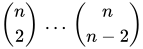
I'm going to exploit the use of LaTeX for now. As soon as I can program the AcadaWiki, I will stop.
Dr. Euler's Calculus I Sample Exam Problems
1. True or False
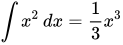
![{\displaystyle \int x^{2}\,dx={\frac {1}{3}}x^{3}}]()
2. True or False

3. True or False
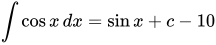
4. Evaluate
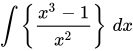
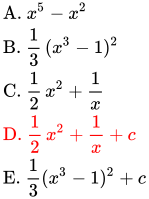
5. Evaluate

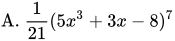
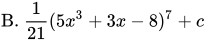

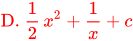
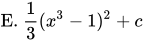
6. True or False

7. True or False
![{\displaystyle \int {\Big [}f(x){\Big ]}^{n}\,dx={\frac {1}{n+1}}{\Big [}f(x){\Big ]}^{n+1}+c\,{\mbox{ if }}n\neq -1}](https://wikimedia.org/api/rest_v1/media/math/render/svg/28f388e1566d744d2b39ac56ac745892b5784b32)
8. True or False
![{\displaystyle \int {\Big [}f(x){\Big ]}^{n}\,f^{\prime }(x)\,dx={\frac {1}{n+1}}{\Big [}f(x){\Big ]}^{n+1}+c\,{\mbox{ if }}n\neq -1}](https://wikimedia.org/api/rest_v1/media/math/render/svg/26bd5936ef03da8c00890ba42e66e98228f5e4ff)
9. True or False

10. True or False

11. True or False
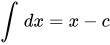
12. True or False
![{\displaystyle \int {\Big [}f(x){\Big ]}^{2}\,dx={\frac {1}{3}}{\Big [}f(x){\Big ]}^{3}+c}](https://wikimedia.org/api/rest_v1/media/math/render/svg/aaa4e4b2e5aea92cc8e640a82cb85edb0c5f6147)
13. Evaluate
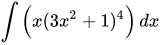
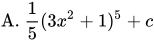
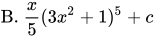
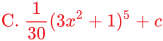
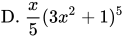
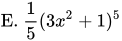
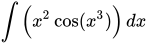
14. Evaluate

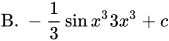
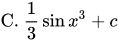
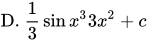
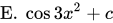
Evaluation of Multiple Derivatives
Dr. Euler assigned a recent extra credit assignment involving the finding of an equation to find the multiple derivatives of a function. The below equations are what I produced, yet they remain to be proved mathematically.

![{\displaystyle {\mbox{If }}f(x)=ax^{\frac {n_{1}}{n_{2}}}{\mbox{, then }}f^{(m)}(x)={\frac {ax^{{\big (}{\frac {n_{1}}{n_{2}}}-m{\big )}}*{\Bigg [}\prod _{h=1}^{m}{\Big \{}n_{1}-n_{2}(m-h){\Big \}}{\Bigg ]}}{n_{2}^{m}}}{\mbox{ with }}m\in \mathbb {N} {\mbox{ and }}a\neq 0}](https://wikimedia.org/api/rest_v1/media/math/render/svg/8a9df483ea9848685a33c0887e82a9840f7b780f)

![{\displaystyle {\mbox{If }}f(x)=ax^{n}{\mbox{, then }}f^{(m)}(x)={\Big [}{}_{n}P_{m}{\Big ]}ax^{(n-m)}{\mbox{ with }}n\in \mathbb {N} {\mbox{ and }}m\in \mathbb {N} {\mbox{ and }}a\neq 0}](https://wikimedia.org/api/rest_v1/media/math/render/svg/9fafb2d6e4e095d7684f81b8be4cdfea5e39893b)
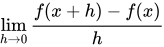
Dr. Euler's approach follows a different method, using limits as a brute-force method. Let us find multiple derivatives of the function  .
.
![{\displaystyle f^{\prime }(x)=\lim _{h\to 0}{\Bigg [}{\frac {f(x+h)-f(x)}{h}}{\Bigg ]}}](https://wikimedia.org/api/rest_v1/media/math/render/svg/77625ddcf8bd48697272965a25d2a20264e1a195) .
.
and
![{\displaystyle {\begin{alignedat}{4}f^{\prime \prime }(x)&=\lim _{h\to 0}{\Bigg [}{\frac {f^{\prime }(x+h)-f^{\prime }(x)}{h}}{\Bigg ]}\\&=\lim _{h\to 0}{\Bigg [}{\frac {{\frac {f(\{x+h\}+h)-f(x+h)}{h}}-{\frac {f(x+h)-f(x)}{h}}}{h}}{\Bigg ]}\\&=\lim _{h\to 0}{\Bigg [}{\frac {\frac {f(x+2h)-f(x+h)-f(x+h)+f(x)}{h}}{h}}{\Bigg ]}\\&=\lim _{h\to 0}{\Bigg [}{\frac {f(x+2h)-2f(x+h)+f(x)}{h^{2}}}{\Bigg ]}\\\end{alignedat}}}](https://wikimedia.org/api/rest_v1/media/math/render/svg/e1c42fd1e43d33e170ee55c8f860b4446b60df62)
and
![{\displaystyle {\begin{alignedat}{6}f^{\prime \prime \prime }(x)&=\lim _{h\to 0}{\Bigg [}{\frac {f^{\prime \prime }(x+h)-f^{\prime \prime }(x)}{h}}{\Bigg ]}\\&=\lim _{h\to 0}{\Bigg [}{\frac {f^{\prime }(x+2h)-2f^{\prime }(x+h)+f^{\prime }(x)}{h^{2}}}{\Bigg ]}\\&=\lim _{h\to 0}{\Bigg [}{\frac {{\frac {f(\{x+2h\}+h)-f(x+2h)}{h}}-2{\frac {f(\{x+h\}+h)-f(x+h)}{h}}+{\frac {f(x+h)-f(x)}{h}}}{h^{2}}}{\Bigg ]}\\&=\lim _{h\to 0}{\Bigg [}{\frac {\frac {f(x+3h)-f(x+2h)-2f(x+2h)+2f(x+h)+f(x)h)-f(x)}{h}}{h^{2}}}{\Bigg ]}\\&=\lim _{h\to 0}{\Bigg [}{\frac {f(x+3h)-3f(x+2h)+3f(x+h)-f(x)}{h^{3}}}{\Bigg ]}\\\end{alignedat}}}](https://wikimedia.org/api/rest_v1/media/math/render/svg/d05cc02953ad7d7483606a523da7845235308a61)
This was the extent to Dr. Euler's illustration of taking multiple derivatives. Obviously Dr. Euler's method trumps over mine because it has already been proven to solve any function, including trigonometric functions and rational functions. Upon analyzing these formulas, I formulated an equation for finding the nth derivative of a function with the help of Isaac Nichols, one of my fellow students.
Suppose you have a function f(x). The derivatives of of this function are as follow:
Calculus II Equations
![{\displaystyle {\begin{aligned}A&=\int _{a}^{b}f(x)\,dx{\mbox{ for individual curves.}}\\&=\int _{a}^{b}{\big [}f(x)-g(x){\big ]}\,dx{\mbox{ for multiple curves.}}\\&=\int _{c}^{d}{\big [}h(y)-k(y){\big ]}\,dy{\mbox{ for multiple curves in respect of the y axis.}}\\V&=\pi \int _{a}^{b}f(x)\,dx{\mbox{ for the Disk Method.}}\\&=\pi \int _{a}^{b}{\big [}f^{2}(x)-g^{2}(x){\big ]}\,dx{\mbox{ for the Washer Method.}}\\&=\int _{a}^{b}A(x)\,dx{\mbox{ with }}A(x)={\mbox{ the area of cross section.}}\\&=2\pi \int _{a}^{b}{\big [}xf^{2}(x){\big ]}\,dx{\mbox{ for Shell Method rotation via the y axis.}}\\&=2\pi \int _{a}^{b}x{\big [}f(x)-g(x){\big ]}\,dx{\mbox{ for Shell Method rotation via the y axis between two curves.}}\\&=\pi \int _{a}^{b}{\big [}({\mbox{outer r}})^{2}-({\mbox{inner r}})^{2}{\big ]}\,dx{\mbox{ for rotation around an alternative axis.}}\\L&=\int _{a}^{b}{\sqrt {1+[f^{\prime }(x)]^{2}}}\,dx{\mbox{ for Curve Length.}}\\&=\int _{a}^{b}{\sqrt {[f^{\prime }(t)]^{2}+[g^{\prime }(t)]^{2}}}\,dt{\mbox{ with Parametric Equations.}}\\\end{aligned}}}](https://wikimedia.org/api/rest_v1/media/math/render/svg/f0ee532137605f2be440693890ffb449950d9b65)
The Volume of a Cylindrical Wedge
For a cylindrical wedge, similar to the type of wedge that is cut from a tree when chopping, this mathematical equation will find the volume.
If you take a cross section of the wedge to form a right triangle, the area of that cross section can be computed as follows, with  representing the radius of of the semicircle,
  representing the position on the graph of the ellipse, and
  representing the angle the wedge is cut.
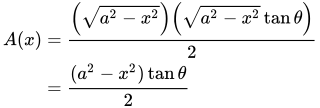
From here, we can calculate the volume of the wedge using the Cross Section method in calculus.
![{\displaystyle {\begin{aligned}V(x)&=\int _{-a}^{a}{\bigg [}{\frac {(a^{2}-x^{2})\tan \theta }{2}}{\bigg ]}dx\\&=2\int _{0}^{a}{\bigg [}{\frac {(a^{2}-x^{2})\tan \theta }{2}}{\bigg ]}dx\\&=\int _{0}^{a}{\Big [}(a^{2}-x^{2})\tan \theta {\Big ]}dx\\&=\tan \theta \int _{0}^{a}(a^{2}-x^{2})\,dx\\&=\tan \theta {\Big (}a^{2}x-{\frac {x^{3}}{3}}{\Big )}{\Big |}_{0}^{a}\\&=\tan \theta {\Big (}a^{3}-{\frac {a^{3}}{3}}{\Big )}\\&=a^{3}\tan \theta {\Big (}1-{\frac {1}{3}}{\Big )}\\&=a^{3}\tan \theta {\Big (}{\frac {2}{3}}{\Big )}\\&={\frac {2a^{3}\tan \theta }{3}}\\\end{aligned}}}](https://wikimedia.org/api/rest_v1/media/math/render/svg/a5dc886cdf0dc7a7b428bd6c832362d424f1e941)
The Paradox of Gabriel's Horn
![{\displaystyle {\begin{aligned}A&=\int _{1}^{\infty }{\frac {1}{x}}\,dx\\&=\lim _{\varphi \to \infty }\int _{1}^{\varphi }{\frac {1}{x}}\,dx\\&=\lim _{\varphi \to \infty }{\big [}\ln {|x|}{\big ]}_{1}^{\varphi }\\&=\lim _{\varphi \to \infty }{\big [}\ln {|\varphi |}-\ln 1{\big ]}\\&=\lim _{\varphi \to \infty }\ln {|\varphi |}\\&=\ln {\infty }\\&=\infty \\\end{aligned}}}](https://wikimedia.org/api/rest_v1/media/math/render/svg/90846da423bed2a43590de1f0a04a54e112d0203)
![{\displaystyle {\begin{aligned}V&=\int _{1}^{\infty }\pi {\Big (}{\frac {1}{x}}{\Big )}dx\\&=\lim _{\aleph \to \infty }\pi \int _{1}^{\aleph }x^{-2}\,dx\\&=\lim _{\aleph \to \infty }{\Big [}-{\frac {\pi }{x}}{\Big ]}_{1}^{\aleph }\\&=\lim _{\aleph \to \infty }{\Big [}-{\frac {\pi }{\aleph }}+{\frac {\pi }{1}}{\Big ]}\\&={\Big [}-{\frac {\pi }{\infty }}+{\frac {\pi }{1}}{\Big ]}\\&=\pi \\&{\mbox{DAMN IT!}}\\\end{aligned}}}](https://wikimedia.org/api/rest_v1/media/math/render/svg/da470b7d8e9c1d6d3564ab40d7023b175969708a)
![{\displaystyle {\begin{array}{lcl}A&=\int _{1}^{\infty }{\frac {1}{x}}\,dxV=&\int _{1}^{\infty }\pi {\Big (}{\frac {1}{x}}{\Big )}dx\\&=\lim _{\varphi \to \infty }\int _{1}^{\varphi }{\frac {1}{x}}\,dx&=\lim _{\aleph \to \infty }\pi \int _{1}^{\aleph }x^{-2}\,dx\\&=\lim _{\varphi \to \infty }{\big [}\ln {|x|}{\big ]}_{1}^{\varphi }&=\lim _{\aleph \to \infty }{\Big [}-{\frac {\pi }{x}}{\Big ]}_{1}^{\aleph }\\&=\lim _{\varphi \to \infty }{\big [}\ln {|\varphi |}-\ln 1{\big ]}&=\lim _{\aleph \to \infty }{\Big [}-{\frac {\pi }{\aleph }}+{\frac {\pi }{1}}{\Big ]}\\&=\lim _{\varphi \to \infty }\ln {|\varphi |}&={\Big [}-{\frac {\pi }{\infty }}+{\frac {\pi }{1}}{\Big ]}\\&=\ln {\infty }&=\pi \\\\&=\infty &{\mbox{DAMN IT!}}\\\end{array}}}](https://wikimedia.org/api/rest_v1/media/math/render/svg/add0cd3b0647e4bd27d87a334c5b79cf2d5b4df6)




![{\displaystyle \lim _{h\to 0}{\Bigg [}{\frac {f(x+2h)-2f(x+h)+f(x)}{h^{2}}}{\Bigg ]}}](https://wikimedia.org/api/rest_v1/media/math/render/svg/66a916b73926d95ac7ca57b734c7c7cc061bea9b)


![{\displaystyle \lim _{h\to 0}{\Bigg [}{\frac {f(x+3h)-3f(x+2h)+3f(x+h)-f(x)}{h^{3}}}{\Bigg ]}}](https://wikimedia.org/api/rest_v1/media/math/render/svg/7118ee80a506ca11adc1834a0f0ac4a6b9893ca5)


![{\displaystyle \lim _{h\to 0}{\Bigg [}{\frac {\sum _{i=0}^{n}{\Big [}(-1)^{i}{\binom {n}{i}}f(x+\{n-i\}h){\Big ]}}{h^{n}}}{\Bigg ]}}](https://wikimedia.org/api/rest_v1/media/math/render/svg/49511aed44e7eb881b7efe0001c451adc1afc4e2)