User:Gentlemath/Sandbox
In mathematics, the Pell numbers are an integer sequence that has been known at least since 400 BCE.[1] The sequence of Pell numbers starts with 0 and 1
In mathematics, the Pell numbers are an integer sequence that has been known at least since 400 BCE.[1] The sequence of Pell numbers starts with 0 and 1, and then each Pell number is the sum of twice the previous Pell number and the Pell number before that. The first few terms of the sequence are
The Half companion Pell numbers are another sequence which begins 1, 1, 3, 7, 17, 41... and has the same recurrence. Theon of Smyrna defined the two sequences by a paired recurrence and observed that the square of each number in this second sequence is one more or one less than the square of the corresponding Pell number (32=2•22+1 and 72=2•52-1 and so on). Consequently, this second sequence suplies the numerators, and the Pell numbers the denominators, of the sequence 1/1, 3/2, 7/5, 17/12, 41/29 ... of closest rational approximations to the square root of 2. The doubles of the numerators are sometimes called companion Pell numbers or Pell-Lucas numbers; these numbers form a second infinite sequence that begins with 2, 2, 6, 14, 34, and 82.
Both the Pell numbers and the companion Pell numbers may be calculated by means of a recurrence relation similar to that for the Fibonacci numbers, and both sequences of numbers grow exponentially, proportionally to powers of the silver ratio 1 + √2. As well as being used to approximate the square root of two, Pell numbers can be used to find square triangular numbers, to construct nearly-isosceles integer right triangles, and to solve certain combinatorial enumeration problems.[2]
As with Pell's equation, the name of the Pell numbers stems from Leonhard Euler's mistaken attribution of the equation and the numbers derived from it to John Pell. The Pell-Lucas numbers are also named after Edouard Lucas, who studied sequences defined by recurrences of this type; the Pell and companion Pell numbers are Lucas sequences.
Pell numbers
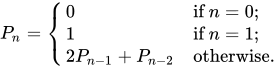
The Pell numbers are defined by the recurrence relation
In words, the sequence of Pell numbers starts with 0 and 1, and then each Pell number is the sum of twice the previous Pell number and the Pell number before that.
The Pell numbers can also be expressed by the closed form formula
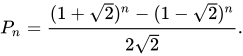
For large values of n, the term dominates this expression, so the Pell numbers are approximately proportional to powers of the silver ratio , analogous to the growth rate of Fibonacci numbers as powers of the golden ratio.


A third definition is possible, from the matrix formula
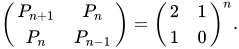
Many identities can be derived or proven from these definitions; for instance an identity analogous to Cassini's identity for Fibonacci numbers,

is an immediate consequence of the matrix formula (found by considering the determinants of the matrices on the left and right sides of the matrix formula).[3]
Approximation to the square root of two

Pell numbers arise historically and most notably in the rational approximation to the square root of 2. If two large integers x and y form a solution to the Pell equation

then their ratio provides a close approximation to . The sequence of approximations of this form is


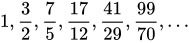
where the denominator of each fraction is a Pell number and the numerator is the sum of a Pell number and its predecessor in the sequence. That is, the solutions have the form . The approximation


of this type was known to Indian mathematicians in the third or fourth century B.C.[4] The Greek mathematicians of the fifth century B.C. also knew of this sequence of approximations;[5] they called the denominators and numerators of this sequence side and diameter numbers and the numerators were also known as rational diagonals or rational diameters.[6]
These approximations can be derived from the continued fraction expansion of :
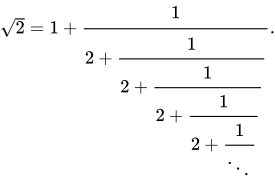
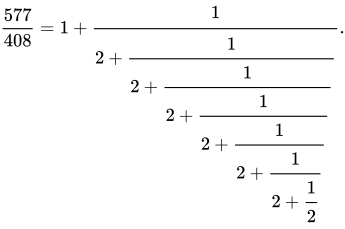
Truncating this expansion to any number of terms produces one of the Pell-number-based approximations in this sequence; for instance,
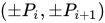
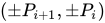
As Knuth (1994) describes, the fact that Pell numbers approximate allows them to be used for accurate rational approximations to a regular octagon with vertex coordinates and . All vertices are equally distant from the origin, and form nearly uniform angles around the origin. Alternatively, the points , , and form approximate octagons in which the vertices are nearly equally distant from the origin and form uniform angles.



Primes and squares
A Pell prime is a Pell number that is prime. The first few Pell primes are
As with the Fibonacci numbers, a Pell number can only be prime if n itself is prime.

The only Pell numbers that are squares, cubes, or any higher power of an integer are 0, 1, and 169 = 132.[7]
However, despite having so few squares or other powers, Pell numbers have a close connection to square triangular numbers.[8] Specifically, these numbers arise from the following identity of Pell numbers:

The left side of this identity describes a square number, while the right side describes a triangular number, so the result is a square triangular number.
Santana and Diaz-Barrero (2006) prove another identity relating Pell numbers to squares and showing that the sum of the Pell numbers up to is always a square:


For instance, the sum of the Pell numbers up to , , is the square of . The numbers forming the square roots of these sums,




are known as the NSW numbers.
Pythagorean triples

If a right triangle has integer side lengths a, b, c (necessarily satisfying the Pythagorean theorem a2+b2=c2), then (a,b,c) is known as a Pythagorean triple. As Martin (1875) describes, the Pell numbers can be used to form Pythagorean triples in which a and b are one unit apart, corresponding to right triangles that are nearly isosceles. Each such triple has the form

The sequence of Pythagorean triples formed in this way is
- (4,3,5), (20,21,29), (120,119,169), (696,697,985), ....
Companion Pell numbers (Pell-Lucas numbers)
The companion Pell numbers or Pell-Lucas numbers are defined by the recurrence relation
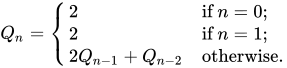
In words: the first two numbers in the sequence are both 2, and each successive number is formed by adding twice the previous Pell-Lucas number to the Pell-Lucas number before that, or equivalently, by adding the next Pell number to the previous Pell number: thus, 82 is the companion to 29, and 82 = 2 * 34 + 14 = 70 + 12. T he first few terms of the sequence are (sequence A002203 in the OEIS): 2, 2, 6, 14, 34, 82, 198, 478...
The companion Pell numbers can be expressed by the closed form formula

These numbers are all even; each such number is twice the numerator in one of the rational approximations to discussed above.
Computations and Connections
The following table gives the first few powers of the silver ratio and its conjugate .


| 0 | ||
| 1 | ||
| 2 | ||
| 3 | ||
| 4 | ||
| 5 | ||
| 6 | ||
| 7 | ||
| 8 | ||
| 9 | ||
| 10 | ||
| 11 | ||
| 12 |


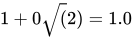
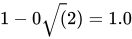
























The coefficients are the Pell numbers and the Half companion Pell numbers and The Pell numbers which are the (non-negative) solutions to . A Square triangular number is a number which is both the th triangular number and the th square number. A near isosceles Pythagorean triple is an integer solution to where . $H_n$ is always odd. The next table shows that splitting $H_n$ into nearly equal halves gives a square triangular number when n is even and a near isosceles Pythagorean triple when n is odd. All solutions arise in this manner.


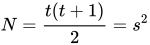


| t | t+1 | s | a | b | c | |||
|---|---|---|---|---|---|---|---|---|
| 0 | 1 | 0 | 0 | 0 | 0 | |||
| 1 | 1 | 1 | 0 | 1 | 1 | |||
| 2 | 3 | 2 | 1 | 2 | 1 | |||
| 3 | 7 | 5 | 3 | 4 | 5 | |||
| 4 | 17 | 12 | 8 | 9 | 6 | |||
| 5 | 41 | 29 | 20 | 21 | 29 | |||
| 6 | 99 | 70 | 49 | 50 | 35 | |||
| 7 | 239 | 169 | 119 | 120 | 169 | |||
| 8 | 577 | 408 | 288 | 289 | 204 | |||
| 9 | 1393 | 985 | 696 | 697 | 985 | |||
| 10 | 3363 | 2378 | 1681 | 1682 | 1189 | |||
| 11 | 8119 | 5741 | 4059 | 4060 | 5741 | |||
| 12 | 19601 | 13860 | 9800 | 9801 | 6930 |
Definitions
The half companion Pell Numbers and the Pell numbers can be derived in a number of easily equivalent ways:
Raising to powers:


From this it follows that there are closed forms:

and

Paired recurrences:


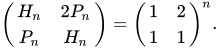
and Matrix formulations:

So
Approximations
The difference between and is which goes rapidly to zero. So is extremely close .




From this last observation it follows that the integer ratios rapidly approach while and rapidly approach .


The Pell Equation
Since is irrational, we can't have i.e. . The best we can achieve is either or .


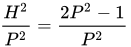
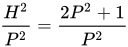
The (non-negative) solutions to are exactly the pairs even and the solutions to are exactly the pairs odd. To see this, note first that




so that these differences, starting with are alternately . Then note that that every positive solution comes in this way from a solution with smaller integers since . The smaller solution also has positive integers with the one exception which comes from .




Square triangular numbers
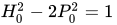
The required equation is equivalent to which becomes with the substitutions . Hence the nth solution is and
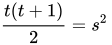

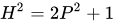

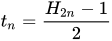

Observe that and are relatively prime so that happens exactly when they are adjacent integers, one a square and the other twice a square . Since we know all solutions of that equation, we also have


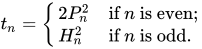
and

This alternate expression is seen in the next table.
| t | t+1 | s | a | b | c | |||||
|---|---|---|---|---|---|---|---|---|---|---|
| 0 | 1 | 0 | ||||||||
| 1 | 1 | 1 | 1 | 2 | 1 | 1 | 0 | 1 | ||
| 2 | 3 | 2 | 8 | 9 | 6 | 3 | 4 | 5 | ||
| 3 | 7 | 5 | 49 | 50 | 35 | 21 | 20 | 29 | ||
| 4 | 17 | 12 | 288 | 289 | 204 | 119 | 120 | 169 | ||
| 5 | 41 | 29 | 1681 | 1682 | 1189 | 697 | 696 | 985 | ||
| 6 | 99 | 70 | 9800 | 9801 | 6930 | 4059 | 4060 | 5741 |
Pythagorean Triples
The equality occurs exactly when which becomes with the substitutions . Hence the nth solution is and


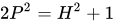

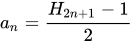

The table above shows that in one order or the other are while



Notes
- ^ See Knorr (1976) for the fifth century date, which matches Proclus' claim that the side and diameter numbers were discovered by the Pythagoreans. For more detailed exploration of later Greek knowledge of these numbers see Thompson (1929), Vedova (1951), Ridenhour (1986), Knorr (1998), and Filep (1999).
- ^ For instance, Sellers (2002) proves that the number of perfect matchings in the Cartesian product of a path graph and the graph K4-e can be calculated as the product of a Pell number with the corresponding Fibonacci number.
- ^ For the matrix formula and its consequences see Ercolano (1979) and Kilic and Tasci (2005). Additional identities for the Pell numbers are listed by Horadam (1971) and Bicknell (1975).
- ^ As recorded in the Shulba Sutras; see e.g. Dutka (1986), who cites Thibaut (1875) for this information.
- ^ See Knorr (1976) for the fifth century date, which matches Proclus' claim that the side and diameter numbers were discovered by the Pythagoreans. For more detailed exploration of later Greek knowledge of these numbers see Thompson (1929), Vedova (1951), Ridenhour (1986), Knorr (1998), and Filep (1999).
- ^ For instance, as several of the references from the previous note observe, in Plato's Republic there is a reference to the "rational diameter of 5", by which Plato means 7, the numerator of the approximation 7/5 of which 5 is the denominator.
- ^ Pethő (1992); Cohn (1996). Although the Fibonacci numbers are defined by a very similar recurrence to the Pell numbers, Cohn writes that an analogous result for the Fibonacci numbers seems much more difficult to prove.
- ^ Sesskin (1962). See the square triangular number article for a more detailed derivation.
References
- Bicknell, Marjorie (1975). "A primer on the Pell sequence and related sequences". Fibonacci Quarterly. 13 (4): 345–349. MR 0387173.
- Cohn, J. H. E. (1996). "Perfect Pell powers". Glasgow Mathematical Journal. 38 (1): 19–20. MR 1373953.
- Dickson, L. E. (1919). History of the Theory of Numbers, Vol. 2: Diophantine Analysis. Carnegie Institute. p. 341.
{{cite book}}: Unknown parameter|etc=ignored (help) - Dutka, Jacques (1986). "On square roots and their representations". Archive for History of Exact Sciences. 36 (1): 21–39. doi:10.1007/BF00357439. MR 0863340.
- Ercolano, Joseph (1979). "Matrix generators of Pell sequences". Fibonacci Quarterly. 17 (1): 71–77. MR 0525602.
- Filep, László (1999). "Pythagorean side and diagonal numbers" (PDF). Acta Mathematica Academiae Paedagogiace Nyíregyháziensis. 15: 1–7.
- Horadam, A. F. (1971). "Pell identities". Fibonacci Quarterly. 9 (3): 245–252, 263. MR 0308029.
- Kilic, Emrah; Tasci, Dursun (2005). "The linear algebra of the Pell matrix". Boletín de la Sociedad Matemática Mexicana, Tercera Serie. 11 (2): 163–174. MR 2207722.
{{cite journal}}: CS1 maint: multiple names: authors list (link) - Knorr, Wilbur (1976). "Archimedes and the measurement of the circle: A new interpretation". Archive for History of Exact Sciences. 15 (2): 115–140. doi:10.1007/BF00348496. MR 0497462.
- Knorr, Wilbur (1998). ""Rational diameters" and the discovery of incommensurability". American Mathematical Monthly. 105 (5): 421–429. doi:10.2307/3109803.
- Knuth, Donald E. (1994). "Leaper graphs". The Mathematical Gazette. 78: 274–297. arXiv:math/9411240. doi:10.2307/3620202.
- Martin, Artemas (1875). "Rational right angled triangles nearly isosceles". The Analyst. 3 (2): 47–50. doi:10.2307/2635906. JSTOR 2635906.
- Pethő, A. (1992). "The Pell sequence contains only trivial perfect powers". Sets, graphs, and numbers (Budapest, 1991). Colloq. Math. Soc. János Bolyai, 60, North-Holland. pp. 561–568. MR 1218218.
{{cite conference}}: Unknown parameter|booktitle=ignored (|book-title=suggested) (help) - Ridenhour, J. R. (1986). "Ladder approximations of irrational numbers". Mathematics Magazine. 59 (2): 95–105. JSTOR 2690427.
- Santana, S. F.; Diaz-Barrero, J. L. (2006). "Some properties of sums involving Pell numbers" (PDF). Missouri Journal of Mathematical Sciences. 18 (1).
{{cite journal}}: CS1 maint: multiple names: authors list (link) - Sellers, James A. (2002). "Domino tilings and products of Fibonacci and Pell numbers" (PDF). Journal of Integer Sequences. 5. MR 1919941.
- Sesskin, Sam (1962). "A "converse" to Fermat's last theorem?". Mathematics Magazine. 35 (4): 215–217.
- Thibaut, George (1875). "On the Súlvasútras". Journal of the Royal Asiatic Society of Bengal. 44: 227–275.
- Thompson, D'Arcy Wentworth (1929). "III.—Excess and defect: or the little more and the little less". Mind: New Series. 38 (149): 43–55. JSTOR 2249223.
- Vedova, G. C. (1951). "Notes on Theon of Smyrna". American Mathematical Monthly. 58 (10): 675–683. doi:10.2307/2307978.
External links
unrelated

|

|
|
|
|
|
   
|
Content Disclaimer
Informasi ini disarikan dari Wikipedia dan disajikan kembali untuk tujuan edukasi. Konten tersedia di bawah lisensi CC BY-SA 3.0. Kami tidak bertanggung jawab atas ketidakakuratan data yang bersumber dari kontribusi publik tersebut.
- The information displayed on this website is sourced in part or in whole from Wikipedia and has been adapted for the purpose of restating it. We strive to provide accurate and relevant information, however:
- There is no guarantee of absolute accuracy. Wikipedia is an open, collaborative project that can be edited by anyone, so information is subject to change.
- It is not intended to constitute professional advice. The content displayed is for informational and educational purposes only. For important decisions (e.g., medical, legal, or financial), please consult a professional.
- Content copyright. Wikipedia is licensed under the Creative Commons Attribution-ShareAlike License (CC BY-SA). This means that content may be reused with appropriate attribution and shared under a similar license.
- Responsible use. Any risk arising from the use of information from this website is entirely the responsibility of the user.