User:Edblah
World0

Linear density, linear mass density or linear mass is a measure of mass per unit of length, and it is a characteristic of strings or other one-dimensional objects. The SI unit of linear density is the kilogram per metre (kg/m). It is defined as:
where μ is the linear density of the object, m is the mass, and x is a coordinate along the (one dimensional) object.
For the common case of a homogenous substance of length L and total mass m, this simplifies to:

Let be the length of the string, its mass and the tension.


When the string is deflected it bends as an approximate arc of circle. Let be the radius and the angle under the arc. Then .


The string is recalled to its natural position by a force :


The force is also equal to the centripetal force
- where is the speed of propagation of the wave in the string.


Let be the linear mass of the string. Then


and
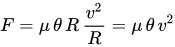
Equating the two expressions for gives:

Solving for velocity v, we find

Frequency of the wave
Once the speed of propagation is known, the frequency of the sound produced by the string can be calculated. The speed of propagation of a wave is equal to the wavelength divided by the period , or multiplied by the frequency :


If the length of the string is , the fundamental harmonic is the one produced by the vibration whose nodes are the two ends of the string, so is half of the wavelength of the fundamental harmonic. Hence:
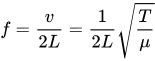
where is the tension, is the linear mass, and is the length of the vibrating part of the string.
Content Disclaimer
Informasi ini disarikan dari Wikipedia dan disajikan kembali untuk tujuan edukasi. Konten tersedia di bawah lisensi CC BY-SA 3.0. Kami tidak bertanggung jawab atas ketidakakuratan data yang bersumber dari kontribusi publik tersebut.
- The information displayed on this website is sourced in part or in whole from Wikipedia and has been adapted for the purpose of restating it. We strive to provide accurate and relevant information, however:
- There is no guarantee of absolute accuracy. Wikipedia is an open, collaborative project that can be edited by anyone, so information is subject to change.
- It is not intended to constitute professional advice. The content displayed is for informational and educational purposes only. For important decisions (e.g., medical, legal, or financial), please consult a professional.
- Content copyright. Wikipedia is licensed under the Creative Commons Attribution-ShareAlike License (CC BY-SA). This means that content may be reused with appropriate attribution and shared under a similar license.
- Responsible use. Any risk arising from the use of information from this website is entirely the responsibility of the user.