User:Differintegral/sandbox
I should move away from the overly pithy style, because the function doesn't actually follow that form

I should move away from the overly pithy style, because the function doesn't actually follow that form
Voltage-gated ion channels
Using a series of voltage clamp experiments and by varying extracellular sodium and potassium concentrations, Hodgkin and Huxley developed a model in which the properties of an excitable cell are described by a set of four ordinary differential equations.[1] Together with the equation for the total current mentioned above, these are:



where I is the current per unit area, and and are rate constants for the i-th ion channel, which depend on voltage but not time. is the maximal value of the conductance. n, m, and h are dimensionless quantities between 0 and 1 that are associated with potassium channel activation, sodium channel activation, and sodium channel inactivation, respectively. In the original paper by Hodgkin and Huxley,[2] the functions and are given by


while in many current software programs,[3] Hodgkin-Huxley type models generalize and to
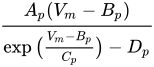
with appropriate constants.
where the specific values of and depend on the ionic gate. In the original paper by Hodgkin and Huxley, these values are


| Units | |||
|---|---|---|---|
| mV,msec | |||
| mV, | |||
| mV, | |||
| mV,msec | |||
| mV, |


- .

and , and are the steady state values for activation and inactivation, respectively, and are usually represented by Boltzmann equations as functions of .


In order to characterize voltage-gated channels, the equations are fit to voltage clamp data. For a derivation of the Hodgkin–Huxley equations under voltage-clamp, see.[4] Briefly, when the membrane potential is held at a constant value (i.e., voltage-clamp), for each value of the membrane potential the nonlinear gating equations reduce to equations of the form:
![{\displaystyle m(t)=m_{0}-[(m_{0}-m_{\infty })(1-e^{-t/\tau _{m}})]\,}](https://wikimedia.org/api/rest_v1/media/math/render/svg/7628fde7c11cc9053f49af7569f0807ffa6bf09c)
![{\displaystyle h(t)=h_{0}-[(h_{0}-h_{\infty })(1-e^{-t/\tau _{h}})]\,}](https://wikimedia.org/api/rest_v1/media/math/render/svg/3bba9ecee241689c0b7b5374c9567462a9b8931d)
![{\displaystyle n(t)=n_{0}-[(n_{0}-n_{\infty })(1-e^{-t/\tau _{n}})]\,}](https://wikimedia.org/api/rest_v1/media/math/render/svg/46507359f94faf96b2f83d41dc74bbce09630fd1)
Thus, for every value of membrane potential the sodium and potassium currents can be described by


In order to arrive at the complete solution for a propagated action potential, one must write the current term I on the left-hand side of the first differential equation in terms of V, so that the equation becomes an equation for voltage alone. The relation between I and V can be derived from cable theory and is given by
- ,
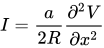
where a is the radius of the axon, R is the specific resistance of the axoplasm, and x is the position along the nerve fiber. Substitution of this expression for I transforms the original set of equations into a set of partial differential equations, because the voltage becomes a function of both x and t.
The Levenberg–Marquardt algorithm,[5][6] a modified Gauss–Newton algorithm, is often used to fit these equations to voltage-clamp data.[citation needed]
While the original experiments treated only sodium and potassium channels, the Hodgkin Huxley model can also be extended to account for other species of ion channels.
- ^ Hodgkin, A.L., and Huxley, A.F., "A quantitative description of membrane current and its application to conduction and excitation in nerve. J. Physiol. (1952) 177, 500-544
- ^ Hodgkin, A. L.; Huxley, A. F. (1952). "A quantitative description of membrane current and its application to conduction and excitation in nerve". The Journal of physiology. 117 (4): 500–544. doi:10.1113/jphysiol.1952.sp004764. PMC 1392413. PMID 12991237.
- ^ Nelson ME (2005) Electrophysiological Models In: Databasing the Brain: From Data to Knowledge. (S. Koslow and S. Subramaniam, eds.) Wiley, New York, pp. 285-301
- ^ Gray, Daniel Johnston; Wu, Samuel Miao-Sin (1997). Foundations of cellular neurophysiology (3rd. ed.). Cambridge, Massachusetts [u.a.]: MIT Press. ISBN 9780262100533.
- ^ Marquardt, D. W. (1963). "An Algorithm for Least-Squares Estimation of Nonlinear Parameters". Journal of the Society for Industrial and Applied Mathematics. 11 (2): 431–000. doi:10.1137/0111030.
- ^ Levenberg, K (1944). "A method for the solution of certain non-linear problems in least squares". Qu. App. Maths. 2: 164.
Content Disclaimer
Informasi ini disarikan dari Wikipedia dan disajikan kembali untuk tujuan edukasi. Konten tersedia di bawah lisensi CC BY-SA 3.0. Kami tidak bertanggung jawab atas ketidakakuratan data yang bersumber dari kontribusi publik tersebut.
- The information displayed on this website is sourced in part or in whole from Wikipedia and has been adapted for the purpose of restating it. We strive to provide accurate and relevant information, however:
- There is no guarantee of absolute accuracy. Wikipedia is an open, collaborative project that can be edited by anyone, so information is subject to change.
- It is not intended to constitute professional advice. The content displayed is for informational and educational purposes only. For important decisions (e.g., medical, legal, or financial), please consult a professional.
- Content copyright. Wikipedia is licensed under the Creative Commons Attribution-ShareAlike License (CC BY-SA). This means that content may be reused with appropriate attribution and shared under a similar license.
- Responsible use. Any risk arising from the use of information from this website is entirely the responsibility of the user.