User:CFDFEM
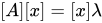
In linear algebra, it is more common to see the standard form of an eigensystem which is expressed as:
Comparison to linear algebra
In linear algebra, it is more common to see the standard form of an eigensystem which is expressed as:
Both equations can be seen as the same because if the general equation is multiplied through by the inverse of the mass, ,
![{\displaystyle [M]^{-1}}](https://wikimedia.org/api/rest_v1/media/math/render/svg/a3eb7314f3fed6296d404de8a83e6c1c78a2b7b5)



![{\displaystyle P(x)={\frac {1}{2}}{\Big [}1+\operatorname {erf} {\Big (}{\frac {x-\mu }{\sqrt {2\sigma ^{2}}}}{\Big )}{\Big ]}}](https://wikimedia.org/api/rest_v1/media/math/render/svg/9ec95f9f58c6b3e86b5fcae7b4e08e1ea160391b)
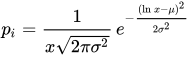
![{\displaystyle P(x)={\frac {1}{2}}+{\frac {1}{2}}\,\mathrm {erf} {\Big [}{\frac {\ln x-\mu }{\sqrt {2\sigma ^{2}}}}{\Big ]}}](https://wikimedia.org/api/rest_v1/media/math/render/svg/d5f43925cb5471db13b5b83327b82d3558d43156)
![{\displaystyle Probabilty(V>observed)=Q_{KP}([{\sqrt {N}}+0.155+0.24/{\sqrt {N}}]D)=Q_{KP}(\lambda )}](https://wikimedia.org/api/rest_v1/media/math/render/svg/d827d0e12ccccbafe4f7d7fc8fff40d7bd189189)
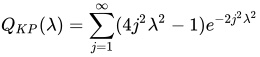
![{\displaystyle V=D_{+}+D_{-}~=\max _{-\infty <x<\infty }[S_{N}(x)-P(x)]+\max _{-\infty <x<\infty }[P(x)-S_{N}(x)]}](https://wikimedia.org/api/rest_v1/media/math/render/svg/fe32e94b6f0d2a496490ef6dc9042947a7cdb55f)

but the eigenvectors are the same.
Methods of solution
For linear elastic problems that are properly set up (no rigid body rotation or translation), the stiffness and mass matrices and the system in general are positive definite. These are the easiest matrices to deal with because the numerical methods commonly applied are guaranteed to converge to a solution. When all the qualities of the system are considered:
- Only the smallest eigenvalues and eigenvectors of the lowest modes are desired
- The mass and stiffness matrices are sparse and highly banded
- The system is positive definite
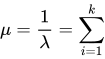
a typical prescription of solution is first to tridiagonalize the system using the Lanczos algorithm. Next, use the QR algorithm to find the eigenvectors and eigenvalues of this tridiagonal system. If inverse iteration is used, the new eigenvalues will relate to the old by , while the eigenvectors of the original can be calculated from those of the tridiagonalized matrix by:

![{\displaystyle [r^{n}]=[Q][v^{n}]}](https://wikimedia.org/api/rest_v1/media/math/render/svg/84fdda88501ac45f289796e7177c1453e55d808c)
where is a Ritz vector approximately equal to the eigenvector of the original system, is the matrix of Lanczos vectors, and is the eigenvector of the tridiagonal matrix.
![{\displaystyle [r^{n}]}](https://wikimedia.org/api/rest_v1/media/math/render/svg/4caa03b79c5ce865a74a2b03c4cfc5104733b39e)
![{\displaystyle [Q]}](https://wikimedia.org/api/rest_v1/media/math/render/svg/32d2453284fa72720da205f53dd91aedcaac8e35)
![{\displaystyle [v^{n}]}](https://wikimedia.org/api/rest_v1/media/math/render/svg/05bb6c86138b15f733d35b16d254acd709e2186d)

Content Disclaimer
Informasi ini disarikan dari Wikipedia dan disajikan kembali untuk tujuan edukasi. Konten tersedia di bawah lisensi CC BY-SA 3.0. Kami tidak bertanggung jawab atas ketidakakuratan data yang bersumber dari kontribusi publik tersebut.
- The information displayed on this website is sourced in part or in whole from Wikipedia and has been adapted for the purpose of restating it. We strive to provide accurate and relevant information, however:
- There is no guarantee of absolute accuracy. Wikipedia is an open, collaborative project that can be edited by anyone, so information is subject to change.
- It is not intended to constitute professional advice. The content displayed is for informational and educational purposes only. For important decisions (e.g., medical, legal, or financial), please consult a professional.
- Content copyright. Wikipedia is licensed under the Creative Commons Attribution-ShareAlike License (CC BY-SA). This means that content may be reused with appropriate attribution and shared under a similar license.
- Responsible use. Any risk arising from the use of information from this website is entirely the responsibility of the user.