User:Apdevries/Bass diffusion formula
The Bass diffusion model was developed by Frank Bass and describes the process how new products get adopted as an interaction between users and potential users.
The Bass diffusion model was developed by Frank Bass and describes the process how new products get adopted as an interaction between users and potential users. The model is widely used in forecasting, especially product forecasting and technology forecasting.
Frank Bass published his paper "A new product growth for model consumer durables" in 1969 [1] Prior to this, Everett Rogers published Diffusion of Innovations, a highly influential work that described the different stages of product adoption. Bass contributed some mathematical ideas to the concept. [2]
This model has been widely influential in marketing and management science. In 2004 it was selected as one of the ten most frequently cited papers in the 50-year history of Management Science [3]. It was ranked number five, and the only marketing paper in the list. It was subsequently reprinted in the December 2004 issue of Management Science.
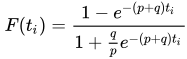
Model formulation
[1]
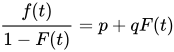
Where:
is the rate of change of the installed base fraction is the installed base fraction is the ultimate market potential is the coefficient of innovation is the coefficient of imitation


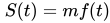
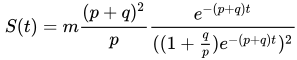
Sales is the rate of change of installed base (i.e. adoption) multiplied by the ultimate market potential :

[1]
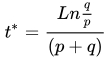
The time of peak sales

[1]
Explanation
The coefficient p is called the coefficient of innovation, external influence or advertising effect. The coefficient q is called the coefficient of imitation, internal influence or word-of-mouth effect.
Typical values of p and q:[4]
- The average value of p has been found to be 0.03, and is often less than 0.01
- The average value of q has been found to be 0.38, with a typical range between 0.3 and 0.5
- q typically takes values between 0.5 and 0.9, with 0.7 the average


Extensions to the model
Generalised Bass model (with pricing)
Bass found that his model fit the data for almost all product introductions, despite a wide range of managerial decision variable, e.g. pricing and advertising. This means that decision variable can shift the Bass curve in time, but that the shape of the curve is always similar.
Although many extensions of the model has been proposed, only one of these reduces to the Bass model under ordinary circumstances.. This model was developed in 1994 by Frank Bass, Trichy Krishnan and Dipak Jain:
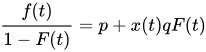
where is a function of percentage change in price and other variables

Successive generations
Technology products succeed one another in generations. Norton and Bass extended the model in 1987 for sales of products with continuous repeat purchasing. The formulation for three generations is as follows:



where
is the incremental number of ultimate adopters of the ith generation product is the average (continuous) repeat buying rate among adopters of the ith generation product is the time since the introduction of the ith generation product


It has been found that the p and q terms are generally the same between successive generations.
Relationship with other s-curves
There are two special cases of the Bass diffusion model.
- The first special case occurs when q=0, when the model reduces to the Exponential distribution.
- The second special case reduces to the logistic distribution, when p=0.
References
- ^ a b c d Bass, Frank (1969). "A new product growth for model consumer durables". Management Science. 15 (5): 215–227. doi:10.1287/mnsc.15.5.215.
- ^ Management Science 50 Number 12 Supplement, Dec 2004 ISSN 0025-1909 p1833-1840
- ^ Management Science 15(5) p215
- ^ Mahajan, Vijay (1995). "Diffusion of new products: Empirical generalizations and managerial uses". Management Science. 14 (3): G79–G88.
{{cite journal}}: Unknown parameter|coauthors=ignored (|author=suggested) (help)
See also
External links
Content Disclaimer
Informasi ini disarikan dari Wikipedia dan disajikan kembali untuk tujuan edukasi. Konten tersedia di bawah lisensi CC BY-SA 3.0. Kami tidak bertanggung jawab atas ketidakakuratan data yang bersumber dari kontribusi publik tersebut.
- The information displayed on this website is sourced in part or in whole from Wikipedia and has been adapted for the purpose of restating it. We strive to provide accurate and relevant information, however:
- There is no guarantee of absolute accuracy. Wikipedia is an open, collaborative project that can be edited by anyone, so information is subject to change.
- It is not intended to constitute professional advice. The content displayed is for informational and educational purposes only. For important decisions (e.g., medical, legal, or financial), please consult a professional.
- Content copyright. Wikipedia is licensed under the Creative Commons Attribution-ShareAlike License (CC BY-SA). This means that content may be reused with appropriate attribution and shared under a similar license.
- Responsible use. Any risk arising from the use of information from this website is entirely the responsibility of the user.