Talk:Wave packet
I really like the Shrödinger part where it is used as a way to show what a dispersive medium can do, but I would like to add that I don't know many particles o

 | This  level-5 vital article is rated C-class on Wikipedia's content assessment scale. level-5 vital article is rated C-class on Wikipedia's content assessment scale.It is of interest to the following WikiProjects: | ||||||||||
| |||||||||||
.jpg)


Interesting article but
I really like the Shrödinger part where it is used as a way to show what a dispersive medium can do, but I would like to add that I don't know many particles obbeying the Shrodinger's equation. If you describe photons, you will use Maxwell's equation and quantize them as much as you can, if you look at electrons, you will deal with the Dirac equation. None of them exhibit that dispersive behavior (at least in vacuum). That dispersive behavior is a pathology of the model, it creates faster than light signals. Klinfran (talk) 10:38, 15 June 2024 (UTC)
Proposal to revert edits related to "quadratic phase"
@Cosmia Nebula added content about quadratic phase but without references. This content cannot be verified. I would normally just revert such edits but later ones on Airy waves did have references. Johnjbarton (talk) 04:18, 29 August 2024 (UTC)
- Unfortunately it is not the first time this has happened. I had the exact same issue with recent edits in the wave equation article, which I addressed on her talk page. (I actually suggested the citer tool I found on your userpage, which is amazing)
- Then (to a lesser degree) the same happend in the weyl algebra article, which I almost had to WP:TAGBOMB
- To her credit, she somewhat improved the referencing afterwards and I do believe it is clearly a case of WP:GF as the mathematics is usually very solid. However, when she goes into "storytelling mode" the situation becomes more problematic; violating WP:NOR.
- It feels like referencing is being treated as an afterthought rather than the basis of the edits. If WP:V and WP:NOR is not taken into consideration in future, then she shouldn't be surprised her edits will be reverted. Otherwise we'll keep having this discussion over and over again.
- Kind regards, Roffaduft (talk) 06:18, 29 August 2024 (UTC)
Animations
I'm trying to read this page but it has animations all over it. So while I try to focus there is always some distracting motion that draws my eye. It sucks. Jayarava (talk) 07:54, 7 April 2025 (UTC)
- Maybe there is a way to have an on-demand animation so users would click on the image to see the animation. Perhaps you can ask on WP:Village pump for such an option. Johnjbarton (talk) 17:56, 7 April 2025 (UTC)
Formula for doubling time T seems to be wrong
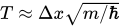
At the end of the Historical background section, there is a formula for the time for a wavefunction to double in size. The formula cannot be correct because its units are square root of seconds, rather than seconds. I believe the right hand side of this equation needs to be squared: T approx DeltaX^2 times m over hbar.
I don't know how to do equations in Wikipedia and cannot do the correction. Stuartsamuel123 (talk) 23:11, 14 May 2025 (UTC)
- While I agree with your dimensional analysis, reliable sources do not. The given equation does verify with the given source. Other sources discussing the "Ehrenfest time" say is it proportional to one over square root of hbar.
- Schubert, R., Vallejos, R. O., & Toscano, F. (2012). How do wave packets spread? Time evolution on Ehrenfest time scales. Journal of Physics A: Mathematical and Theoretical, 45(21), 215307.
- Shepelyansky, D. (2020). Ehrenfest time and chaos. Scholarpedia, 15(9), 55031.
- Later I can check if any of my QM books cover this. Johnjbarton (talk) 01:47, 15 May 2025 (UTC)
- I derived the formula from scratch. Then I did Google search with "wave packet doubling time formula" and the result appeared in Search Labs AI Overview. One reference that appeared was Equation (2.11.13) of https://phys.libretexts.org/Bookshelves/Quantum_Mechanics/Introductory_Quantum_Mechanics_(Fitzpatrick)/02%3A_Wave-Particle_Duality/2.11%3A_Evolution_of_Wave-Packets
- The result is also consistent with the analysis in "Gaussian wave packets in quantum mechanics" of this Wikipedia webpage.
- By the way, Ehrenfest time is not the wavefunction spreading doubling time.
- I figured out how to implement the math formatting and did it. Stuartsamuel123 (talk) 04:22, 15 May 2025 (UTC)
- I reverted your change as it conflicts with the given source. Dimensional analysis also fails for Ehrenfest time, which the reason I pointed to it.
- The phys.libretexts.org source is pretty good, but the AI and Wikipedia sources are unacceptable, incorrect for many physics cases. That gives us two different sources with two different results.
- I won't agree to a change without a solid textbook source replacing the one in the article now. If the topic is notable this should not be difficult. You can seek other opinions of course.
- I think in the meantime we should just remove the content. Johnjbarton (talk) 16:22, 15 May 2025 (UTC)
- I removed this disputed content:
- Later in 1927 Paul Ehrenfest showed that the time, for a matter wave packet of width and mass to spread by a factor of 2 was . Since is so small, wave packets on the scale of macroscopic objects, with large width and mass, double only at cosmic time scales.<ref name="Kragh"/>{{rp|830}}
- Note that this is a secondary ref reporting on a historical publication. Ehrenfest's 1927 article is in German but it is short and as far as I can tell the last paragraph contains the formula and it does not have the square root shown here. Johnjbarton (talk) 17:34, 15 May 2025 (UTC)
- Stuartsamuel123 is right. Not only the correct formula is easy to derive, he also gave a good source for it. Your sources about the Ehrenfest time are talking about something else. Since Ehrenfest's paper also agrees I think there's no reason to remove the content. Tercer (talk) 18:24, 15 May 2025 (UTC)
- I removed this disputed content:
- I found a different secondary ref that agrees with your correction. This ref has the same formula as Ehrenfest but in English. Thanks for fixing this! Johnjbarton (talk) 18:49, 15 May 2025 (UTC)



Content Disclaimer
Informasi ini disarikan dari Wikipedia dan disajikan kembali untuk tujuan edukasi. Konten tersedia di bawah lisensi CC BY-SA 3.0. Kami tidak bertanggung jawab atas ketidakakuratan data yang bersumber dari kontribusi publik tersebut.
- The information displayed on this website is sourced in part or in whole from Wikipedia and has been adapted for the purpose of restating it. We strive to provide accurate and relevant information, however:
- There is no guarantee of absolute accuracy. Wikipedia is an open, collaborative project that can be edited by anyone, so information is subject to change.
- It is not intended to constitute professional advice. The content displayed is for informational and educational purposes only. For important decisions (e.g., medical, legal, or financial), please consult a professional.
- Content copyright. Wikipedia is licensed under the Creative Commons Attribution-ShareAlike License (CC BY-SA). This means that content may be reused with appropriate attribution and shared under a similar license.
- Responsible use. Any risk arising from the use of information from this website is entirely the responsibility of the user.