Talk:Unit hyperbola
I recommend changing the exponential function, from ( e t ,

 | This article is rated C-class on Wikipedia's content assessment scale. It is of interest to the following WikiProjects: | ||||||||||
| |||||||||||

Parametrization
I recommend changing the exponential function, from to , and the linear mapping, from


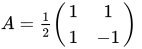
to
, so that A will be a rotation matrix (and scaling) in standard form, unless there is some historical reason for the non-standard form. The linear mapping can thus be seen to rotate the hyperbola clockwise through an angle of π/4 and scale it by . See rotation matrix. Thoughts? — Anita5192 (talk) 03:40, 2 March 2014 (UTC)


- Yes, Anita, the matrix reverses orientation so it is not a rotation. Yes again, it has something to do with the historical development of the subject. Look at hyperbolic sector where there is a standard position and positive hyperbolic angles evolve in the direction opposite to the direction of evolution of circular angles. Thus the reversal of orientation. Circular angles evolve consistent with the Sun rising over the Earth from the East. The hyperbolic sector evolves as used by Gregoire de Saint-Vincent in the discovery of logarithm. The unit hyperbola of this article not only normalizes the x y = 1 of Saint-Vincent, but also orients its evolution to agree with the familiar circular evolution. Your suggestion would do the normalization but require a revised format from the traditional basis of hyperbolic angle.Rgdboer (talk) 21:57, 3 March 2014 (UTC)
- Thank you! — Anita5192 (talk) 03:33, 4 March 2014 (UTC)
Hyperbolic functions
Given that Wikipedia is written for a general audience it makes sense to provide wikilinks for things like tanh. Axiom Theory (talk) 22:10, 11 February 2026 (UTC)
 Done—Anita5192 (talk) 00:26, 13 February 2026 (UTC)
- Thanks. Axiom Theory (talk) 17:21, 22 February 2026 (UTC)

Content Disclaimer
Informasi ini disarikan dari Wikipedia dan disajikan kembali untuk tujuan edukasi. Konten tersedia di bawah lisensi CC BY-SA 3.0. Kami tidak bertanggung jawab atas ketidakakuratan data yang bersumber dari kontribusi publik tersebut.
- The information displayed on this website is sourced in part or in whole from Wikipedia and has been adapted for the purpose of restating it. We strive to provide accurate and relevant information, however:
- There is no guarantee of absolute accuracy. Wikipedia is an open, collaborative project that can be edited by anyone, so information is subject to change.
- It is not intended to constitute professional advice. The content displayed is for informational and educational purposes only. For important decisions (e.g., medical, legal, or financial), please consult a professional.
- Content copyright. Wikipedia is licensed under the Creative Commons Attribution-ShareAlike License (CC BY-SA). This means that content may be reused with appropriate attribution and shared under a similar license.
- Responsible use. Any risk arising from the use of information from this website is entirely the responsibility of the user.