Talk:Unified Video Decoder
How about adding APUs (e.g. E-350, E-450). According to AMD they support UVD 3 http://www.amd.com/de/products/desktop/apu/all-in-one/Pages/all-in-one.aspx#3 Tha

| This is the talk page for discussing improvements to the Unified Video Decoder article. This is not a forum for general discussion of the subject of the article. |
Article policies
|
| Find sources: Google (books · news · scholar · free images · WP refs) · FENS · JSTOR · TWL |
 | This article is rated Start-class on Wikipedia's content assessment scale. It is of interest to multiple WikiProjects. | ||||||||||||||||||||||||||||||||||||||||||||||||||||||
| |||||||||||||||||||||||||||||||||||||||||||||||||||||||


UVD enabled GPUs
How about adding APUs (e.g. E-350, E-450). According to AMD they support UVD 3 http://www.amd.com/de/products/desktop/apu/all-in-one/Pages/all-in-one.aspx#3 Thank you. — Preceding unsigned comment added by 92.226.16.109 (talk) 22:40, 11 March 2012 (UTC)
- Done: Template:AMD APU features and maybe AMD_Eyefinity#Availability.
- How about not calling it "UVD-enabled"? It's "smart-people speak" for "contains the UVD application-specific integrated circuit in version x.y". User:ScotXWt@lk 12:06, 3 February 2015 (UTC)
Regarding the references in dispute
Okay. Look, that chinese forum reference, is not simply "to prove UVD+ exists", the fact that reference DOES NOT mean anything for its existence, and is simply saying the difference between UVD and UVD+ is the "HDCP support for video streams at higher resolutions", notice the HDCP support is not necessarily equates to the decoder can actually decode higher resolution video streams.
Your argument is that, I quote form your edit summary: "UVD+ is incorrect and furthermore some cards indicated as UVD+ do not do "higher resolutions" and RS780 is a UVD2 chipset"
And while I reverted your edit, and asked for a source, you simply ignored and failed to provide any source, also you cannot provide proof in the "RS780 is a UVD2 chipset" claim you made.
You should made you stance clear and provide sources to your claims here. Thank you. --202.40.137.202 (talk) 03:52, 24 August 2008 (UTC)
- BTW, RS780 is at best an UVD chipset according to AMD marketing material, FYI. --202.40.137.202 (talk) 03:54, 24 August 2008 (UTC)
- Then what is the purpose of the Chinese forum? It is not my reference. I am removing a section of the article that has NOT been referenced properly. Please reference AMD marketing material that proves the existence of such a UVD+ and not some Chinese forum that I can add a post and say anything I please. It is YOUR responsibility to prove that UVD+ exist, not MINE to prove it does not.
- If you agree with aforementioned, then the entire article should be written without any reference to UVD+. And if you desire, RS780 would be UVD and not UVD+. On the other hand, you reverted the article in its entirety with the references to UVD+, while you only asked to prove that RS780 is a UVD 2 ASIC.
- As for the issue of whether RS780 is a UVD 2 ASIC, the main differentiating factor is the hardware decode of MPEG2. Looking at AMD marketing material, http://www.amd.com/us-en/0,,3715_15532_15533,00.html, scroll down to AMD M780G and under "ATI Avivo HD Technology" you will see that "Unified video decoder is a dedicated hardware block to decode and playback HD-DVD and Blu-ray content. Supports MPEG2, VC-1, and H.264 formats." Note the MPEG2 format reference. --76.64.50.229 (talk) 04:42, 24 August 2008 (UTC)
- Well, for your reference, UVD/UVD+ has "Hardware Acceleration" for MPEG2 video stream playback and "full hardware decoding" for H.264 and VC-1 video streams, so if AMD say that UVD/UVD+ does not support MPEG2, it's not making any sense at all as it's just "partially supported", do you agree with me? So this phrase "UVD+ supports MPEG2, VC-1 and H.264 formats" has mislead you to think "RS780M/M780 with UVD+ (or UVD per AMD marketing material)" has "full hardware decoding" for MPEG2 videos, then sorry, you are being misleaded, it's not the editor's fault, it's your own problem for not digging deep enough for facts on the matter and believe in the fancy advertisment phrases. --203.218.194.8 (talk) 16:24, 24 August 2008 (UTC)
- Yes, but UVD is not used for MPEG2 decode in that case. As already written in the article, "The UVD 2 features full MPEG-2 hardware decoding, alongside the full hardware decoding of H.264/MPEG-4 AVC and VC-1 video streams".
- There are two main issues being disputed here:
- 1. UVD+ has not been referenced and really should be removed immediately. Wikipedia itself says that references must be credible sources and a forum is hardly a credible source.
- 2. RS780 supports UVD 2. I attempted to provide reference to the closest thing of official word from AMD marketing. But now it seems that you dispute my proof that RS780 has UVD 2 and accuse me of believing in fancy advertisement phrases.
- As for 1, there does not seem to be any dispute and it was inadvertently reverted as part of reverting the edits which included RS780 being UVD 2. If the existence of a UVD+ cannot be properly sourced, then it does not deserve to be written as fact in this encyclopedia and should be immediately removed.
- For 2, the reference indeed proves that RS780 supports UVD 2. The fact that the UVD is supporting MPEG2 implies UVD 2. The article already says exactly this. --76.64.50.229 (talk) 19:47, 24 August 2008 (UTC)
- Besides the "closest thing of official word from AMD marketing" you have attempted to cite, what other sources agree with your point that "RS780 has UVD2 included"? You said the editor does not give concrete sources about the existence of UVD+ but you also failed to do so. According to Wikipedia Policy on sources, the first sentence: "Articles should rely on reliable, third-party published sources with a reputation for fact-checking and accuracy", and I personally don't think that materials from AMD marketing is a "third-party source". --218.102.212.123 (talk) 17:50, 30 August 2008 (UTC)
- I shall enter into the discussion with the official Avivo HD whitepapers which can be found at http://ati.amd.com/technology/avivo/downloads.html The one is about the UVD from the 2600 Series:
(e.g for 30" display @ 2560x1600). On the "new avivo" paper, it is saidATI Radeon™ HD 2000 series can support HDCP on all of is DVI interfaces, be it single-link DVI or dual-link DVI
Therefore, nothing seems to have change on the 3600 Series, and the UVD+ advantage (HDCP in higher resolution) depicted on the Chinese forum is infirmed. Moreover, on the Purevideo page, it is said that UVD is limited to profile High Level 4.1 while I've just tested successfully a [email protected] on my HD3650. Some source will be welcome here too. I've also tested a MPEG2 HD video, and DXVA is clearly used (PowerDVD), so UVD supports already MPEG2. (in windows XP/ default WRM7 renderer, enabling/disabling DXVA is pretty easy: when the video contains subtitles, DXVA is disabled, with no subtitle, DXVA can be enabled, check also MPC-HD -> the difference in CPU usage is massive: from 5-10% to 20-80% depending on the source). However, I cannot state if it is "hardware assisted" or "fully decoded by the VPU" (bitstream), probably the first. Concerning UVD 2 (4800 series), many features are introduced (see the whitepaper), the most significant may be the upscaling processor for SD source. —Preceding unsigned comment added by 92.229.174.186 (talk) 18:38, 17 April 2009 (UTC)AMD introduced the Unified Video Decoder, or UVD, commencing with ATI Radeon™ HD 2600 and ATI Radeon™ HD 2400 family of products, and continuing with later ATI Radeon™ HD 3000 series.
- I shall enter into the discussion with the official Avivo HD whitepapers which can be found at http://ati.amd.com/technology/avivo/downloads.html The one is about the UVD from the 2600 Series:
Citation for lower UVD2 CPU usage
Computerbase HD4870Review(German) —Preceding unsigned comment added by 213.3.29.73 (talk) 14:01, 7 January 2009 (UTC)
Conflicting?
"AMD refuses to release any documentation regarding the UVD technology [2] thus making it unlikely a third party OS will ever support it. AMD supports Windows since the launch of the technology and Linux since Oct, 2008 [3]"
does that sound right? The first sentence pretty much translates to "UVD will never be on Linux", while the second says "UVD is already on Linux". So far, I have been unable to find out how to get UVD working under Linux. --173.16.22.10 (talk) 08:07, 5 February 2010 (UTC)
ATI HD3200(RS780) has UVD2,because http://i064.radikal.ru/1010/7c/1de26eb81b01.png , http://i074.radikal.ru/1010/d8/10dfc38fe95c.png , http://s07.radikal.ru/i180/1010/1c/62c4361adde2.png , http://s03.radikal.ru/i176/1010/24/e5d65784e44c.jpg , http://s43.radikal.ru/i101/1010/3e/b44fd45e1089.png .It's possible(dual-stream acceleration,deblocking,mosquito nr,color vibrance and more) only with UVD2. —Preceding unsigned comment added by Denis Pen (talk • contribs) 22:17, 8 October 2010 (UTC) --Denis Pen (talk) 15:31, 9 October 2010 (UTC)--Denis Pen (talk) 15:31, 9 October 2010 (UTC)


Suggestion to add graphics
I suggest to add graphics which would illustrate the features of UVD, and the differences between each version. Concretely, I mean this one (or similar) : http://alienbabeltech.com/main/wp-content/uploads/2010/10/UVD-3RDGEN.jpg — Preceding unsigned comment added by 95.155.98.194 (talk) 19:49, 1 July 2011 (UTC)
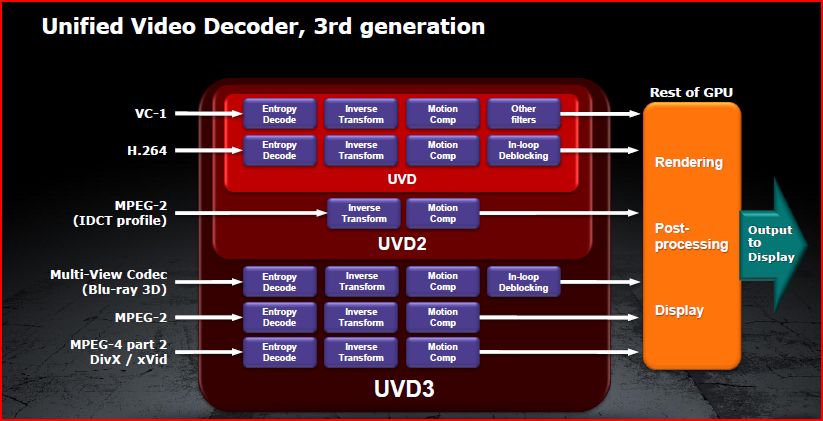
Can't find HD6300-series eg HD6330
This was an empty headline when I got here, and I am not aware of any HD6330 existing, only HD6330M which is something different.
Anyway, searching HD 6310 or E-350 on AMD.com yields no results, and doing it via google gives dead links. But according to these links, HD6310, HD6320 etc have UVD3 support:
http://en.wikipedia.org/wiki/Comparison_of_AMD_graphics_processing_units#IGP_.28HD_6xxx.29
http://en.wikipedia.org/wiki/AMD_Fusion#Brazos_.28Ultra-portable.29
http://www.guru3d.com/article/amd-brazos-platform-tested-e350-apu-review/2
http://techreport.com/articles.x/19937
http://www.amd.com/us/press-releases/Pages/amd-fusion-apu-era-2011jan04.aspx
The last link is the only place on AMD.com I found where it says anything about UVD, and that is just an early press release.
All I find by searching within AMD.com is HD6300M seris which has UDV2 support:
But this is a mobile version and may well be more limited than desktop versions. So my conclusion is that I don't know but there are stong indications they have UVD3 support. And that AMD have crappy documentation.
Structure
IMO this article needs more structure:
- maybe an extra section regarding the computation to be accelerated, e.g. entropy decoding (ED), Inverse discrete cosine transform (iDCT), motion compensation (MC) an Deblocking filter (in-loop deblocking).
- then an extra section for the hardware: is the ASIC based on some DSP? etc.
Not just AMD by it seems that all companies are rather busy spreading marketing bla then some solid information regarding their SIP/ASICs, so the info needs to be gathered. User:ScotXWt@lk 12:21, 5 February 2015 (UTC)
IMO this article is dated:
It's known in other Wiki pages that AMD uses Xtensa DPUs as the UVD and with Kaveri, a more powerful Xtensa IVP DPU; h.265 can be decoded without using GCNGPU shaders. AMD uses Cadence-Tensilica HiFi DSP for Trueaudio and that is a DSP block inside a Xtensa DPU. Codec decoding on Xtensa DPUs is software based so the same DPU can support multiple codecs and compression schemes.
Xtensa DPUs can also be used for streaming DRM like Playready and HDCP 2. They can also support OpenVX, OpenCL and can be configured to emulate a low power OpenGL GPU; likely needed for XB1 and PS4 (Both Microsoft and Sony have 2 GPU patents and the leaked Xbox 720 powerpoint had a always on block with a low power GPU (300mhz and smaller).
Xtensa processors are designed for a ARM buss and for AMD is the DSP mentioned in HSA/HSAIL.
[1] [2] 71.228.71.40 (talk) 10:16, 9 February 2015 (UTC)
- "It is known" means exactly ... AMD should bother to document their products better. And people contributing to the Wikipedia should bother to avoid more confusion:
- UVD is a name or a brand.
- UVD refers to some ASIC that is to be found on several AMD products, but not as a stand-alone product
- UVD comes in multiple version, newer ones containing the entire feature-set of older versions
- the ASIC is either an hardware implementation of several video DEcoding algorithms or, some special purpose DSP, which can execute software (firmware) implementation of such codecs fast.
- AMD introduced two marketing names: "Unified Video Decoder" for ASIC that is capable of video DEcoding and "Video Codec Engine" for ASIC that is capable of video ENcoding. User:ScotXWt@lk 13:50, 15 May 2015 (UTC)
References
External links modified
Hello fellow Wikipedians,
I have just added archive links to 2 external links on Unified Video Decoder. Please take a moment to review my edit. If necessary, add {{cbignore}} after the link to keep me from modifying it. Alternatively, you can add {{nobots|deny=InternetArchiveBot}} to keep me off the page altogether. I made the following changes:
- Added archive https://web.archive.org/20070927060558/http://www.hardspell.com/pic/2007/4/30/9e955066-558b-490c-8d06-5cf935f72a79.jpg to http://www.hardspell.com/pic/2007/4/30/9e955066-558b-490c-8d06-5cf935f72a79.jpg
- Added archive https://web.archive.org/20130911104934/http://www.amd.com/us/Documents/49282_G-Series_platform_brief.pdf to http://www.amd.com/us/documents/49282_g-series_platform_brief.pdf


When you have finished reviewing my changes, please set the checked parameter below to true to let others know.
This message was posted before February 2018. After February 2018, "External links modified" talk page sections are no longer generated or monitored by InternetArchiveBot. No special action is required regarding these talk page notices, other than regular verification using the archive tool instructions below. Editors have permission to delete these "External links modified" talk page sections if they want to de-clutter talk pages, but see the RfC before doing mass systematic removals. This message is updated dynamically through the template {{source check}} (last update: 5 June 2024).
- If you have discovered URLs which were erroneously considered dead by the bot, you can report them with this tool.
- If you found an error with any archives or the URLs themselves, you can fix them with this tool.
Cheers.—cyberbot IITalk to my owner:Online 20:22, 22 February 2016 (UTC)
Table
A table showing the implemented stuff would be nice, like Intel_HD_and_Iris_Graphics#Capabilities_.28GPU_video_acceleration.29 or https://www.computerbase.de/2016-11/intel-core-i7-7500u-test/2/ User:ScotXWt@lk 10:34, 1 November 2016 (UTC)
vega hybrid vp9 decode
I noticed the vega whitepaper mentions I think that vega has hybrid VP9 decode acceleration support. Not 100% ASIC accelerated but part ASIC part driver/stream cores. Fanccr (talk) 20:12, 11 June 2023 (UTC)
Content Disclaimer
Informasi ini disarikan dari Wikipedia dan disajikan kembali untuk tujuan edukasi. Konten tersedia di bawah lisensi CC BY-SA 3.0. Kami tidak bertanggung jawab atas ketidakakuratan data yang bersumber dari kontribusi publik tersebut.
- The information displayed on this website is sourced in part or in whole from Wikipedia and has been adapted for the purpose of restating it. We strive to provide accurate and relevant information, however:
- There is no guarantee of absolute accuracy. Wikipedia is an open, collaborative project that can be edited by anyone, so information is subject to change.
- It is not intended to constitute professional advice. The content displayed is for informational and educational purposes only. For important decisions (e.g., medical, legal, or financial), please consult a professional.
- Content copyright. Wikipedia is licensed under the Creative Commons Attribution-ShareAlike License (CC BY-SA). This means that content may be reused with appropriate attribution and shared under a similar license.
- Responsible use. Any risk arising from the use of information from this website is entirely the responsibility of the user.